When wood is heated into charcoal, it does not shrink evenly. It contracts more in some directions than others, and that unevenness — anisotropic shrinkage — shapes the pores and fine structure of the biochar that eventually comes out of the furnace. A new study published in the journal Biochar reports that this directional behavior is governed by the sequential thermal degradation of the cell-wall polysaccharides, and that it can be tuned by swapping the metal cations lodged in the cell wall.
In total, 50 distinct samples were prepared from veneer sheets of roughly 0.2 mm thickness, using only the sapwood portion of each species: Japanese cedar, Japanese cypress, western redcedar, Douglas fir, Japanese larch, Japanese beech, Japanese zelkova, walnut, ash, and paulownia.
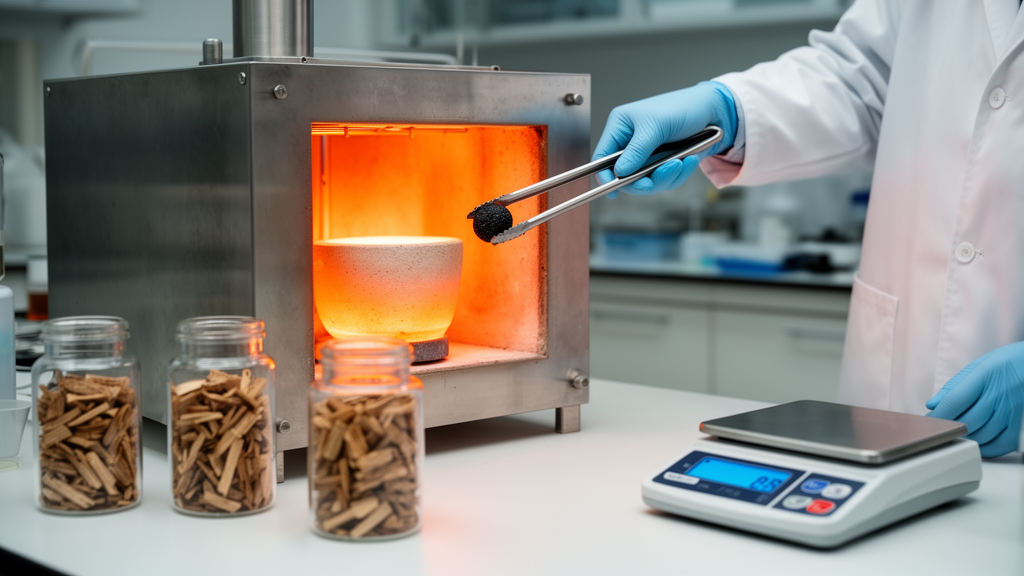
The team combined thermogravimetric analysis with continuous dimensional monitoring. Each 4 × 4 mm veneer was heated from 40 °C to 550 °C at 10 °C per minute under nitrogen, while a CCD camera recorded the specimen so that its longitudinal and radial dimensions could be tracked at every temperature, expressed relative to their values at 150 °C. The onset temperature of shrinkage was defined as the point where shrinkage was first detected in each direction, and the temperatures of maximum shrinkage rate were recorded for both directions.
The central finding concerns which polymer triggers shrinkage in which direction. At the onset of radial shrinkage, most of the cellulose remained intact, while only 40–90% of glucomannan and 30–90% of xylan — the dominant hemicelluloses of softwoods and hardwoods, respectively — remained undegraded. Radial shrinkage therefore begins primarily with hemicellulose decomposition. Longitudinal shrinkage, by contrast, started only after cellulose decomposition had progressed substantially: at that point the hemicelluloses were mostly gone, with 10–80% of the cellulose still remaining.
The reason lies in the architecture of the cell wall. Cellulose microfibrils run parallel to the long axis of the wood cells and act as the primary load-bearing framework, embedded in a hemicellulose–lignin matrix. Along the longitudinal direction, those microfibrils resist contraction until most of them have degraded. In the transverse direction, the microfibrils are cross-linked through the matrix, so once the hemicelluloses in that matrix begin to break down, shrinkage can proceed. Consistent with this, the temperature of maximum longitudinal shrinkage rate occurred about 10 °C above that of the radial direction, corresponding to the DTG peak temperature plus 10–20 °C, where cellulose recovery had fallen to 2–36% in softwoods and 1–25% in hardwoods.
Exchangeable cations proved to be powerful levers over this process. Previous work by the same group had shown that substituting sodium or potassium ions lowers the cellulose degradation temperature by roughly 30 °C. In the present study, Na+ and K+/Na+ exchange led to shrinkage onset at lower temperatures than H+, Mg2+, or Ca2+ exchange in both directions for most species, reflecting that enhanced reactivity. In the presence of these monovalent cations, partial cellulose degradation begins at temperatures where hemicellulose degradation is already underway, so the two polymers co-degrade; longitudinal shrinkage could then begin while relatively large amounts of hemicelluloses remained.
The cations also affected how much the wood shrank. In hardwoods, radial shrinkage magnitude increased with H+ and Mg2+ substitution — Japanese beech and ash exchanged with Mg2+ or H+ shrank more than those carrying other cations — while Ca2+ exchange tended to reduce radial shrinkage in both wood groups, though with substantial species-to-species variability. Two species behaved atypically: Japanese larch, whose hemicellulose composition includes substantial galactan, was largely insensitive to cation type, and Mg2+-exchanged Japanese walnut showed unusually high thermal reactivity, possibly related to a less compact aggregation state of its cell-wall components.
Anatomy explained why hardwoods generally shrank more in the radial direction than softwoods, regardless of cation type. Most cells oriented in the radial direction are ray parenchyma cells, which constitute only a small proportion of the wood tissue. In softwoods these rays typically occur as single rows, whereas in hardwoods they often form large multiseriate aggregates, as in Japanese beech. Their extremely short long axes, especially in hardwoods, may make them more susceptible to shrinkage during thermal degradation, and in softwoods, ray tracheids at the ends of ray aggregates may further suppress it. Among hardwoods, Japanese beech and walnut showed particularly large radial shrinkage, possibly because their diffuse-porous vessel arrangement, with large vessel lumens, facilitates inward shrinkage. Japanese zelkova consistently shrank less in the radial direction, likely because its high calcium oxalate content persists after cation exchange and keeps calcium’s influence in place.
The study also confirmed a practical index of anisotropy. The difference between the longitudinal and radial onset temperatures, ΔT, correlated negatively with the R/L ratio at 450 °C: a larger ΔT meant a lower ratio and thus greater shrinkage anisotropy. For the ten virgin wood species the linear regression reached R² = 0.9008, while for the cation-exchanged samples the correlation weakened, with R² values of 0.5106–0.6484 and greater scatter among species. Above about 400 °C, once cellulose degradation was complete, the R/L ratio stabilized and anisotropy essentially disappeared, as the microfibrillar restraint on longitudinal shrinkage was lost.
Because the radial and longitudinal shrinkage responses track different stages of polysaccharide decomposition, and because those stages can be shifted by choosing the cation environment and the feedstock species, the authors argue that directional shrinkage during carbonization can be predictably tuned. The findings, they note, provide a mechanistic basis for controlling pore development and microstructure in biochar production, although lignin’s contribution was not quantified in this study because measuring lignin remaining in char is difficult, and the mechanisms linking lignin pyrolysis to cellulose degradation remain under investigation.
Subject of Research: Anisotropic shrinkage of wood during carbonization and its control by polysaccharide degradation and exchangeable cations
Article Title: Cell-wall chemistry governs anisotropic shrinkage during wood carbonization: roles of polysaccharide degradation and exchangeable cations
Article References: Wang, Y., Eljamal, R., Yokoyama, M., Nomura, T., Minami, E., & Kawamoto, H. (2026). Cell-wall chemistry governs anisotropic shrinkage during wood carbonization: roles of polysaccharide degradation and exchangeable cations. Biochar, 8(1), Article 144. https://doi.org/10.1007/s42773-026-00661-5
Image Credits: AI Generated
DOI: 10.1007/s42773-026-00661-5
Keywords: biochar, wood carbonization, anisotropic shrinkage, cellulose degradation, hemicellulose, exchangeable cations, cell wall, ray parenchyma, thermogravimetric analysis, pyrolysis, microstructure, softwoods and hardwoods
Cite Scienmag News
Bethany Barker. (October 28, 2026). How Wood’s Own Chemistry Steers Shrinkage as It Turns to Biochar. Scienmag. https://scienmag.com/how-woods-own-chemistry-steers-shrinkage-as-it-turns-to-biochar/
Bethany Barker. "How Wood’s Own Chemistry Steers Shrinkage as It Turns to Biochar." Scienmag, 28 October 2026, https://scienmag.com/how-woods-own-chemistry-steers-shrinkage-as-it-turns-to-biochar/. Accessed 28 October 2026.
Bethany Barker. "How Wood’s Own Chemistry Steers Shrinkage as It Turns to Biochar." Scienmag. October 28, 2026. https://scienmag.com/how-woods-own-chemistry-steers-shrinkage-as-it-turns-to-biochar/