


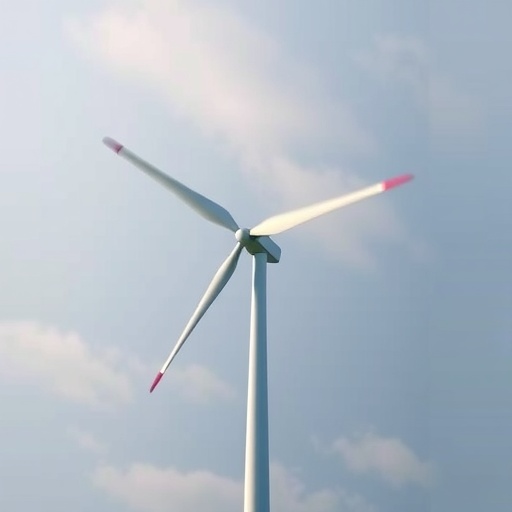
As wind turbines continue to grow in size and power capacity, the engineering challenges they face become increasingly complex. Modern offshore wind turbines boast rotor diameters surpassing 200 meters, harnessing up to 20 megawatts of power—enough to supply electricity to around 200,000 households. However, this remarkable scale brings with it unprecedented mechanical stresses, particularly from turbulent wind loads and sudden gusts. These forces induce significant bending in turbine components, leading to material fatigue, potential cracks, and eventual structural failures. Addressing these challenges requires refined models that can accurately capture the intricate dynamics of wind loading on turbine rotors.
In a groundbreaking study published in the journal Wind Energy Science, a team of researchers from the University of Oldenburg, together with collaborators from ICM – Institut Chemnitzer Maschinen- und Anlagenbau e.V. and the industry leader Nordex, have developed an innovative approach to modeling the mechanical loads acting on wind turbine rotors. This new method improves upon traditional models by incorporating the non-uniformity and localized fluctuations of wind forces, which were previously simplified or overlooked. The result is a more precise prediction of load distributions, enabling better design and longevity of turbine components.
Historically, turbine manufacturers made the simplifying assumption that wind gusts impinge uniformly across the entire rotor area. This approximation was reasonable for smaller turbines but leads to inaccuracies with the massive rotors characterizing today’s offshore installations. The latest research highlights that localized gusts—wind disturbances concentrated in small sections of the rotor—are a critical driver of fatigue damage. These localized loads cause differential bending moments and asymmetric stresses on the blades, accelerating material wear and risk of failure. Recognizing and quantifying these effects is essential for the next generation of turbine designs.
At the heart of the new modeling framework lies the concept of the “centre of wind pressure.” This parameter captures the effective point on the rotor plane where the aerodynamic wind forces act. In conditions of uniform wind flow, this center aligns with the rotor’s geometric midpoint. However, when turbulence or gusts affect only part of the rotor, this center shifts toward the disturbed area, resulting in uneven blade bending and generating significant torque on the drivetrain. Mapping this shifting center continuously allows for a dynamic representation of loading conditions that was hitherto unattainable in standard models.
To verify and calibrate this approach, the team integrated vast datasets including high-resolution measurements from contemporary turbines and archived wind field data from the historic GROWIAN campaign conducted in Schleswig-Holstein during the 1980s. Using these data, researchers reconstructed detailed spatial wind fields interacting with rotor blades. Aeroelastic simulations were then conducted in which the coupled effects of airflow and structural response were solved simultaneously, illuminating the complex load patterns caused by turbulent winds. These simulations, run on high-performance computing clusters, validated that incorporating the centre of wind pressure yields load predictions that closely match observed turbine behavior.
While full aeroelastic simulations provide detailed insights, their computational cost prohibits long-duration analyses, limiting practical industrial use. Addressing this, the research team advanced a stochastic model for the centre of wind pressure that distills the essential physics into a simplified yet accurate statistical framework. This approach enables manufacturers to perform longer-term, multiyear load simulations to better estimate lifetime fatigue and optimize component robustness. The ability to forecast extreme loads and fatigue events over extended periods marks a transformative advance in turbine modeling.
One critical finding is that the greatest mechanical strain occurs when the centre of wind pressure moves toward the rotor blade tips, the outermost regions. Such off-center loads induce extreme bending moments that current turbine control systems often fail to detect or mitigate. Incorporating this new understanding could inform the development of advanced control strategies designed to adapt dynamically to localized gusts, mitigating harmful stress concentrations before damage accumulates.
Beyond load estimation, this research offers significant potential to influence turbine design processes. Presently, manufacturers estimate the expected range of material deformations and stresses over a turbine’s 20-year operational lifespan, designing structures with safety margins to accommodate uncertainty. However, these estimates are hampered by a fundamental lack of precise, spatially resolved wind condition data. The new centre of wind pressure framework reduces this uncertainty by providing a more realistic representation of the wind load heterogeneity. This can lead to better-informed material choices and the possibility of lighter, more cost-effective components without compromising reliability.
Ongoing efforts to gather detailed wind measurements complement this work. The WiValdi research wind farm on the River Elbe, a collaboration including the University of Oldenburg’s ForWind research center, is conducting cutting-edge wind flow and load measurements. These high-fidelity datasets will further refine load models and contribute to industry guidelines for turbine design and operation under turbulent wind conditions.
The entire project materialized within the PASTA research initiative (Precise design methods of complex coupled oscillation systems of modern wind turbines in turbulent excitation), supported over three and a half years by Germany’s Federal Ministry for Economic Affairs and Energy and coordinated by Nordex. This collaborative effort underscores the critical intersection of academic research, advanced simulation, and industrial application needed to tackle the evolving challenges of renewable energy infrastructure.
As wind energy continues to expand and offshore installations become ever larger and more powerful, the importance of accurate load modeling cannot be overstated. The introduction of the centre of wind pressure as a guiding parameter ushers in a new era of precision in understanding the complex interplay between turbulent atmospheric flows and turbine mechanics. This innovation promises to enhance turbine performance, extend component life, and reduce maintenance costs—key factors for the sustainable growth of wind energy worldwide.
Ultimately, this shift from oversimplified uniform wind load assumptions to dynamic, localized force modeling could be revolutionary. It enhances not only engineering practice but also opens avenues for integrating active load control mechanisms into turbine design. Such advancements will ensure that tomorrow’s wind turbines remain resilient in the face of nature’s inherent variability, securing clean energy supplies for generations to come.
News Publication Date: 17-Apr-2026
Web References: http://dx.doi.org/10.5194/wes-11-1267-2026
Cite Scienmag News
Faith Mcneil. (April 21, 2026). How Turbulence Impacts Wind Turbine Performance. Scienmag. https://scienmag.com/how-turbulence-impacts-wind-turbine-performance/
Faith Mcneil. "How Turbulence Impacts Wind Turbine Performance." Scienmag, 21 April 2026, https://scienmag.com/how-turbulence-impacts-wind-turbine-performance/. Accessed 4 September 2026.
Faith Mcneil. "How Turbulence Impacts Wind Turbine Performance." Scienmag. April 21, 2026. https://scienmag.com/how-turbulence-impacts-wind-turbine-performance/


