


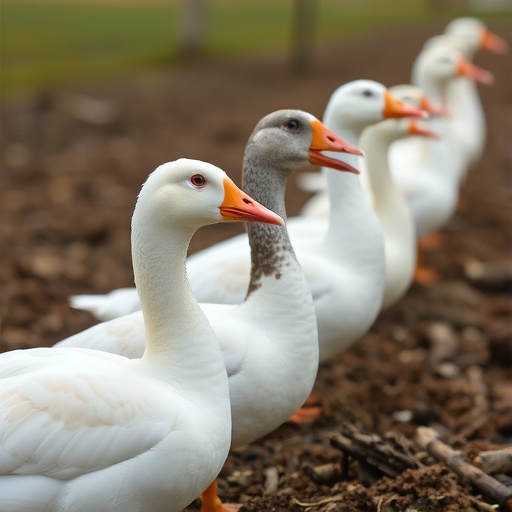
Each spring, the unmistakable V-shaped formations of migrating Canada geese signal the arrival of warmer days while simultaneously heralding an environmental challenge. These large birds, often seen congregating in urban parks and natural habitats alike, are notorious for leaving behind feces in overwhelming quantities. Their droppings, far from being a mere nuisance for park visitors, can inflict significant ecological harm, affecting water quality and local biotic communities. However, emerging research led by Concordia University scientists reveals an innovative, sustainable means of managing this organic waste by harnessing the natural capabilities of the black soldier fly, an insect gaining traction in agricultural circles.
The study explores the potential for black soldier fly larvae to convert goose feces—a resource abundant in urban settings—into valuable byproducts such as protein-rich biomass and nutrient-dense fertilizer. This novel approach addresses two pressing issues simultaneously: mitigating the environmental impact of prolific goose populations and creating sustainable products that support circular agricultural practices. The black soldier fly (Hermetia illucens), already extensively used in waste conversion and animal feed production, exhibits remarkable adaptability to various organic substrates, making it a promising agent for goose waste bioconversion.
Initial investigations quantified the relationship between Canada goose abundance and fecal deposition at multiple urban sites across southern Quebec and Ontario. Researchers demonstrated a clear positive correlation, underscoring the rapid accumulation of fecal matter in public greenspaces frequented by these birds. Such accumulation not only deteriorates recreational environments but also poses risks of nutrient overload and bacterial contamination in adjacent water bodies, potentiating eutrophication and habitat degradation.
Laboratory trials then assessed the developmental performance of black soldier fly larvae when fed distinct diets, including a conventional Gainesville diet (a mix of wheat bran, alfalfa, and corn meal), pure goose feces, and a 50-50 mixture of the two. Larvae consuming the hybrid diet exhibited superior growth rates, survival probabilities, and waste conversion efficiency compared to those fed exclusively on goose feces or the standard feed. This finding suggests that dietary diversity enhances larval health and accelerates organic waste breakdown, optimizing bioconversion outcomes.
Interestingly, larvae reared solely on goose feces displayed slower developmental progress, reduced survival, and smaller adult sizes, indicating the limitations of feces as a singular nutrient source. Nonetheless, the fact that larvae could subsist and significantly reduce waste mass on this diet alone confirms the feasibility of using goose droppings as a viable substrate. This is particularly relevant in urban management scenarios where feed supplementation for larvae may be logistically constrained.
Another compelling dimension of the study investigated the influence of microbial communities present in the feces on larval growth. By comparing larvae raised on autoclaved (sterilized) droppings versus raw feces, the researchers found notable disparities. Autoclaving eliminated beneficial microbiota, resulting in reduced larval consumption, smaller adult mass, and shortened lifespan on the feces-only diet. This unveils the critical role of symbiotic microorganisms in facilitating efficient nutrient assimilation and larval development, a nuance vital to scaling the bioconversion process.
Beyond larval growth, the study examined the utility of frass—the residual insect waste generated after larvae consume organic matter—as a biofertilizer. Using duckweed (Lemna minor), an aquatic plant esteemed for its rapid growth and multifunctional applications in feed, bioenergy, and wastewater treatment, as a model crop, researchers evaluated fertilization efficacy. Remarkably, duckweed treated with goose feces-derived frass outperformed counterparts receiving a standard nutrient solution or fresh feces, exhibiting a 32% increase in biomass yield and morphological traits indicative of optimal nutrient availability.
This remarkable enhancement of plant growth by frass highlights a closed-loop opportunity wherein urban goose feces are transformed into high-value inputs for sustainable plant production systems. Such circular waste management strategies not only alleviate sanitation concerns in public spaces by removing vast quantities of avian feces but also generate renewable biomass resources. The resultant products can serve as cost-effective alternatives to traditional compost, synthetic fertilizers, and even conventional animal feed ingredients.
The implications for urban ecology and agricultural sustainability are profound. Managers of parks, recreational areas, and peri-urban farms could adopt black soldier fly-based bioconversion systems to mitigate environmental pollution while creating feedstock and fertilizer locally. Moreover, this method could prove particularly advantageous in remote areas lacking infrastructure for conventional waste management, introducing a low-tech, scalable solution aligned with principles of sustainability.
Despite these promising findings, the researchers emphasize the necessity for further investigation before industrial-scale implementation. Considerations such as optimizing larval diets, ensuring biosecurity, evaluating long-term ecological impacts, and integrating with existing waste management frameworks remain priorities. Nonetheless, this pioneering study paves the way for inventive approaches to managing challenges posed by superabundant wildlife species in human-dominated landscapes.
The interdisciplinary team, led by assistant professor Rassim Khelifa of Concordia’s Department of Biology and including master’s student Carlos López-Manzano as first author, underscores the potential of coupling entomology with urban ecology to devise impactful environmental interventions. Supported by the Natural Sciences and Engineering Research Council of Canada, their work extends beyond academic inquiry, offering practical solutions that resonate with global imperatives to promote circular economies and safeguard ecosystems.
As global urbanization intensifies, human-wildlife interactions will increasingly require innovative management to balance ecological health with societal needs. This study exemplifies how leveraging biological agents like the black soldier fly can convert ecological challenges into opportunities for sustainability, embodying a future where urban waste streams become valuable resources rather than liabilities.
Cite Scienmag News
Alan Morgan. (April 21, 2026). Concordia Research Reveals Goose Poop as a Catalyst for Circular Agriculture. Scienmag. https://scienmag.com/concordia-research-reveals-goose-poop-as-a-catalyst-for-circular-agriculture/
Alan Morgan. "Concordia Research Reveals Goose Poop as a Catalyst for Circular Agriculture." Scienmag, 21 April 2026, https://scienmag.com/concordia-research-reveals-goose-poop-as-a-catalyst-for-circular-agriculture/. Accessed 3 September 2026.
Alan Morgan. "Concordia Research Reveals Goose Poop as a Catalyst for Circular Agriculture." Scienmag. April 21, 2026. https://scienmag.com/concordia-research-reveals-goose-poop-as-a-catalyst-for-circular-agriculture/


