


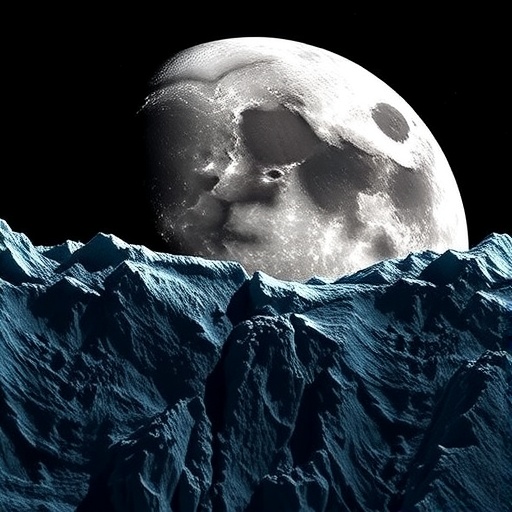
Icy moons are often portrayed as quiet worlds, sealed beneath frozen shells and evolving slowly in the darkness around the outer planets. Yet beneath their surfaces, many may conceal global oceans, while their histories are marked by impacts powerful enough to shatter, melt and rebuild planetary bodies. A new study published in Nature Astronomy examines what happens when these two forces—subsurface water and catastrophic collisions—meet. The researchers find that even enormous impacts rarely determine whether an icy moon has an ocean for its entire history. Instead, collisions usually alter the thickness or lifetime of an ocean, with the most dramatic effects restricted to particular moon sizes, impact energies and moments in the Solar System’s past.
The study combines two types of numerical modelling that are rarely used together for this problem. First, the researchers simulate disruptive collisions with a smoothed-particle hydrodynamics, or SPH, model. In this approach, a moon is represented by a vast collection of computational particles that interact according to the laws of fluid dynamics, gravity and material physics. The method is well suited to impacts because it can follow the extreme deformation, fragmentation, heating and redistribution of ice and rock during an event in which a target may be partially or almost completely destroyed. The resulting debris and reaccreted moon are then passed into a thermal-structural evolution model, which tracks how the rebuilt body cools, differentiates and changes internally over geological time.
The central question is deceptively simple: can an impact create an ocean where none would otherwise exist, or erase an ocean that would have formed naturally? The answer from the simulations is largely negative. The models did not produce a moon that remained frozen in its collision-free history but later developed a lasting ocean because of the collision itself. Neither direct impact heating, the heat generated as debris falls back together, nor collision-induced changes in orbital conditions consistently supplied enough long-term energy to transform such a moon into an ocean world. The findings suggest that impacts are more effective at modifying pre-existing ocean environments than at creating entirely new ones.
That conclusion is important because a major collision can inject enormous energy into a moon. During an impact, kinetic energy is converted into shock heating, deformation and motion. Ice may melt locally or globally, rock can be heated and redistributed, and fragments can escape before some of the material returns to orbit and reaccretes. It might seem inevitable that such violence would produce a deep, persistent sea beneath the surface. But an ocean is not defined only by whether ice melts once. It must survive against freezing, heat loss and changes in the moon’s internal structure. If the energy is released too quickly, much of it can radiate away or remain concentrated in regions that do not sustain a global liquid layer.
The simulations show a striking size-dependent pattern. In reaccreted moons with radii approaching 1,000 kilometres, an ocean can survive a disruptive collision and become substantially thicker than it would have been without the impact. Larger moons retain heat more effectively because their greater volume gives them a lower surface-area-to-volume ratio. They may also develop stronger internal pressure and more substantial rocky and icy layers, allowing liquid water to persist for longer periods. When a large target is broken apart and rebuilt, the resulting internal rearrangement can place heat and materials in configurations that favour a thicker subsurface ocean, particularly when the collision occurs late in the moon’s thermal evolution.
The story is different for smaller bodies with radii near 500 kilometres. In these moons, an ocean that would otherwise develop can disappear from the post-impact history because the collision promotes ice–rock differentiation. Differentiation occurs when the moon’s materials separate according to density, with rock sinking toward the centre and ice moving outward. This process changes the distribution of radioactive elements, thermal insulation and latent heat—the energy absorbed or released when ice melts or freezes. Instead of maintaining a mixed, slowly evolving interior that supports a liquid layer, the collision can accelerate the separation of materials and redirect the moon’s thermal evolution. In some cases, the result is a frozen world where an ocean would have existed without the impact.
The researchers also tested whether orbital changes caused by collisions could indirectly generate oceans through tidal heating. A disruptive impact can alter a moon’s mass, spin, shape or orbit, potentially changing its gravitational interactions with a planet or neighbouring moons. Those changes could drive stronger tides, and tidal flexing converts orbital energy into heat inside the moon. This mechanism powers or may power internal activity on several icy worlds in the Solar System. However, in the modelled scenarios, collision-induced orbital changes did not create a post-impact ocean in a moon that otherwise would have remained frozen. The tidal response was either insufficient, too brief or unable to deliver heat in the right way and for long enough to maintain global liquid water.
The strongest ocean-enhancing outcome requires a specific combination: a large, roughly 1,000-kilometre-class target, a late disruptive impact and a collision energetic enough to substantially reshape the moon without simply removing its volatile materials. “Late” is crucial because the timing of an impact determines how much internal heat remains and how the moon’s layers have already evolved. An early collision occurs while the young Solar System is still dynamically violent, but the rebuilt body then has a long time to cool and freeze. A later collision can refresh the thermal state of a large moon at a stage when its interior is otherwise losing the ability to sustain liquid water.
That timing also limits how relevant the effect may be to moons in the modern outer Solar System. The researchers conclude that late disruptive impacts onto large icy moons are unlikely in recent Solar System history. The most spectacular collision-driven extension of an ocean may therefore be physically possible but statistically uncommon. For the moons we observe today, the existence and persistence of an ocean are more likely to be controlled by initial composition, radiogenic heating, insulation by ice layers, pressure-dependent melting behaviour and long-term tidal interactions than by a single late catastrophe. Impacts remain important, but usually as modifiers rather than originators of ocean worlds.
The study offers a more nuanced picture of planetary habitability and the evolution of icy satellites. A collision does not simply switch an ocean on or off; its effects depend on body size, internal composition, impact timing, reaccretion and the competition between heating and cooling. Large moons may gain thicker or longer-lived oceans after rare late impacts, while smaller moons may lose oceans through accelerated differentiation. Yet the simulations found no example in which a collision reliably created a lasting ocean inside a moon that would otherwise have stayed frozen. This result narrows one proposed pathway to ocean formation while highlighting how violent events can still reshape hidden environments beneath alien ice. For future missions investigating worlds such as Europa, Ganymede, Callisto, Enceladus or other ocean candidates, the geological record of impacts may reveal not only when a moon was struck, but also how that strike changed the depth and duration of its concealed water.
Cite Scienmag News
Violet Maxwell. (August 20, 2026). How Major Impacts Shape Ocean Formation and Longevity on Icy Moons. Scienmag. https://scienmag.com/how-major-impacts-shape-ocean-formation-and-longevity-on-icy-moons/
Violet Maxwell. "How Major Impacts Shape Ocean Formation and Longevity on Icy Moons." Scienmag, 20 August 2026, https://scienmag.com/how-major-impacts-shape-ocean-formation-and-longevity-on-icy-moons/. Accessed 3 September 2026.
Violet Maxwell. "How Major Impacts Shape Ocean Formation and Longevity on Icy Moons." Scienmag. August 20, 2026. https://scienmag.com/how-major-impacts-shape-ocean-formation-and-longevity-on-icy-moons/


