


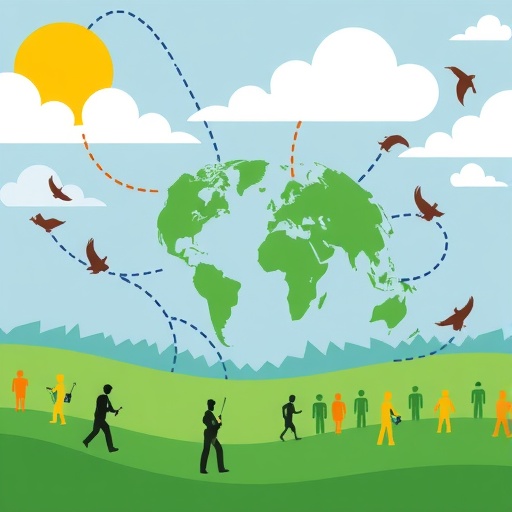
In recent years, climate change has been predominantly framed as an environmental and economic threat, yet emerging research from the University of Sydney reveals that its ramifications extend deep into the fabric of social life. This comprehensive study, published in the esteemed journal Nature Human Behaviour, elucidates how climate change acts as a catalyst for a profound social crisis by seriously undermining the interpersonal relationships that sustain human resilience and survival. At a time when communal support is critical, these deteriorating social connections create a perilous feedback loop, hampering people’s ability to recover from and adapt to climate disruptions.
The lead author of the study, Dr. Marlee Bower of the Matilda Centre for Research in Mental Health and Substance Use, emphasizes that climate change is no longer a distant concept but an active force reshaping human interaction and social support structures. She warns that the erosion of these connections threatens not only individual well-being but also collective capacities to withstand crises, underscoring a fundamental shift in how climate change impacts human systems.
The research synthesizes a wide array of global data, demonstrating how escalating climate pressures progressively restrict daily opportunities for social engagement. Environmental stressors including heatwaves and worsening air quality compel individuals to retreat indoors, limiting their access to communal gathering spaces. Moreover, climate-induced disruptions to essential institutions such as schools and workplaces further impede the maintenance of social networks, which function as vital channels for emotional and practical support.
Notably, the experience of communities in China and Tuvalu exemplifies the psychological toll of these disruptions. Here, diminished social interaction is associated with increased instances of depression and, in some cases, a withdrawal from active community participation. Such social withdrawal exacerbates vulnerability, undermining the collective efficacy crucial for climate adaptation strategies and disaster preparedness.
The social damage is more acute in the aftermath of extreme weather events such as floods, cyclones, and wildfires. These disasters often result in forced displacement, destruction of homes, and damage to public infrastructure, irrevocably altering daily routines. Case studies from the Dominican Republic and Japan illustrate a paradox where relocation efforts aimed at physical safety inadvertently deepen social isolation and adversely affect public health outcomes.
Beyond immediate disasters, chronic stressors linked to climate change, such as the prolonged droughts experienced in rural Australia, demonstrate a gradual but persistent decline in community cohesion. This erosion of collective participation is compounded by financial hardships, food insecurity, and the spread of misinformation, all of which engender mistrust and further disconnect individuals from social networks critical to resilience.
The study highlights that the social repercussions of climate change are disparate, disproportionately burdening populations already challenged by socioeconomic disadvantages. Individuals living on lower incomes, those in substandard housing, persons with disabilities, and members of marginalized groups are systematically exposed to greater climate risks and possess fewer resources to maintain or rebuild social ties.
Dr. Bower articulates this phenomenon as a “double burden” where vulnerability is compounded not only by environmental exposure but also by diminished social and economic support frameworks. This dynamic intensifies a growing “social health gap,” delineating a widening chasm between those who manage to preserve robust social connections and those plunged into isolation.
The integrity of social networks figures prominently in shaping community responses to climate crises. The research underscores that high levels of interpersonal trust correlate strongly with enhanced public commitment to climate mitigation and cooperative action. Conversely, social fragmentation impedes collective efficacy, reducing communal engagement and mutual aid precisely when these are most needed.
Disturbingly, empirical data indicate that weakened social connections can be fatal during climatic catastrophes. For instance, during the 2021 British Columbia Heat Dome, over 600 deaths occurred, with individuals diagnosed with schizophrenia—a group often socially isolated—accounting for roughly eight percent of these fatalities. This stark statistic illustrates how social isolation magnifies physical vulnerability under extreme environmental conditions.
Despite the clear evidence linking social health to climate resilience, policy frameworks worldwide remain predominantly fixated on physical infrastructure and emergency logistics, neglecting the social dimensions that determine who receives assistance and who remains vulnerable. Social disconnection already affects up to one in four people globally, with its impact on mortality rates rivaling those of smoking and obesity, positioning it as an unacknowledged public health crisis intertwined with climate change.
The researchers advocate for a paradigm shift whereby social connection is recognized as a critical component of climate infrastructure. This entails integrating social health considerations into urban planning, housing design, transport systems, and community development, fostering environments that nurture social ties and collective resilience amid escalating climate stressors.
Lastly, observations from Australia’s Black Summer bushfires reinforce the vital role of pre-existing social networks in post-disaster recovery. Communities with strong social cohesion exhibited lower psychological distress and more rapid resilience long after the immediate crisis had passed. Dr. Bower points out that although there is often a surge in solidarity following disaster events, this tenacity wanes over time. Sustained resilience depends fundamentally on the social groundwork laid before catastrophe strikes.
In sum, as climate change continues to challenge ecological and economic stability, its social repercussions demand urgent recognition and action. Strengthening social infrastructures and fostering community connectivity must be at the forefront of climate adaptation and mitigation strategies to ensure that societies not only survive but thrive amid unprecedented environmental upheaval.
News Publication Date: 15-May-2026
Web References:
10.1038/s41562-026-02455-y
References:
Bower, M., et al. (2026). Climate change and social health. Nature Human Behaviour. DOI: 10.1038/s41562-026-02455-y
Cite Scienmag News
Sloane Callahan. (May 15, 2026). How Climate Change Harms Human Lives by Disrupting Social Connections. Scienmag. https://scienmag.com/how-climate-change-harms-human-lives-by-disrupting-social-connections/
Sloane Callahan. "How Climate Change Harms Human Lives by Disrupting Social Connections." Scienmag, 15 May 2026, https://scienmag.com/how-climate-change-harms-human-lives-by-disrupting-social-connections/. Accessed 4 September 2026.
Sloane Callahan. "How Climate Change Harms Human Lives by Disrupting Social Connections." Scienmag. May 15, 2026. https://scienmag.com/how-climate-change-harms-human-lives-by-disrupting-social-connections/


