


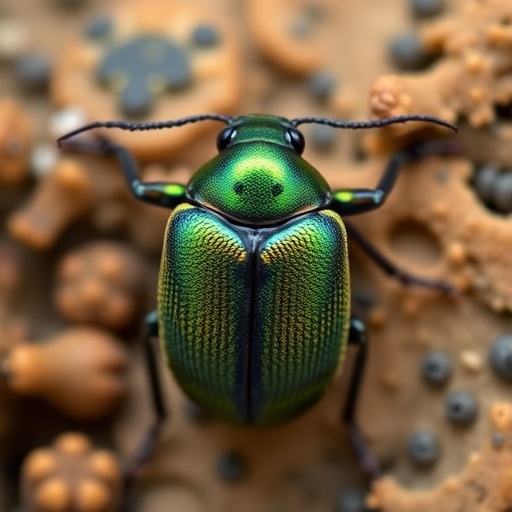
A groundbreaking taxonomic revision of the rove beetle genus Platydracus within the Chinese fauna has recently been published in the esteemed journal Insect Systematics and Diversity. This comprehensive work unveils more than a hundred documented species, with over half being entirely new to science. The study rewrites our understanding of beetle biodiversity in this region and highlights significant gaps in the current taxonomic catalog.
It is a remarkable discovery considering the size and visibility of these beetles. Platydracus beetles are relatively large, often reaching several centimeters in length, many displaying striking coloration or mimicking wasps. Despite these conspicuous traits, numerous species remained unrecognized either in natural habitats or misidentified in museum collections for decades. This paradox sharply challenges the assumption that large, colorful insects are well studied and known.
Alexey Solodovnikov, Associate Professor and curator at the Natural History Museum of Denmark, and senior author of this study, reflects on the astonishing fact that such biodiversity remained hidden among conspicuous organisms. The findings underscore the vast unknown in global biodiversity and demonstrate that even some of the most conspicuous species can evade scientific recognition. This evidence accentuates the pressing need for intensified exploration, even within familiar faunas.
Led by PhD candidate Qinghao Zhao and postdoctoral researcher Aslak Kappel Hansen, the international team collaborated across institutions including the Ottawa Research and Development Centre and Shanghai Normal University. Their integrative approach combined meticulous morphological examinations with cutting-edge DNA barcoding techniques. This dual-method strategy not only unveiled many new species but also corrected numerous inaccuracies stemming from past taxonomic assessments.
One of the study’s critical contributions is confronting the enduring “Linnean shortfall,” a term describing the discrepancy between described species and the total extant species on Earth. Despite being the most species-rich animal group, only about 925,000 insect species have been described to date, while estimates suggest over five million exist globally. Within the Staphylinidae family, which includes Platydracus, around 70,000 species are described, representing merely a quarter of their total estimated diversity.
The research delved deeply into historical descriptions, exposing that many species had been chronicled based on scant data—often a single specimen or limited geographical records. This dearth of comprehensive documentation impeded understanding of their distribution, morphological variation, and ecological roles. Employing modern taxonomic standards, the team reassessed these species, providing more accurate limits and refining previously ambiguous classifications.
Their methodology integrated traditional morphological taxonomy, involving detailed examinations of external features and genitalia, with molecular barcoding to analyze genetic markers. This integrative framework revealed intriguing biological complexities: certain species displayed significant phenotypic variation despite sharing identical DNA sequences, whereas others exhibited minimal morphological differences but marked genetic divergence. Such findings emphasize the necessity for multifaceted approaches in species identification and taxonomy for future biodiversity research.
China and Southeast Asia represent some of the world’s richest biodiversity hotspots, yet many aspects of their insect fauna remain poorly cataloged. This study lays a crucial foundational framework for ongoing research in these regions, advancing the documentation and understanding of Platydracus species. Significantly, it also demonstrates how incomplete our current species inventories are, even for relatively large, conspicuous insects.
Though the researchers could describe many new species, they found that knowledge gaps persist for previously named taxa. Natural history, precise distributions, and ecological behaviors of these beetles are largely unknown. Several newly confirmed species exist in collections or natural settings solely represented by a handful of specimens from single locations, underscoring the fragmented state of biodiversity knowledge.
The continued discovery of unknown species within well-studied insect groups highlights the essential role of taxonomy in biodiversity conservation and ecological research. Accurate species identification underpins effective environmental management and conservation strategies, yet taxonomic expertise and resources remain critically underfunded worldwide. This study underscores the scientific and conservation imperatives of supporting taxonomic revisions enhanced by modern integrative approaches.
In conclusion, the revision of the Platydracus genus in China is a watershed in understanding beetle diversity, revealing both overlooked species richness and the complexity of species delineations. It exposes the limitations of historical taxonomic practices and champions the combination of classical morphological investigations with molecular genetics as a template for future taxonomic endeavors. This research significantly enriches baseline knowledge fundamental for biodiversity conservation in an era of accelerating habitat loss.
As global biodiversity faces unprecedented threats, uncovering and accurately documenting species diversity is more urgent than ever before. This study not only expands the known catalog of life on Earth but also challenges researchers to reconsider assumptions about taxonomic completeness, even among familiar insect groups. The ongoing effort to describe and understand our planet’s species will be pivotal for preserving ecosystems and their endemic biological heritage.
By breathing new life into overlooked museum collections and field samples, this research exemplifies how tradition and innovation can synergize to unlock the secrets of biodiversity. It also calls for expanded international collaboration, funding, and expertise in taxonomy to address the enormous, still largely uncharted, biological diversity worldwide. Through such concerted efforts, humanity’s knowledge of life’s complexity can continue to flourish.
News Publication Date: 13-May-2026
Web References: DOI: 10.1093/isd/ixag003
Cite Scienmag News
Margaret Porter. (May 15, 2026). 61 Newly Discovered Beetle Species Highlight How Much We Still Have to Learn About Biodiversity. Scienmag. https://scienmag.com/61-newly-discovered-beetle-species-highlight-how-much-we-still-have-to-learn-about-biodiversity/
Margaret Porter. "61 Newly Discovered Beetle Species Highlight How Much We Still Have to Learn About Biodiversity." Scienmag, 15 May 2026, https://scienmag.com/61-newly-discovered-beetle-species-highlight-how-much-we-still-have-to-learn-about-biodiversity/. Accessed 3 September 2026.
Margaret Porter. "61 Newly Discovered Beetle Species Highlight How Much We Still Have to Learn About Biodiversity." Scienmag. May 15, 2026. https://scienmag.com/61-newly-discovered-beetle-species-highlight-how-much-we-still-have-to-learn-about-biodiversity/


