


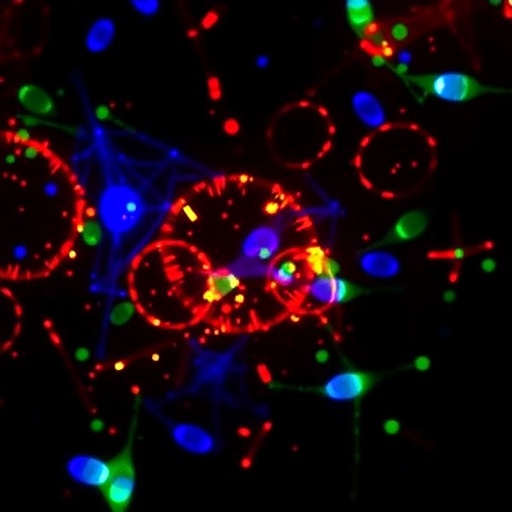
Recent advancements in cardiac biology and computational imaging have culminated in the development of a cutting-edge artificial intelligence platform, termed CardioNVT, designed for intricate analysis of cardiomyocyte nuclear ploidy directly within heart tissue. This breakthrough promises to overcome longstanding barriers in cardiac research by enabling high-throughput and accurate quantification of nuclear volume and ploidy states, providing invaluable insights into heart development, disease progression, and potential regenerative mechanisms.
Understanding the ploidy of cardiomyocyte nuclei is crucial because it reflects cellular processes integral to cardiac growth, remodeling, and repair. Traditionally, however, assessing nuclear ploidy within myocardial tissue has posed formidable challenges. The heart is composed of a highly heterogeneous and structurally complex assembly of various cell types, making selective and precise measurement difficult. Conventional methodologies often rely on immunostaining techniques that require cardiomyocyte-specific markers in combination with labor-intensive three-dimensional microscopy and analysis. These requirements render large-scale studies impractical and have impeded advances in elucidating the detailed mechanisms underpinning cardiac remodeling and pathology.
The interdisciplinary research team, comprising experts from Fuwai Hospital under the Chinese Academy of Medical Sciences and the Institute of Software at the Chinese Academy of Sciences, harnessed the power of artificial intelligence to tackle this problem. They engineered CardioNVT, an integrated platform that capitalizes on recent innovations in deep learning for image segmentation and tracking, specifically tailored to interpret cardiomyocyte nuclei stained solely with DAPI—a widely used fluorescent marker for DNA—thus eliminating the dependency on specialized immunostaining.
Central to CardioNVT is its sophisticated image segmentation module built on the UNet++ architecture, a state-of-the-art convolutional neural network known for enhanced precision in biomedical segmentation tasks. Employing this model, CardioNVT autonomously identifies and segments cardiomyocyte nuclei from two-dimensional DAPI-stained images of cardiac tissue sections. Rigorous validation in adult mouse heart samples demonstrated exceptional performance metrics, including high intersection over union (IoU) scores and area under the curve (AUC) values, underscoring the model’s accuracy and robustness. Notably, the platform retained its performance integrity in pathologically remodeled myocardium, evidenced by its application to cardiac hypertrophy models induced via transverse aortic constriction. Such adaptability highlights CardioNVT’s utility in both physiological and diseased states of cardiac tissue.
To gain insight into the network’s decision-making process, the researchers applied Gradient-weighted Class Activation Mapping (Grad-CAM++), an advanced technique for interpretability in deep learning. This approach revealed that the model’s high attention and confidence centered on nuclear regions, indicating that CardioNVT discriminates cardiomyocyte nuclei principally by recognizing nuanced staining patterns and morphological cues intrinsic to DAPI images. This finding reflects an innovative pivot from conventional reliance on immunolabeling, positioning morphology as a robust discriminator of cell identity.
Beyond two-dimensional segmentation, CardioNVT incorporates a novel cross-plane tracking mechanism powered by the Segment Anything Model 2 (SAM2), which enables the algorithm to trace individual nuclei across multiple consecutive tissue sections in the z-axis. This capability permits high-fidelity reconstruction of the three-dimensional nuclear architecture within serial tissue slices—a remarkable advancement given that nuclear volume is closely linked with ploidy status. The researchers implemented a comprehensive post-processing pipeline to ameliorate common tracking artifacts such as fragmented tracks and noise, culminating in highly accurate volumetric measurements.
Analysis of the reconstructed nuclear volumes revealed distinct bimodal distributions corresponding to diploid and polyploid cardiomyocyte populations, congruent with corroborating data from prior fluorescence in situ hybridization (FISH) studies. This correlation affirms that nuclear volumetric parameters can reliably serve as proxies for ploidy inference, circumventing the need for more invasive or complex biochemical assays. Such volumetric inference represents a pivotal leap forward in cardiomyocyte ploidy research, offering an efficient and scalable approach to probe nuclear dynamics across cardiac conditions.
Intriguingly, CardioNVT’s exploitation of nuclear morphology extends conventional segmentation paradigms by demonstrating that nuclear shape and texture are potent features for cell-type classification within heterogeneous tissues. This paradigm shift encourages the development of future segmentation frameworks that integrate morphological biomarkers, potentially enhancing specificity and functional interpretation beyond mere pixel-level classification.
While CardioNVT has demonstrated superior performance in mouse myocardial tissue, its modular design inherently facilitates adaptability to diverse biological systems and experimental contexts. Prospective applications may include human cardiac tissues, formalin-fixed paraffin-embedded (FFPE) samples common in clinical pathology, or alternate staining protocols. Through the application of transfer learning and targeted model fine-tuning, CardioNVT could be customized to interpret a wide range of tissue types and pathological states.
Moreover, the platform’s capabilities suggest exciting avenues for expansion, such as identifying distinct cellular subpopulations based on nuanced nuclear morphological signatures. Such developments could drastically enhance the resolution and specificity of cardiac cellular analysis, enabling precise mapping of disease-associated remodeling at the single-cell level and informing targeted therapeutic interventions.
This convergence of deep learning, advanced imaging, and cardiac biology embodied by CardioNVT represents a transformative step in cardiovascular research. It not only streamlines the laborious process of nuclear ploidy assessment but also opens new horizons for exploring fundamental questions around cardiomyocyte biology, cardiac regeneration, and disease pathology. The methodology stands as a testament to the potential of artificial intelligence to revolutionize biomedical inquiry by extracting rich, multidimensional information from standard histological preparations.
As the research community continues to embrace AI-driven analytics, platforms like CardioNVT exemplify the impact of integrating computational prowess with biological insight. This synergy offers promising prospects for accelerating discoveries in heart disease mechanisms and advancing personalized medicine approaches.
News Publication Date: Information not provided
Web References: http://dx.doi.org/10.1016/j.scib.2026.05.029
Cite Scienmag News
Drew Townsend. (June 4, 2026). AI-Driven CardioNVT Revolutionizes High-Throughput In Situ Cardiomyocyte Ploidy Analysis Without Immunostaining. Scienmag. https://scienmag.com/ai-driven-cardionvt-revolutionizes-high-throughput-in-situ-cardiomyocyte-ploidy-analysis-without-immunostaining/
Drew Townsend. "AI-Driven CardioNVT Revolutionizes High-Throughput In Situ Cardiomyocyte Ploidy Analysis Without Immunostaining." Scienmag, 4 June 2026, https://scienmag.com/ai-driven-cardionvt-revolutionizes-high-throughput-in-situ-cardiomyocyte-ploidy-analysis-without-immunostaining/. Accessed 3 September 2026.
Drew Townsend. "AI-Driven CardioNVT Revolutionizes High-Throughput In Situ Cardiomyocyte Ploidy Analysis Without Immunostaining." Scienmag. June 4, 2026. https://scienmag.com/ai-driven-cardionvt-revolutionizes-high-throughput-in-situ-cardiomyocyte-ploidy-analysis-without-immunostaining/


