


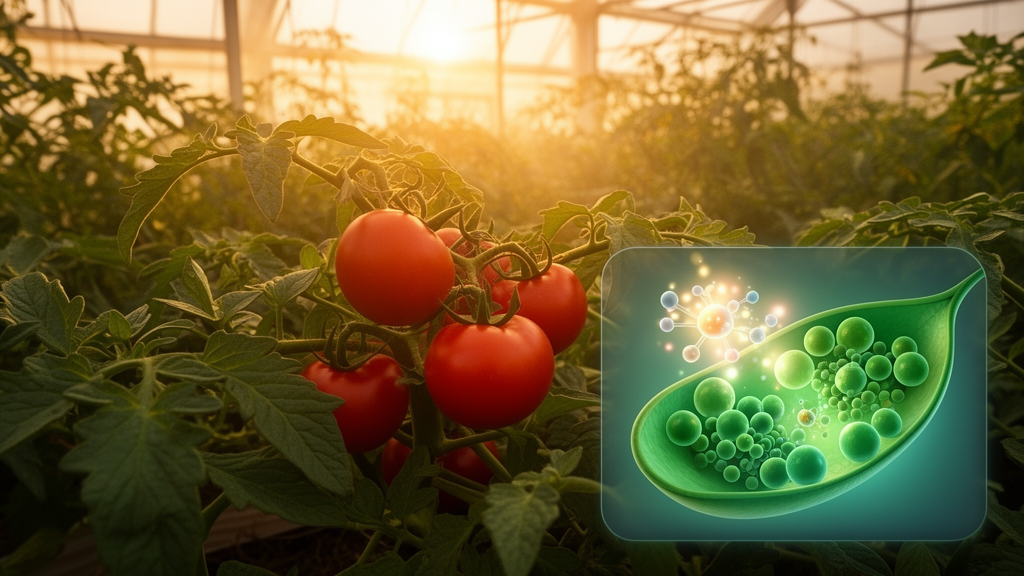
As heat waves grow more frequent and more intense, one of the most vulnerable steps in the global food supply is also one of the least visible: the biochemistry of photosynthesis inside a leaf. When temperatures climb beyond a crop’s comfort zone, the delicate molecular machinery that converts sunlight into sugar begins to falter, and yields fall with it. Now, a team of researchers at Gansu Agricultural University in Lanzhou, China, has mapped out in fine molecular detail how a natural plant hormone can shield that machinery in tomato plants, one of the world’s most economically important vegetable crops. Writing in BMC Plant Biology, Guangzheng Wang, Zhongqi Tang, Jihua Yu and colleagues describe how exogenous application of 2,4-epibrassinolide, an active brassinosteroid compound, significantly improves tomato heat tolerance by coordinating two processes that must work in lockstep: the conversion of light energy in the photosystems and the fixation of carbon dioxide in the Calvin cycle.
Brassinosteroids are steroid hormones found throughout the plant kingdom, best known for promoting growth, cell elongation and stress resilience. Farmers and researchers have long observed that spraying crops with brassinosteroid analogues can blunt the damage caused by drought, salinity and extreme temperatures, but the underlying molecular wiring has remained frustratingly opaque, particularly for photosynthesis, the process most sensitive to heat. The new study set out to close that gap by combining classical physiological measurements with a genome-wide transcriptomic survey, asking precisely which genes change their activity when heat-stressed tomato plants are treated with the hormone and which regulatory circuits orchestrate those changes.
The experimental system was straightforward but revealing. Tomato plants of the cultivar Condine Red were subjected to heat stress, with some groups receiving 2,4-epibrassinolide treatment and others left untreated as controls. The team then measured a battery of physiological indicators. Under heat stress alone, tomato leaves showed classic signs of photoinhibition: the maximum photochemical efficiency of photosystem II, denoted Fv/Fm, declined, as did the operating efficiency of photosystem II, Y(II), indicating that the light-harvesting apparatus was absorbing energy it could no longer safely process. Chloroplast ultrastructure, the finely stacked membrane architecture inside the organelle where the light reactions occur, was visibly compromised. Meanwhile, levels of malondialdehyde, a standard marker of lipid peroxidation, and of the superoxide anion radical, a reactive oxygen species, climbed sharply, both hallmarks of oxidative damage running out of control.
When the hormone was applied, that cascade of damage was markedly attenuated. EBR-treated plants preserved the integrity of their chloroplast ultrastructure, accumulated less malondialdehyde and fewer superoxide radicals, and maintained substantially higher Fv/Fm and Y(II) values than their heat-stressed counterparts. In practical terms, the photosynthetic electron transport chain, the series of protein complexes that shut excited electrons through photosystem II, the cytochrome complex and photosystem I, kept functioning under temperatures that would normally cause it to back up and leak damaging electrons. The authors interpret this as evidence that the hormone helps maintain the balance between light energy capture and its downstream consumption, preventing the energetic bottleneck that makes heat stress so destructive.
But protecting the light reactions is only half the story. Photosynthesis is a two-part enterprise: light energy must be converted into chemical energy, and that chemical energy must then be spent fixing carbon dioxide into sugars. If the second half stalls, the first half becomes dangerous, because absorbed photons have nowhere productive to go. The study found that EBR acted on the carbon-fixing side as well. Stomata, the adjustable pores on the leaf surface, opened more readily in treated plants, increasing stomatal conductance and transpiration. That had a double benefit: more carbon dioxide entered the leaf, raising the intercellular CO2 concentration available for fixation, and more water evaporated from the leaf surface, actively cooling it. Under heat stress, a lower leaf temperature is a meaningful physiological advantage, and the hormone effectively recruited the plant’s own evaporative cooling system to help.
Inside the chloroplast, the enzyme machinery of the Calvin cycle also responded. The researchers documented enhanced activity and gene expression of three key enzymes: Rubisco, the carboxylase that attaches carbon dioxide to its sugar substrate and arguably the most important enzyme in the biosphere; fructose-1,6-bisphosphatase, or FBPase, a regulatory enzyme controlling the flux of carbon through the cycle; and NADP-dependent glyceraldehyde-3-phosphate dehydrogenase, or NADP-GAPDH, which catalyzes a reduction step central to producing the sugars that exit the cycle. By keeping these enzymes abundant and active, EBR ensured that the ATP and NADPH generated by the light reactions were consumed efficiently, closing the loop between energy capture and energy use and sustaining net carbon assimilation under conditions that would otherwise throttle it.
To understand how these coordinated changes were encoded in the genome, the team performed transcriptome sequencing across the treatment groups. The analysis identified 718 differentially expressed genes that responded to both heat and EBR, a shared set representing the molecular intersection of stress and hormone response. When these genes were subjected to pathway enrichment analysis, three functional categories dominated: photosynthesis-antenna proteins, the light-harvesting complexes that funnel captured photons into the reaction centers; the core photosynthesis pathway itself; and carbon fixation pathways. That enrichment pattern is strikingly coherent with the physiological data, indicating that the hormone’s protective effect is not a diffuse stress response but a targeted transcriptional program centered on the photosynthetic apparatus.
The deepest layer of the analysis came from weighted gene co-expression network analysis, a computational method that groups thousands of genes into modules based on correlated expression patterns and then hunts for regulatory genes sitting at the hubs of those modules. This approach flagged two transcription factors as potential master mediators linking brassinosteroid signaling to photosynthetic gene regulation: an MYB-family transcription factor encoded by the gene Solyc02g036370.3 and a WRKY-family transcription factor encoded by Solyc10g084380.1. Transcription factors of these families are well known as integrators of hormonal and environmental signals in plants, and the network analysis positioned them as plausible bridges between the hormone’s perception machinery and the promoters of photosynthesis-related genes. Among the downstream targets implicated were CAB genes, which encode chlorophyll a/b-binding proteins of the antenna complexes; PsbO, an extrinsic subunit of the photosystem II oxygen-evolving complex; PsaC, an iron-sulfur protein essential to photosystem I; and RbcS, the small subunit of Rubisco itself.
Taken together, the authors propose a mechanistic model with a satisfying logic. Under heat stress, brassinosteroid signaling activates MYB and WRKY transcription factors, which in turn tune the expression of genes spanning the entire photosynthetic pipeline, from light capture through electron transport to carbon fixation. The result is a leaf that can keep its photosystems supplied with an efficient outlet for absorbed energy, maintain the structural integrity of its chloroplasts, limit oxidative damage, cool itself through transpiration, and continue fixing carbon when untreated plants have largely shut down. It is a systems-level account of hormone-mediated thermotolerance, and it converts what was previously a loose correlation between brassinosteroid application and stress resilience into a testable chain of molecular causation.
The practical implications extend well beyond the greenhouse bench. Tomatoes are a staple of global vegetable production, and heat stress during flowering and fruiting seasons already causes substantial losses, a problem projected to worsen as climate change reshapes growing regions. If the MYB and WRKY regulators identified here can be verified functionally, they become candidate targets for breeding programs seeking heat-resilient cultivars, or for genome editing approaches that could strengthen the same transcriptional circuitry without any chemical input. The study also offers a molecular rationale for the exogenous brassinosteroid sprays already used in some agricultural systems, suggesting that timing and dosing could be optimized around the photosynthetic gene programs the hormone controls. For now, the work stands as a vivid reminder that the difference between a wilting field and a productive one can hinge on a handful of transcription factors quietly deciding which genes a leaf will express on the hottest afternoon of the year.
Subject of Research: Brassinosteroid-mediated enhancement of heat tolerance through photosynthetic regulation in tomato
Article Title: Transcriptomic insights into brassinolide-mediated enhancement of heat tolerance through photosynthetic regulation in tomato
Article References: Wang, G., An, W., Wang, J., Tang, Z., & Yu, J. (2026). Transcriptomic insights into brassinolide-mediated enhancement of heat tolerance through photosynthetic regulation in tomato. BMC Plant Biology. https://doi.org/10.1186/s12870-026-10000-2
Image Credits: AI Generated
DOI: 10.1186/s12870-026-10000-2
Keywords: tomato, heat stress, brassinosteroids, 2,4-epibrassinolide, photosynthesis, Calvin cycle, Rubisco, photosystem II, transcription factors, MYB, WRKY, transcriptomics
Cite Scienmag News
Juliet Wilcox. (October 9, 2026). How a Plant Hormone Helps Tomatoes Beat the Heat: New Clues From the Photosynthesis Genes. Scienmag. https://scienmag.com/how-a-plant-hormone-helps-tomatoes-beat-the-heat-new-clues-from-the-photosynthesis-genes/
Juliet Wilcox. "How a Plant Hormone Helps Tomatoes Beat the Heat: New Clues From the Photosynthesis Genes." Scienmag, 9 October 2026, https://scienmag.com/how-a-plant-hormone-helps-tomatoes-beat-the-heat-new-clues-from-the-photosynthesis-genes/. Accessed 9 October 2026.
Juliet Wilcox. "How a Plant Hormone Helps Tomatoes Beat the Heat: New Clues From the Photosynthesis Genes." Scienmag. October 9, 2026. https://scienmag.com/how-a-plant-hormone-helps-tomatoes-beat-the-heat-new-clues-from-the-photosynthesis-genes/


