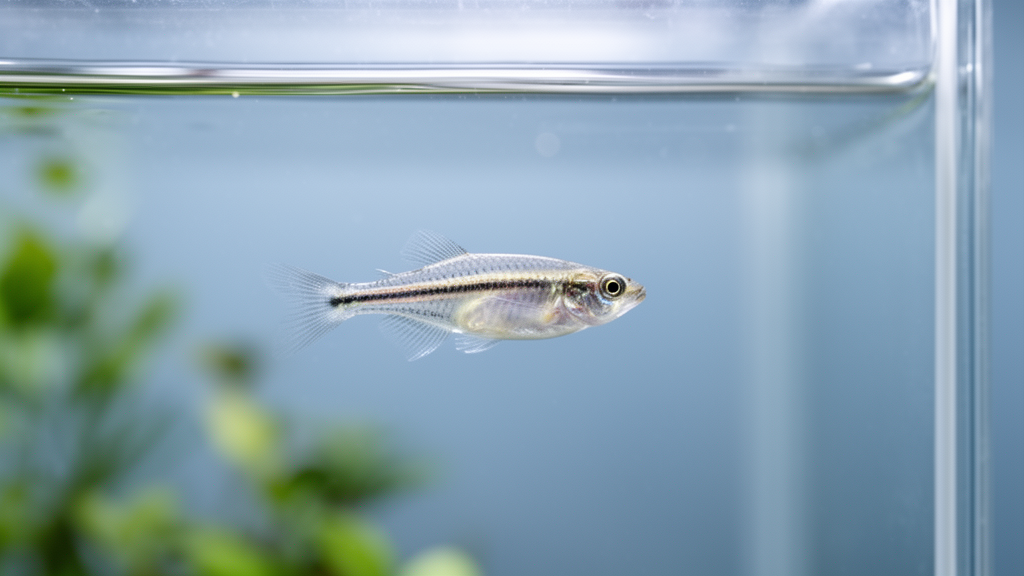
When food runs short of protein, most animals simply fail to thrive. Growth stalls, immunity crumbles, and the young die first. Yet a new study published in PLOS Genetics reveals that zebrafish can do something far stranger than merely endure such a crisis: across successive generations, lineages burdened with a mutation that cripples dietary protein absorption can gradually rebuild their intestinal machinery until it works better than normal, restoring survival and growth even on a protein-poor diet. The finding, from Siyao Wang, Laura Childers, Fernando Martinez III, Michel Bagnat, and Jieun Park, offers a vivid, mechanistic portrait of adaptation unfolding in real time, driven by sweeping changes in gene expression rather than by any single heroic mutation.
The story begins with a gene called plasmolipin, or pllp, which encodes an endosomal membrane protein found at strikingly high levels in a specialized population of gut cells known as lysosome-rich enterocytes, or LREs. These cells are the protein-processing workhorses of the fish intestine, and they also perform the same duty in neonatal mammals, where they swallow and digest intact dietary proteins wholesale. In zebrafish, when pllp is knocked out, LREs fail to differentiate properly, protein absorption collapses, and mutant larvae show sharply reduced survival. On its face, this is a devastating loss-of-function mutation, the kind of genetic damage that developmental biologists routinely generate in the lab and that natural selection would normally prune from a population.
But the researchers noticed something unexpected when they kept the mutants alive. By carefully raising pllp homozygous mutants through to adulthood and then crossing them with one another over multiple generations, the colony’s survival and growth rates crept back upward. Remarkably, the recovered fish handled a low-protein diet with ease, despite still carrying the broken gene. This was not a laboratory artifact or a hidden rescue construct; the fish remained mutants at pllp, yet their bodies had found another route to the same physiological destination. The question became how a population could climb out of a functional hole without ever repairing the original lesion.
To dissect the mechanism, the team assembled a three-way comparison that serves as the analytical backbone of the study. They generated a brand-new pllp mutant allele, freshly crippled and still suffering the full consequences of protein malabsorption. They compared it with the older, adapted pllp allele that had been inbred across generations. And critically, they included genetically related wild-type fish as the baseline, ensuring that any differences attributed to adaptation would not simply reflect the accumulated genetic drift of a laboratory strain. This design allowed the researchers to separate what the mutation destroys from what subsequent evolution rebuilds.
Transcriptome profiling across these groups revealed a clear signature of adaptation. The adapted pllp mutants showed upregulation of the endocytic components that LREs use to engulf dietary proteins, essentially turning up the dial on the cell’s internal swallowing apparatus. Quantitative protein absorption assays then confirmed that this transcriptional shift had real functional teeth: the adapted mutants absorbed protein at levels that exceeded even the wild-type fish. In other words, evolution had not merely restored the lost function to its original set point. It had pushed the intestinal absorptive machinery into a state of hyperactivation, compensating for the defective differentiation of LREs by making whatever absorptive capacity remained work overtime.
That hyperactivation, however, came with a hidden cost that the study also illuminates. Cells that engulf enormous quantities of material from the intestinal lumen inevitably expose the animal to a heavier load of environmental antigens, including bacterial products and undigested macromolecules. Consistent with this, the adapted mutants displayed transcriptional regulation of immune genes, suggesting that the immune system had been recalibrated in parallel with the digestive one. The authors propose that these immune adjustments may be a crucial part of why the adapted fish survive so well, buffering them against the heightened antigenic exposure that comes with a gut running in absorptive overdrive. Adaptation, in this view, is not a single fix but a coordinated physiological package.
Perhaps the most provocative result concerns how these phenotypes emerge over time. Genetic analyses indicated that the improved survival and growth did not appear suddenly in one generation. Instead, they accumulated gradually, generation after generation, as the inbred mutant line was propagated. This stepwise trajectory implies that multiple genetic changes, likely spread across the genome, contribute incrementally to the adaptive phenotype, each one nudging survival a little higher until the population as a whole regains robust fitness. Genome-wide transcriptional profiling captures the endpoint of that process: a broad, stable reprogramming of intestinal and immune gene expression that underlies the organism-level recovery.
Even more striking is the study’s evidence that this adaptation is repeatable. When the researchers generated an entirely independent pllp mutant allele and subjected it to the same regimen of inbreeding and natural selection, the same divergent phenotypes re-emerged. The recovery of survival and growth on a low-protein diet was not a lucky accident confined to one lineage’s genetic background. It recurred, suggesting that the paths evolution can take to solve the problem of protein malnutrition in this system are constrained and reproducible, funneling independent lineages toward similar transcriptional and physiological solutions. Recurrent adaptation of this kind hints at deep regularities in how genomes can be rewired to compensate for a specific functional deficit.
The broader implications stretch beyond fish biology. LREs mediate protein uptake in neonatal mammals, so understanding how their endocytic and absorptive programs can be transcriptionally tuned may inform questions about early-life nutrition, gut maturation, and the interplay between digestion and mucosal immunity. The study also speaks to a long-standing debate in evolutionary biology about whether adaptation proceeds through large single-step changes or through the gradual accumulation of many small effects. Here, the gradual, multigenerational emergence of the phenotype, tracked alongside its recurrent appearance in an independent allele, argues for a distributed, polygenic route in which genome-wide expression changes are the substrate on which selection acts.
What makes the work resonate beyond its technical achievements is the picture it paints of living systems as capable of engineering their own workarounds. A broken gene that should spell starvation instead becomes the starting point for an evolutionary project, one in which the gut learns to absorb more than it ever did and the immune system learns to tolerate the consequences. The zebrafish in these experiments did not wait for their DNA to be repaired. They rewired the instructions around it, generation by generation, until protein malnutrition was a problem they had simply outgrown. In doing so, they offer one of the clearest demonstrations yet that stable, heritable improvements in organ function can be built from the raw material of genome-wide transcriptional change, assembled under the patient pressure of natural selection.
Subject of Research: Gradual, recurrent transcriptional adaptation to protein malnutrition in zebrafish lacking the endosomal gene plasmolipin
Article Title: Genome wide transcriptional changes underlie gradual and recurrent adaptation to protein malnutrition in zebrafish
Article References: Genome wide transcriptional changes underlie gradual and recurrent adaptation to protein malnutrition in zebrafish. (n.d.). https://doi.org/10.1371/journal.pgen.1012071
Image Credits: AI Generated
DOI: 10.1371/journal.pgen.1012071
Keywords: zebrafish, protein malnutrition, lysosome-rich enterocytes, plasmolipin, transcriptomics, endocytosis, intestinal absorption, adaptation, genetics, immunity, natural selection, PLOS Genetics
Cite Scienmag News
Juliet Wilcox. (October 9, 2026). Zebrafish Rewire Their Guts Over Generations to Survive Protein Starvation. Scienmag. https://scienmag.com/zebrafish-rewire-their-guts-over-generations-to-survive-protein-starvation/
Juliet Wilcox. "Zebrafish Rewire Their Guts Over Generations to Survive Protein Starvation." Scienmag, 9 October 2026, https://scienmag.com/zebrafish-rewire-their-guts-over-generations-to-survive-protein-starvation/. Accessed 9 October 2026.
Juliet Wilcox. "Zebrafish Rewire Their Guts Over Generations to Survive Protein Starvation." Scienmag. October 9, 2026. https://scienmag.com/zebrafish-rewire-their-guts-over-generations-to-survive-protein-starvation/