


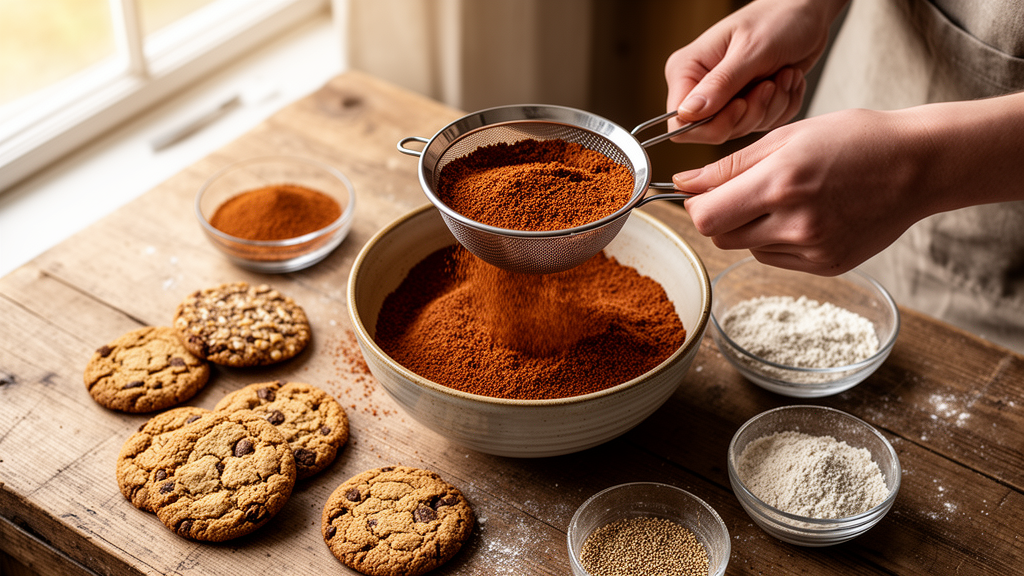
Teff, the tiny Ethiopian grain that anchors the country’s beloved injera flatbread, has been quietly building a global reputation as a gluten-free powerhouse. Now a new study from Ethiopian researchers suggests that the secret to making the most of this ancient cereal may come down to something deceptively simple: how finely the flour is milled. By systematically grinding three teff varieties into different particle sizes and baking them into cookies, the team has shown that the physical dimensions of flour particles can dramatically alter everything from how the powder flows through industrial equipment to how crisp a cookie snaps between the teeth.
The research, published in Food Science & Nutrition, examined three teff varieties from the Ethiopian Institute of Agricultural Research’s Debrezeit Agricultural Research Center: Bora, a very white grain; Jitu, a pale white variety; and Filagot, a red-grained type. Each variety was milled using a local attrition milling method and then fractionated through standard laboratory test sieves into three size classes: a coarse fraction between 260 and 360 micrometers, a middle fraction between 160 and 260 micrometers, and a fine fraction between 90 and 160 micrometers. Particles larger than 360 micrometers and smaller than 90 micrometers were removed, giving the researchers tightly controlled flour fractions to work with.
The first striking finding concerned bulk density, a property that matters enormously to food manufacturers because it determines how much flour fits into a given volume and how it packs during storage and transport. As particle size decreased from the coarsest to the finest fraction, bulk density rose from 0.72 to 0.86 grams per milliliter. The explanation is geometric: smaller particles nestle into the pore spaces left between larger ones, reducing porosity and increasing compaction. Variety also mattered, with the red Filagot flour reaching the highest bulk density at 0.83 grams per milliliter, compared with 0.74 for the white Bora variety. Similar patterns have been reported for other milled products, including sugar beet powder, whose bulk density climbed as particles shrank.
Flow behavior told the opposite story. Using the funnel method, the researchers measured the angle of repose, the natural slope a conical heap of flour forms when poured onto a flat surface. Finer flours produced steeper heaps: the angle rose from 37.40 degrees for the coarsest fraction to 41.80 degrees for the finest. This happens because smaller particles have more surface area per unit mass, giving cohesive surface forces and friction more opportunity to act and making the powder stickier and harder to move. For engineers designing hoppers and conveying systems, the implication is practical and important: the inclination of a hopper must exceed the flour’s angle of repose to keep material flowing without clogging, so finer teff flours will demand steeper equipment geometries.
Color measurements on the Hunter L, a, b scale revealed a subtle but consistent relationship between particle size and appearance. Lightness values increased as particles got smaller, rising from 66.88 for the coarsest fraction to 68.73 for the finest, while redness and yellowness values both fell. The researchers attribute this to the fine, homogeneous pores of smaller particles, which absorb less light and reflect more, making the flour appear lighter and less saturated. Variety effects were even more pronounced: the white Bora flour scored the highest lightness at 70.29, while the red Filagot flour scored lowest at 64.74 and showed the highest redness value, a consequence of pigments from the grain’s seed coat dispersing through the flour during milling. In terms of color alone, the finest fraction was judged the most desirable, being lighter and less reddish than its coarser counterparts.
Mineral analysis added a nutritional dimension to the varietal comparison. The red Filagot variety significantly outperformed its white relatives, delivering 132 milligrams of calcium, 14.31 milligrams of iron, and 4.14 milligrams of zinc per 100 grams of flour, roughly double the iron content of the Bora variety. This aligns with earlier findings that red teff tends to be richer in iron than white types. Intriguingly, particle size had no significant effect on mineral content, meaning that milling finer does not dilute the grain’s micronutrient profile. The minerals were evenly distributed across fractions, so processors can pursue fine milling for functional benefits without sacrificing nutritional value.
The sensory heart of the study came when the flours were transformed into cookies using a standard formulation of teff flour, sugar, shortening, salt, baking soda, and water, baked at 190 degrees Celsius for 18 minutes. Thirty trained panelists, drawn from food science and food technology departments, evaluated the cookies within 24 hours of baking on a seven-point hedonic scale covering color, texture, crispness, taste, flavor, and overall acceptability. The results were unambiguous: finer flour made better cookies. Samples made from the 90 to 160 micrometer fraction scored highest on nearly every attribute, with overall acceptability reaching 6.00, compared with just 4.90 for cookies made from the coarsest flour.
Crispness showed one of the most compelling particle-size relationships. Cookies baked from the finest flour earned a crispness score of 6.51, while those from the coarsest flour managed only 5.74. The researchers explain this through starch damage and surface area: smaller particles present more surface to the dough matrix, producing a thinner, more brittle structure that fractures cleanly rather than deforming during chewing. As particle size increases, the force and energy required to break the cookie rise, making samples harder and less crispy. Variety mattered too, though differently across attributes. Bora cookies dominated in color, texture, taste, flavor, and overall acceptability, scoring 6.35 overall, while the red Filagot cookies lagged at 4.43, likely penalized by their darker color, which lowered consumer preference despite the variety’s superior mineral content.
The study’s broader significance lies in what it means for teff’s global future. Despite an exceptional nutritional profile, complete with all essential amino acids and more lysine and vitamins than most other cereals, teff remains largely confined to Ethiopia, and industrial processing of the grain is still in its infancy. By demonstrating that variety and particle size jointly govern flour behavior and consumer acceptance, the research gives millers and bakers a concrete parameter to optimize. The finest fraction, 90 to 160 micrometers, combined favorable flow characteristics for handling with the best sensory outcomes in the baked product, while the white Bora variety proved the strongest candidate for consumer-facing products. The panelists’ scores spanned the full hedonic range, from a low of 4.00, meaning neither like nor dislike, for coarse Filagot cookies up to 7.00, meaning liked very much, for fine Bora cookies, a spread that underscores just how much processing decisions can shape the fate of a single ingredient.
For a grain that has sustained Ethiopian communities for millennia, these findings offer a roadmap for wider adoption. Gluten-free markets are expanding rapidly as consumers seek alternatives to wheat, and teff brings antioxidant properties and a complete amino acid profile that few competitors can match. The lesson from this research is that nutrition alone will not win over global palates; the physical craft of milling, the size of each particle, and the choice of variety all converge to determine whether a teff cookie delights or disappoints. With the right combination of fine milling and light-colored grain, this ancient Ethiopian staple may finally be positioned to take its place on bakery shelves worldwide.
Subject of Research: Effect of teff flour variety and particle size on flour physicochemical properties and gluten-free cookie sensory quality
Article Title: Impact of Particle Size on Flour Physicochemical Properties and Cookies Sensory Acceptability Made From Teff (Eragrostis tef (Zucc.) Trotter)
Article References: Boka, A. L., & Tolesa, G. N. (2026). Impact of Particle Size on Flour Physicochemical Properties and Cookies Sensory Acceptability Made From Teff ( Eragrostis tef (Zucc.) Trotter). Food Science & Nutrition, 14(10), Article e72432. https://doi.org/10.1002/fsn3.72432
Image Credits: AI Generated
DOI: 10.1002/fsn3.72432
Keywords: teff, flour particle size, gluten-free cookies, bulk density, angle of repose, sensory evaluation, food color, mineral content, Ethiopia, food processing, Eragrostis tef, baking quality
Cite Scienmag News
Alan Morgan. (October 8, 2026). Tiny Grains, Big Difference: How Teff Flour Particle Size Shapes Cookie Quality. Scienmag. https://scienmag.com/tiny-grains-big-difference-how-teff-flour-particle-size-shapes-cookie-quality/
Alan Morgan. "Tiny Grains, Big Difference: How Teff Flour Particle Size Shapes Cookie Quality." Scienmag, 8 October 2026, https://scienmag.com/tiny-grains-big-difference-how-teff-flour-particle-size-shapes-cookie-quality/. Accessed 8 October 2026.
Alan Morgan. "Tiny Grains, Big Difference: How Teff Flour Particle Size Shapes Cookie Quality." Scienmag. October 8, 2026. https://scienmag.com/tiny-grains-big-difference-how-teff-flour-particle-size-shapes-cookie-quality/


