


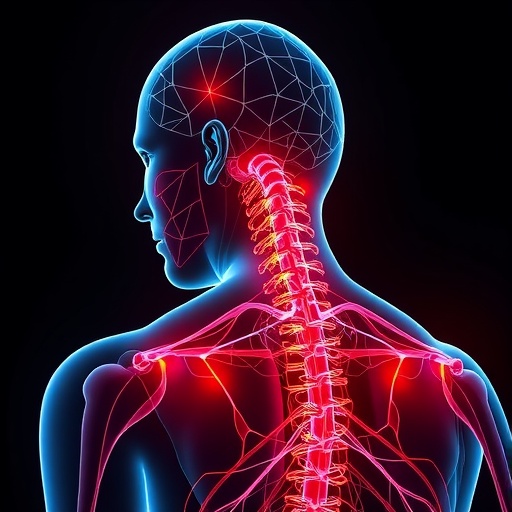
Chronic low back pain remains a pervasive and debilitating condition affecting millions globally, yet its underlying biological mechanisms often evade clear diagnosis. Traditional imaging frequently fails to identify definitive structural causes, leaving many patients frustrated by persistent discomfort that disrupts daily activities and diminishes quality of life. However, groundbreaking research from Johns Hopkins University School of Medicine may herald a new era in understanding and treating this enigmatic ailment by targeting the cellular crosstalk within degenerating spinal tissues.
At the heart of this study is the parathyroid hormone (PTH), a key regulator of calcium metabolism and bone turnover, long employed clinically to counteract osteoporosis through its bone-forming actions. Surprisingly, increasing evidence now suggests PTH’s role transcends skeletal maintenance, extending into modulation of sensory nerve growth and pain perception. The Johns Hopkins team, led by Dr. Janet L. Crane, embarked on an intricate exploration of spinal degeneration models in mice, keen to elucidate how PTH influences aberrant nerve fiber proliferation within compromised vertebral endplates—critical anatomical structures that interface spinal discs and vertebrae.
Spinal degeneration provokes an abnormal innervation pattern whereby nociceptive (pain-sensing) nerve fibers invade regions previously devoid of such neural elements. This pathological nerve ingrowth heightens pain sensitivity, aggravating chronic low back pain symptoms. Utilizing three robust mouse models that simulate aging-related degeneration, surgically induced instability, and genetic predisposition, the researchers administered daily injections of synthetic PTH over periods ranging from two weeks to two months. High-resolution imaging coupled with behavioral assays measuring responses to pressure, thermal stimuli, and locomotor activity provided comprehensive evaluation of treatment effects.
Remarkably, PTH-treated mice exhibited a restoration of vertebral endplate integrity, characterized by reduced porosity and enhanced structural stability. These anatomical improvements translated functionally into diminished pain behaviors: treated animals showed increased tolerance to mechanical pressure, delayed withdrawal from heat stimuli, and higher levels of spontaneous physical activity compared to untreated controls. Such findings underscore a tangible reversal of degenerative changes contributing to pain.
Delving deeper, the investigative team uncovered that PTH exerts its neuromodulatory effects by stimulating osteoblasts—the bone-forming cells—to secrete Slit3, a repulsive guidance protein known to regulate axon pathfinding. Slit3 acts as a molecular barrier deterring nociceptive nerve fibers from aberrantly infiltrating the vertebral endplate microenvironment. In vitro assays confirmed Slit3’s capacity to truncate nerve extensions and suppress invasive behaviors, lending mechanistic credence to the in vivo observations.
Moreover, the genetic ablation of Slit3 specifically in osteoblasts abolished PTH’s capacity to mitigate abnormal sensory innervation and alleviate pain-related manifestations in the murine models. This critical evidence delineates a PTH-osteoblast-Slit3 signaling axis essential for modulating pathological nerve growth in degenerative spine conditions. Further molecular analysis identified FoxA2, a transcription factor instrumental in activating Slit3 gene expression in response to PTH signaling, elucidating part of the intracellular machinery converting hormonal cues into extracellular guidance signals.
While these insights derive from animal experiments, their translational potential is profound. Notably, anecdotal clinical observations have reported decreased back pain among osteoporosis patients undergoing PTH therapy, an effect now attributable to the neuro-osteogenic mechanisms illuminated by this study. This paradigm shift advocates PTH not merely as a bone anabolic agent but as a novel modulator capable of curbing chronic pain through restraining pathological nerve sprouting.
Cautiously, Dr. Crane and colleagues emphasize the necessity for rigorous clinical trials to evaluate safety, dosing, and efficacy parameters in human populations before integrating PTH-based regimens into standard care for low back pain associated with spinal degeneration. Nevertheless, the prospect of repurposing a well-characterized hormone with established pharmacology holds promise for addressing an unmet medical need, potentially transforming management strategies for millions afflicted by chronic spinal pain.
This research not only advances our fundamental comprehension of skeletal-pain neurobiology but also catalyzes future endeavors in drug development targeting the neurochemical microenvironment within degenerating musculoskeletal interfaces. By illuminating the reversible nature of aberrant nerve innervation governed by osteoblast-derived cues, the findings pave the way for innovative interventions capable of halting or even reversing the disabling effects of spinal degeneration.
In summary, this pioneering study reveals that parathyroid hormone triggers osteoblast secretion of Slit3, which repels invading pain-sensing nerve fibers within degenerated vertebral endplates, thereby restoring spinal tissue integrity and alleviating chronic low back pain in mice. The intricate interplay between hormonal regulation, bone cell signaling, and nerve growth modulation presents a compelling therapeutic avenue that merits expedited exploration in human clinical contexts.
These advances epitomize the potential of integrative biomedical research to decipher complex disease mechanisms and translate them into tangible health benefits, offering renewed hope for patients burdened by chronic pain conditions historically deemed refractory to treatment.
News Publication Date: 22-Jan-2026
References: DOI: 10.1038/s41413-025-00488-z
Cite Scienmag News
Beatrice Stafford. (February 4, 2026). Hormone Therapy Rewires Nerve Signals to Alleviate Pain in Aging Spines. Scienmag. https://scienmag.com/hormone-therapy-rewires-nerve-signals-to-alleviate-pain-in-aging-spines/
Beatrice Stafford. "Hormone Therapy Rewires Nerve Signals to Alleviate Pain in Aging Spines." Scienmag, 4 February 2026, https://scienmag.com/hormone-therapy-rewires-nerve-signals-to-alleviate-pain-in-aging-spines/. Accessed 4 September 2026.
Beatrice Stafford. "Hormone Therapy Rewires Nerve Signals to Alleviate Pain in Aging Spines." Scienmag. February 4, 2026. https://scienmag.com/hormone-therapy-rewires-nerve-signals-to-alleviate-pain-in-aging-spines/


