


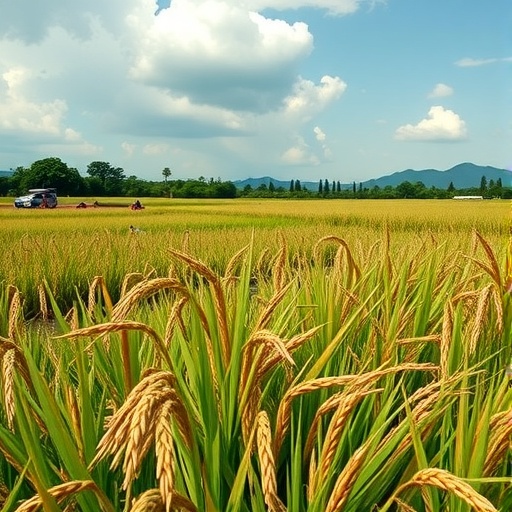
Global rice production—a cornerstone of food security for billions—has experienced a remarkable surge over the past six decades. New research from the University of Illinois Urbana-Champaign reveals that rice output nearly doubled between the 1960s and the 2010s, an achievement realized despite mounting climatic challenges. This compelling study highlights the pivotal role of agricultural management, from irrigation expansion to enhanced nutrient application, in sustaining and even boosting rice yields amid a changing environment. Contrary to common assumptions that climate change is the primary determinant of yield trends, the findings emphasize the profound impact of strategic human intervention.
Rice, a dietary staple for more than half of the world’s population, especially across Asia, faces an increasingly precarious future under global warming scenarios. Yet, this comprehensive analysis led by climate, meteorology, and atmospheric sciences expert Atul Jain and his collaborator Tzu-Shun Lin integrates observational data with sophisticated process-based models to dissect the intertwined effects of environmental change and management practices on rice production dynamics. Their work, recently published in the journal Scientific Reports, provides a nuanced understanding of how both natural and anthropogenic factors have shaped rice yields over decades.
A unique aspect of this research lies in its holistic approach. Previous studies often isolated variables such as temperature increases, water scarcity, or CO2 concentration impacts. However, Jain and Lin’s model accounts simultaneously for irrigation techniques, nitrogen fertilizer and manure usage, multiple cropping seasons, and diverse planting methodologies. This multi-dimensional framework enables the isolation of distinct influences on productivity, revealing that deliberate agricultural management decisions exerted a much stronger positive effect on production growth than did climatic factors alone.
Crucially, while elevated atmospheric CO2 enhanced photosynthetic processes and improved the water-use efficiency of rice plants—thus contributing positively to yield—the study identifies climate warming as a net detractor. Between 2006 and 2015, climate change directly reduced global rice output by approximately seven percent, with heat stress and intensified water shortages presenting formidable obstacles. These contrasting impacts underscore the intricate balance between environmental forces working simultaneously to push and pull on crop productivity.
Regional disparities are also evident within these findings. India, Indonesia, and China, three of the largest rice-producing nations, experienced the most significant climate-related declines. These losses, representing a serious threat to regional food security, amplify the urgency of developing adaptive strategies capable of counteracting adverse climatic effects. Jain stresses that proactive management—not merely passive response to environmental change—will determine rice farming’s future viability amid increasing global warming pressures.
The study demonstrates that farmers’ and policymakers’ informed decisions—such as expanding irrigation infrastructure, applying fertilizers judiciously, and adopting effective cropping systems—have been instrumental in mitigating climate-induced yield losses. These measures essentially offset negative environmental impacts, enabling sustained, and even increased production levels worldwide. This finding challenges deterministic views of climate as the sole driver and highlights the agency humans possess in shaping agricultural outcomes.
Looking forward, Jain’s team plans to extend their research framework towards forecasting future rice production under varying climate scenarios. By integrating projections of environmental variables with potential management adaptations, they aim to chart sustainable pathways that fulfill escalating demand for rice globally. This forward-looking approach addresses the dual imperative of enhancing food security while minimizing agriculture’s environmental footprint.
Equally important is the research group’s intent to examine collateral effects of intensified production strategies, such as greenhouse gas emissions and water resource depletion. Understanding these environmental trade-offs is vital for developing comprehensive policies that promote climate resilience without compromising ecological health. Jain articulates the vision of identifying optimized agricultural pathways that simultaneously boost yields, reinforce climate adaptability, and safeguard sustainability.
This study offers critical insights into the complexities underlying global rice production trends. By highlighting the interplay between human management and environmental change, it reframes the narrative around food security challenges in a warming world. The research invites collaboration between scientists, farmers, and decision-makers to harness adaptive practices that ensure rice cultivation remains robust, equitable, and ecologically sound in decades to come.
As global populations swell and climate impacts intensify, rice production’s future depends as much on innovative management and technological adoption as on mitigating climatic stressors. This holistic understanding underscores a hopeful yet cautious outlook: that with strategic stewardship, critical food systems can persist and evolve in the face of unprecedented planetary change.
The University of Illinois Urbana-Champaign study not only advances academic knowledge but also serves as a clarion call for urgent, integrated action across the agricultural continuum. Effective stewardship of key staple crops like rice embodies one of humanity’s most pressing challenges—one that must be met through ingenuity, collaboration, and resilience for generations yet unborn.
News Publication Date:
3-Jun-2026
Web References:
https://www.nature.com/articles/s41598-026-55973-0
DOI: 10.1038/s41598-026-55973-0
Cite Scienmag News
Alan Morgan. (June 10, 2026). Global Rice Production Nearly Doubles Amid Climate Change, Fueled by Human Management. Scienmag. https://scienmag.com/global-rice-production-nearly-doubles-amid-climate-change-fueled-by-human-management/
Alan Morgan. "Global Rice Production Nearly Doubles Amid Climate Change, Fueled by Human Management." Scienmag, 10 June 2026, https://scienmag.com/global-rice-production-nearly-doubles-amid-climate-change-fueled-by-human-management/. Accessed 3 September 2026.
Alan Morgan. "Global Rice Production Nearly Doubles Amid Climate Change, Fueled by Human Management." Scienmag. June 10, 2026. https://scienmag.com/global-rice-production-nearly-doubles-amid-climate-change-fueled-by-human-management/


