


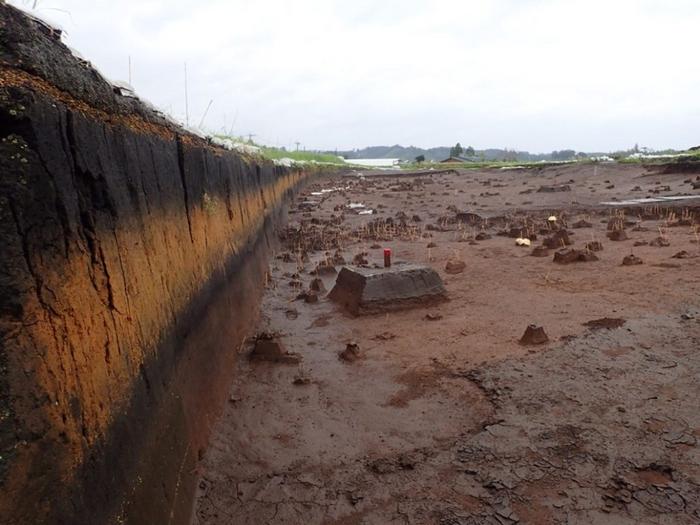
A research paper titled ‘Disaster, survival and recovery: the resettlement of Tanegashima Island following the Kikai-Akahoya ‘super-eruption’, 7.3ka cal BP’ co-written by Hokkaido University GSI’s Professor Peter Jordan has been awarded the prestigious Ben Cullen Prize 2024 for making an “outstanding contribution” to World Archaeology. The wider research project investigates the extent to which past societies coped with massive shocks and sudden environmental catastrophes. The prize-winning paper was published in Antiquity and examines the social and environmental impacts and legacies of the largest volcanic eruption ever to impact global humanity in the last 30,000 years.

Credit: Junzo Uchiyama
A research paper titled ‘Disaster, survival and recovery: the resettlement of Tanegashima Island following the Kikai-Akahoya ‘super-eruption’, 7.3ka cal BP’ co-written by Hokkaido University GSI’s Professor Peter Jordan has been awarded the prestigious Ben Cullen Prize 2024 for making an “outstanding contribution” to World Archaeology. The wider research project investigates the extent to which past societies coped with massive shocks and sudden environmental catastrophes. The prize-winning paper was published in Antiquity and examines the social and environmental impacts and legacies of the largest volcanic eruption ever to impact global humanity in the last 30,000 years.
This catastrophe was the Kikai-Akahoya “super-eruption” which destroyed much of East Asia around 7,300 years ago. Traditionally this event has been viewed as an “apocalyptic” moment which swept away all life and left southern Japan empty and desolate for many hundreds of years, to the extent that it never fully recovered. Over the last three years, the team, led by Peter Jordan (Professor of Archaeology at GSI) has been piecing together a much more nuanced story by carefully studying sites, landscapes and the material remains left behind by ancient communities located across the different disaster-impact zones.
What emerges from the research is a very different, and much more “human” and dynamic narrative: small groups of people somehow survived, even quite close to the epicentre; they made choices, somehow clung on, and learned to live in the new conditions, eventually enabling them to rebuild their social networks and communities.
On winning the prize, Professor Jordan commented:
“We are surprised, thrilled, and of course deeply honoured to be awarded this international prize. This is very much a team effort, bringing together researchers and institutions from across Sweden and Japan. In fact, the paper is our project’s first major research output – it is very much a proof-of-concept study and explores some new ideas we were working on.”
In the next few months the research team will start publishing more of the research’s intriguing results in the next set of research papers. The group also has a formal name – CALDERA, a new Nordic-Japan research programme in “Disaster Studies”.
The GSI team is also looking to develop further case-studies in Hokkaido, which is also an area of high volcanic activity, with different eruptions and disasters severely impacting ancient peoples and cultures right through to recent historic times. Prof. Jordan envisages GSI and CALDERA engaging closely with local communities, institutions and government agencies in Hokkaido where volcanic geohazards remain a daily existential threat. The aim is to understand what strengthened societal resilience to survive and recover from past disasters and catastrophes, but also to understand the extent these kinds of sudden shocks pushed past societies and cultures down other historical pathways.
===
Antiquity is an international peer-reviewed journal of world archaeology, published six times a year and edited by Dr. Robert Witcher. This journal was founded by O.G.S. Crawford in 1927 and is currently edited in the Department of Archaeology at Durham University. The journal is published in partnership with Cambridge University Press (CUP).
Launched in April 2021, Global Station for Indigenous Studies and Cultural Diversity (GSI) is a research and educational hub under Hokkaido University’s Global Institution for Collaborative Research and Education (GI-CoRE).
Cite Scienmag News
Courtney Benton. (June 17, 2024). Hokkaido University researcher awarded the Ben Cullen Prize 2024. Scienmag. https://scienmag.com/hokkaido-university-researcher-awarded-the-ben-cullen-prize-2024/
Courtney Benton. "Hokkaido University researcher awarded the Ben Cullen Prize 2024." Scienmag, 17 June 2024, https://scienmag.com/hokkaido-university-researcher-awarded-the-ben-cullen-prize-2024/. Accessed 4 September 2026.
Courtney Benton. "Hokkaido University researcher awarded the Ben Cullen Prize 2024." Scienmag. June 17, 2024. https://scienmag.com/hokkaido-university-researcher-awarded-the-ben-cullen-prize-2024/

