

Saturday, September 5, 2026
Science
No Result
View All Result
  • Login
  • HOME
  • SCIENCE NEWS
  • CONTACT US
  • HOME
  • SCIENCE NEWS
  • CONTACT US
No Result
View All Result
Scienmag
No Result
View All Result
Home Science News Technology and Engineering

USTC provides mechanism carbonaceous particles formation

June 17, 2024
in Technology and Engineering
Denise Maddox
By Denise Maddox Scienmag Editorial Profile - Mechanical Engineering
Reading Time: 3 mins read
0
USTC provides mechanism carbonaceous particles formation
67
SHARES
612
VIEWS
Share on FacebookShare on Twitter
ADVERTISEMENT

A research team led by Prof. WANG Zhandong from the University of Science and Technology of China (USTC), observed a series of covalent cluster intermediates in resonantly stabilized free radical gas-phase reactions with a synchrotron radiation vacuum ultraviolet photoionization mass spectrometry experimental platform, revealing the role of resonantly stabilized free radicals in the growth of particulate matter mass. The study has been published in Journal of the American Chemical Society.

USTC Provides Mechanism Carbonaceous Particles Formation

Credit: ustc

A research team led by Prof. WANG Zhandong from the University of Science and Technology of China (USTC), observed a series of covalent cluster intermediates in resonantly stabilized free radical gas-phase reactions with a synchrotron radiation vacuum ultraviolet photoionization mass spectrometry experimental platform, revealing the role of resonantly stabilized free radicals in the growth of particulate matter mass. The study has been published in Journal of the American Chemical Society.


Carbonaceous particles are produced in transportation, industrial emissions, and combustion. Apart from causing haze, they can induce respiratory and cardiovascular diseases if inhaled by humans. Carbonaceous particles will also affect the performance and lifespan of engines. Therefore, it is urgent to reduce these particles in air. To realize that, revealing how carbonaceous particles are formed helps.


Resonantly stabilized radicals (RSR) are a special class of radicals detected in carbonaceous particles, which obtain higher stability and longer lifetime through electron delocalization. Due to limitations of experimental methods, research on the reaction mechanism of RSR mainly focuses on the reaction path, and there is no direct experimental evidence on how RSR achieves particle mass growth.


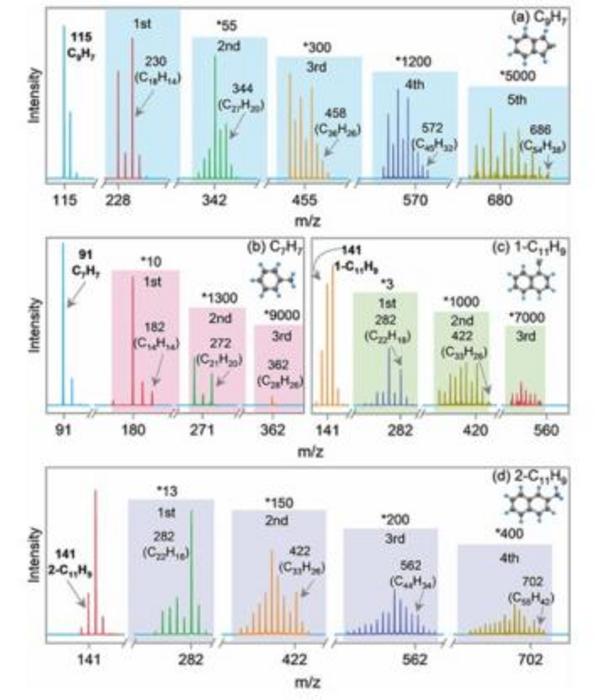
A series of regularly growing covalently bound clusters (CBCs), intermediates in the evolution from small RSRs, is observed in experiments by using in situ synchrotron radiation ultraviolet photoionization mass spectrometry (SVUV-PIMS) at the BL09U beamline of the National Synchrotron Radiation Laboratory (the undulator-based beamline was designed with an energy range of 7–124 eV to study the spectroscopy and dynamics of atoms, molecules, and clusters). Pyrolyze halogenated radical precursors in a laminar flow reactor was chose to conduct the experiment. Since RSR could be exclusively produced via cleavage of the C−Br bond at a high temperature in this reactor.


Combined with quantitative calculations, hydrogen atom abstraction and multiple RSR additions were found to promote the formation and rapid growth of covalent clusters. These clusters gradually dehydrogenated to produce large-sized peri-condensed condensed aromatic and polycyclic aromatic radicals and form white smoke-like carbonaceous particles.


This progressive H-losses from CBCs (PHLCBC) elucidated an important relationship among resonance-stabilized radicals, covalent clusters, and peri-condensed condensed aromatics, bridging small-sized gas-phase radical intermediates with large-sized nanocarbon particles.


This study is expected to provide important insights for multi-scale simulation of carbonaceous particulates, and guide the synthesis of carbon nanomaterials, reveal the formation mechanism of fullerene clusters in flames, and develop new coking inhibitors.

Paper link:


Journal

Journal of the American Chemical Society

DOI

10.1021/jacs.4c03417

Article Title

Direct Observation of Covalently Bound Clusters in Resonantly Stabilized Radical Reactions and Implications for Carbonaceous Particle Growth

Article Publication Date

6-May-2024

Subject of Research: Technology and Engineering

Article Title: USTC provides mechanism carbonaceous particles formation

Article References: Original research article

Image Credits: AI Generated

DOI: Not provided

Keywords: Not provided

Cite Scienmag News

Denise Maddox. (June 17, 2024). USTC provides mechanism carbonaceous particles formation. Scienmag. https://scienmag.com/ustc-provides-mechanism-carbonaceous-particles-formation/

Denise Maddox. "USTC provides mechanism carbonaceous particles formation." Scienmag, 17 June 2024, https://scienmag.com/ustc-provides-mechanism-carbonaceous-particles-formation/. Accessed 5 September 2026.

Denise Maddox. "USTC provides mechanism carbonaceous particles formation." Scienmag. June 17, 2024. https://scienmag.com/ustc-provides-mechanism-carbonaceous-particles-formation/

Share27Tweet17
Previous Post

ASU researchers gain insight into how a deadly strain of salmonella fine-tunes its infection tactics

Next Post

Hokkaido University researcher awarded the Ben Cullen Prize 2024

Related Posts

Optical strain and spectral-spatial networks decode micro-expressions
Technology and Engineering

Optical strain and spectral-spatial networks decode micro-expressions

September 5, 2026
Graph attention model improves recommendations by weighting users’ past interactions
Technology and Engineering

Graph attention model improves recommendations by weighting users’ past interactions

September 5, 2026
Multimodal biosignals power deep learning stress detection
Technology and Engineering

Multimodal biosignals power deep learning stress detection

September 5, 2026
Adam Optimizer’s Neural Network Training Regimes Mapped Through Observable Measurements
Technology and Engineering

Adam Optimizer’s Neural Network Training Regimes Mapped Through Observable Measurements

September 5, 2026
Chemical fabrication of SnO2/Co3O4/Si photodetector for visible-infrared light detection
Technology and Engineering

Chemical fabrication of SnO2/Co3O4/Si photodetector for visible-infrared light detection

September 5, 2026
Biomaterials Break Physical Barriers to Boost Drug Delivery in Tumors
Technology and Engineering

Biomaterials Break Physical Barriers to Boost Drug Delivery in Tumors

September 5, 2026
Next Post
Hokkaido University researcher awarded the Ben Cullen Prize 2024

Hokkaido University researcher awarded the Ben Cullen Prize 2024

  • Mothers who receive childcare support from maternal grandparents show more optimized

    Mothers who receive childcare support from maternal grandparents show more parental warmth, finds NTU Singapore study

    27656 shares
    Share 11059 Tweet 6912
  • University of Seville Breaks 120-Year-Old Mystery, Revises a Key Einstein Concept

    1061 shares
    Share 424 Tweet 265
  • Bee body mass, pathogens and local climate influence heat tolerance

    682 shares
    Share 273 Tweet 171
  • Researchers record first-ever images and data of a shark experiencing a boat strike

    546 shares
    Share 218 Tweet 137
  • Groundbreaking Clinical Trial Reveals Lubiprostone Enhances Kidney Function

    531 shares
    Share 212 Tweet 133
Science

Embark on a thrilling journey of discovery with Scienmag.com—your ultimate source for cutting-edge breakthroughs. Immerse yourself in a world where curiosity knows no limits and tomorrow’s possibilities become today’s reality!

RECENT NEWS

  • Dissipative Torsional Alfvén Waves Detected in Solar Photospheric Flux Tubes
  • Tangent bundle method computes geodesic deviation to every order
  • Fractal Quantum Mechanics Built on Nambu Dynamics
  • Latinx immigrants’ trauma symptoms linked to migration experiences in new study

Categories

  • Agriculture
  • Anthropology
  • Archaeology
  • Athmospheric
  • Biology
  • Biotechnology
  • Blog
  • Bussines
  • Cancer
  • Chemistry
  • Climate
  • Earth Science
  • Editorial Policy
  • Marine
  • Mathematics
  • Medicine
  • Pediatry
  • Policy
  • Psychology & Psychiatry
  • Science Education
  • Social Science
  • Space
  • Technology and Engineering

Subscribe to Blog via Email

Enter your email address to subscribe to this blog and receive notifications of new posts by email.

Join 5,151 other subscribers

© 2025 Scienmag - Science Magazine

Welcome Back!

Login to your account below

Forgotten Password?

Retrieve your password

Please enter your username or email address to reset your password.

Log In
No Result
View All Result
  • HOME
  • SCIENCE NEWS
  • CONTACT US

© 2025 Scienmag - Science Magazine

Discover more from Science

Subscribe now to keep reading and get access to the full archive.

Continue reading