

Wednesday, July 15, 2026
Science
No Result
View All Result
  • Login
  • HOME
  • SCIENCE NEWS
  • CONTACT US
  • HOME
  • SCIENCE NEWS
  • CONTACT US
No Result
View All Result
Scienmag
No Result
View All Result
Home Science News Athmospheric

Himalayan Forests Use Dual Approach to Capture and Store More Carbon

July 15, 2026
in Athmospheric
Reading Time: 2 mins read
0
Himalayan Forests Use Dual Approach to Capture and Store More Carbon

Himalayan Forests Use Dual Approach to Capture and Store More Carbon

65
SHARES
587
VIEWS
Share on FacebookShare on Twitter
ADVERTISEMENT

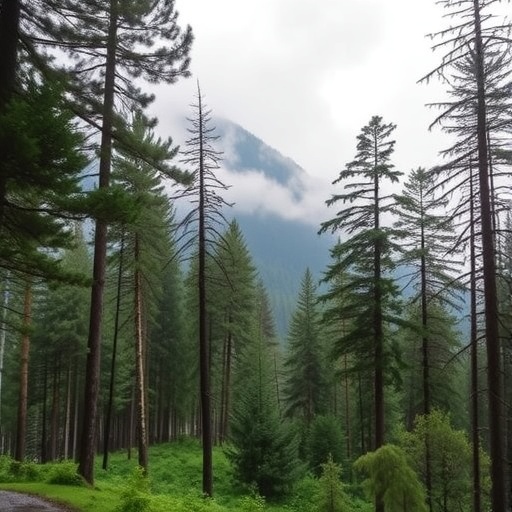
A new study in the Garhwal Himalayas shows that how forests store carbon is not uniform—it shifts systematically with altitude and forest composition. As atmospheric CO₂ rises, identifying where natural ecosystems lock away carbon for the long term has become central to climate mitigation planning.

Researchers compared three forest types spanning distinct elevation bands: Deodar forest at higher altitudes, pine forest at mid-elevations, and mixed forest at lower elevations. They quantified carbon in both living biomass and soils, focusing on tree biomass carbon density and soil organic carbon across two soil layers (0–15 cm and 15–30 cm).

The results reveal a clear division of labor. At higher elevations, conifer-dominated Deodar stands accumulated the most carbon in biomass. Their large, long-lived trees create sustained aboveground carbon reservoirs, producing the highest tree biomass carbon density reported in this study.

Mid-elevation pine forests showed comparatively lower biomass carbon density than Deodar forests. Even so, they still contribute meaningfully to regional carbon sequestration, indicating that altitude-driven productivity and stand structure influence how much carbon remains in woody tissues.

Soil carbon patterns told a different story. Lower-elevation mixed forests, dominated by broadleaf species, stored more stable soil organic carbon than the conifer systems. Their soils contained higher very labile and non-labile carbon fractions in topsoil, suggesting faster conversion of plant-derived inputs into forms that resist rapid decomposition.

To connect composition to stabilization, the team evaluated active and passive soil carbon pools. Mixed forests exhibited the largest active and passive pools, consistent with a microbial and chemical environment that favors long-term sequestration.

Overall, the work supports a “portfolio” perspective for Himalayan climate strategies: conifer forests can maximize biomass retention, while mixed broadleaf forests strengthen soil carbon stability. This approach can improve both mitigation potential and ecosystem resilience under changing climate conditions.

The authors also caution that elevation is tightly coupled to microclimate, making it difficult to fully separate forest-type effects from climatic drivers. They recommend expanded temporal monitoring, microbial community analyses, and improved species-specific biomass equations to refine estimates.

For policymakers, the findings argue for altitude-specific forest management rather than one-size-fits-all interventions. Conserving high-biomass Deodar stands and protecting or restoring mixed broadleaf systems could strengthen India’s carbon sink capacity in the Himalayas.

Subject of Research: Not available
Article Title: Himalayan altitude gradient drives divergent carbon storage: conifer biomass peaks, broadleaf soils stabilize
News Publication Date: 15-Jul-2026
Web References: http://dx.doi.org/10.1007/s44246-026-00287-z
References: Carbon Research (10.1007/s44246-026-00287-z)
Image Credits: Arvind Singh, Vinod Prasad Khanduri, Deepa Rawat, Bhupendra Singh, Manoj Kumar Riyal, Tarun Kumar Thakur, Gaurav Mishra, Munesh Kumar & R. K. Chaturvedi

Keywords: Soil carbon; carbon sequestration; Himalayan forests; altitude gradient; conifer biomass; broadleaf soils; climate change; ecosystem resilience; carbon partitioning; soil organic carbon stability

Tags: altitude-dependent forest carbon storageclimate mitigation through Himalayan forestsDeodar forest biomass carbonecosystem-based climate mitigation strategieselevation impact on forest carbon dynamicsforest composition and carbon allocationHimalayan forest carbon sequestrationlong-term carbon storage in Himalayan ecosystemsmixed broadleaf forest carbon storagenatural carbon sinks in mountain ecosystemspine forest soil organic carbonsoil layers and organic carbon distribution
Share26Tweet16
Previous Post

Braiding and Fusion Enable Universal Gates for Anyons on Quantum Hardware

Next Post

Prebiotics and Probiotics Help Honeybees Survive Temperature Stress Better

Related Posts

Greenland snow reveals industrial impact through rising atmospheric methane levels
Athmospheric

Greenland snow reveals industrial impact through rising atmospheric methane levels

July 15, 2026
Climate Impact Research Needs More Real-World Evidence
Athmospheric

Climate Impact Research Needs More Real-World Evidence

July 15, 2026
India’s monsoon rainfall varies with cleaner air in different regions
Athmospheric

India’s monsoon rainfall varies with cleaner air in different regions

July 15, 2026
New study maps climate measures for Berlin and heat protection for Tirana
Athmospheric

New study maps climate measures for Berlin and heat protection for Tirana

July 15, 2026
Rising desert dust levels over Europe spark renewed environmental concerns
Athmospheric

Rising desert dust levels over Europe spark renewed environmental concerns

July 15, 2026
Amazon Rainforest Waterways: Major but Underestimated Methane Sources
Athmospheric

Amazon Rainforest Waterways: Major but Underestimated Methane Sources

July 14, 2026
Next Post
Prebiotics and Probiotics Help Honeybees Survive Temperature Stress Better

Prebiotics and Probiotics Help Honeybees Survive Temperature Stress Better

  • Mothers who receive childcare support from maternal grandparents show more

    Mothers who receive childcare support from maternal grandparents show more parental warmth, finds NTU Singapore study

    27656 shares
    Share 11059 Tweet 6912
  • University of Seville Breaks 120-Year-Old Mystery, Revises a Key Einstein Concept

    1061 shares
    Share 424 Tweet 265
  • Bee body mass, pathogens and local climate influence heat tolerance

    682 shares
    Share 273 Tweet 171
  • Researchers record first-ever images and data of a shark experiencing a boat strike

    546 shares
    Share 218 Tweet 137
  • Groundbreaking Clinical Trial Reveals Lubiprostone Enhances Kidney Function

    531 shares
    Share 212 Tweet 133
Science

Embark on a thrilling journey of discovery with Scienmag.com—your ultimate source for cutting-edge breakthroughs. Immerse yourself in a world where curiosity knows no limits and tomorrow’s possibilities become today’s reality!

RECENT NEWS

  • Tectonic record reveals early tidal despinning history on Oz Terra, Charon
  • Allergic disease comorbidity shows distinct epidemiological patterns across Taiwan school grades
  • Correction: Positive TKT–c-Myc loop promotes TACE resistance in hepatocellular carcinoma
  • Perseverance rover captures unprecedented record of ancient Mars asteroid impacts

Categories

  • Agriculture
  • Anthropology
  • Archaeology
  • Athmospheric
  • Biology
  • Biotechnology
  • Blog
  • Bussines
  • Cancer
  • Chemistry
  • Climate
  • Earth Science
  • Editorial Policy
  • Marine
  • Mathematics
  • Medicine
  • Pediatry
  • Policy
  • Psychology & Psychiatry
  • Science Education
  • Social Science
  • Space
  • Technology and Engineering

Subscribe to Blog via Email

Enter your email address to subscribe to this blog and receive notifications of new posts by email.

Join 5,146 other subscribers

© 2025 Scienmag - Science Magazine

Welcome Back!

Login to your account below

Forgotten Password?

Retrieve your password

Please enter your username or email address to reset your password.

Log In
No Result
View All Result
  • HOME
  • SCIENCE NEWS
  • CONTACT US

© 2025 Scienmag - Science Magazine

Discover more from Science

Subscribe now to keep reading and get access to the full archive.

Continue reading
