


The Arctic may be generating far more cloud-forming particles than climate models currently account for, according to new research that reveals an unexpected chemical partnership between sunlight, marine life and melting sea ice. Scientists aboard the Royal Research Ship Discovery observed that the number of particles capable of becoming cloud droplets increased fifty-fold in a single day near the boundary between open water and sea ice. The discovery identifies a previously unrecognized natural process that could influence Arctic cloud cover, sunlight reflection and the pace of regional warming.
The findings, published in Nature Geoscience, provide the first field evidence for a mechanism previously seen only in controlled laboratory experiments at CERN’s CLOUD chamber. An international team led by the University of Birmingham detected a mixture of iodine, sulfur and organic compounds in the atmosphere around Greenland and the Davis Strait during an expedition in spring and summer 2022. Under sunlight, these gases reacted to form new atmospheric particles, some of which grew large enough to act as cloud condensation nuclei—the microscopic seeds on which water vapor condenses to form cloud droplets.
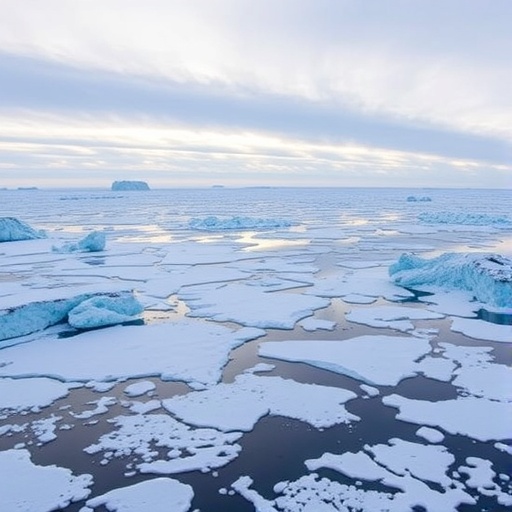
The most dramatic changes occurred in the marginal ice zone, a narrow and highly dynamic region where open ocean meets melting sea ice. During one observed event, the concentration of cloud-seeding particles rose from approximately 50 to 1,500 particles per cubic centimeter. Researchers found that new particle formation occurred on more than 80 percent of sunny days in the study area, suggesting that the process is not an isolated chemical curiosity but a recurring feature of the Arctic atmosphere during the brighter months.
The chemistry begins with emissions from several natural sources. Iodine compounds are released by seawater, sea ice and coastal environments, while dimethyl sulfide—a sulfur-containing gas commonly abbreviated as DMS—is produced by marine microorganisms, algae and other forms of ocean life. Organic vapors also enter the atmosphere from the ocean and surrounding land. Sunlight transforms these gases through a sequence of oxidation reactions, generating highly reactive molecules that can cluster together and form new particles only a few nanometers across.
At that size, however, the particles are too small to reliably affect clouds. Their climatic importance depends on whether they can continue growing before they are removed from the atmosphere. The researchers identified a previously unknown group of compounds called iodine-containing oxygenated organic molecules, or I-OOMs. These molecules appear to contribute to the growth and stabilization of newly formed particles, helping them reach the size required to activate as cloud condensation nuclei. Their detection points to new pathways in atmospheric iodine chemistry that were not included in existing descriptions of Arctic aerosol formation.
Clouds are among the most influential and uncertain components of the climate system. By reflecting incoming sunlight, they can cool the surface, but by trapping outgoing infrared radiation, they can also produce a warming effect. The balance depends on cloud altitude, thickness, droplet size, water and ice content, and the season. More cloud condensation nuclei can lead to clouds containing greater numbers of smaller droplets, potentially changing how much sunlight the clouds reflect and how long they persist. In the Arctic, even modest shifts in cloud properties can have consequences for sea ice and ocean temperatures.
The researchers emphasize that the discovery does not yet establish whether the newly formed particles will produce an overall warming or cooling effect. That outcome will depend on how the particles interact with different cloud types and atmospheric conditions. During the Arctic’s sunlit season, brighter clouds could reflect additional solar energy and cool exposed ocean surfaces. Yet clouds can also act as an insulating blanket, retaining heat near the surface and potentially accelerating sea-ice loss. Their influence may vary from one location and season to another, making the newly identified process important but difficult to translate into a single climate prediction.
The finding is particularly significant because the Arctic is warming more than three times faster than the global average, while its sea ice is retreating and the marginal ice zone is expanding. As more productive ocean water becomes exposed near the ice edge, marine algae and other organisms may release greater quantities of iodine-, sulfur- and carbon-containing compounds. This creates the possibility of a feedback involving sea-ice loss, biological activity, atmospheric particle formation and cloud evolution. Whether that feedback amplifies or moderates warming remains unknown, but its omission from climate models means current projections may be missing an important piece of Arctic atmospheric chemistry.
The team is now working to determine how widespread the process is beyond the waters surveyed during the expedition and how efficiently the particles become cloud droplets under different conditions. Incorporating iodine chemistry, marine sulfur emissions and I-OOM formation into climate models could improve simulations of Arctic clouds and radiation. The study also highlights how rapidly changing environments can expose chemical interactions that are difficult to reproduce through theory alone. In a region already undergoing profound transformation, a previously invisible population of particles may help determine what the Arctic sky looks like—and how much heat the planet keeps or reflects.
News Publication Date: 5 August 2026
References: Mao Du, James Brean, Douglas R. Worsnop et al., “Arctic cloud condensation nuclei enhanced by iodine, sulfur and organic precursors,” Nature Geoscience.
Cite Scienmag News
Russell Cooper. (August 5, 2026). Study finds melting sea ice and Arctic Ocean combine to form clouds. Scienmag. https://scienmag.com/study-finds-melting-sea-ice-and-arctic-ocean-combine-to-form-clouds/
Russell Cooper. "Study finds melting sea ice and Arctic Ocean combine to form clouds." Scienmag, 5 August 2026, https://scienmag.com/study-finds-melting-sea-ice-and-arctic-ocean-combine-to-form-clouds/. Accessed 5 September 2026.
Russell Cooper. "Study finds melting sea ice and Arctic Ocean combine to form clouds." Scienmag. August 5, 2026. https://scienmag.com/study-finds-melting-sea-ice-and-arctic-ocean-combine-to-form-clouds/


