


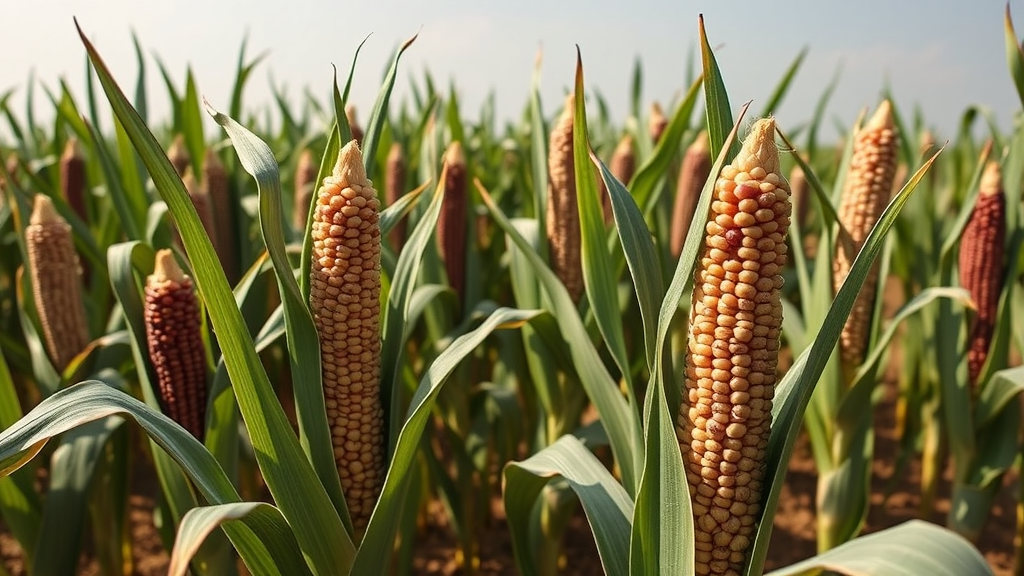
Maize is the backbone of food security in Ethiopia, ranking second only to teff in cultivated area while leading all crops in total production and food contribution. Yet the country’s highland farmers continue to rely on varieties that fall short of their yield potential, a gap that threatens harvests in the cool, elevated agro-ecologies where maize is a dietary staple. A new study published in Discover Agriculture by Abenezer Abebe Tefera of the Holeta Agricultural Research Center, part of the Ethiopian Institute of Agricultural Research, offers a detailed genetic roadmap for closing that gap. The research evaluated 48 experimental single-cross maize hybrids alongside two commercial checks across two representative highland locations, and the results point to a handful of hybrids that could reshape highland maize breeding in East Africa.
The field trials were conducted during the 2019/2020 main cropping season at the Ambo and Holeta Agricultural Research Centers, both situated in the West Showa Zone of Ethiopia’s Oromia region. These sites were deliberately chosen because they represent the major highland maize-producing agro-ecologies of the country, differing in altitude, temperature, soil characteristics, and rainfall patterns. The plant material itself was developed a few years earlier at the Ambo Agricultural Research Center, where 24 inbred lines were crossed with two testers in a line-by-tester mating design to produce the 48 F1 single-cross hybrids. The two commercial checks, AMH851-Jibat and AMH853-Kolba, are three-way cross hybrids released for highland and sub-humid ecologies, requiring roughly 178 days to reach physiological maturity and adapted to altitudes between 1800 and 2600 meters.
Experimental rigor was central to the study’s design. The 50 genotypes were planted in an alpha lattice design with two replications, ten incomplete blocks, and five plots per incomplete block, a layout that improves the precision of field comparisons in heterogeneous environments. Each genotype occupied a single-row plot of 5.25 meters, with 75 centimeters between rows and 25 centimeters between plants. Fertilization followed recommended schedules of 200 kilograms per hectare of urea and 150 kilograms per hectare of diammonium phosphate, supplemented by pre-emergence herbicide against weeds and targeted insecticide applications against fall armyworm, one of the most destructive pests now threatening maize across sub-Saharan Africa.
The combined analysis of variance, run in SAS version 9.3 with locations, replications, and blocks treated as random factors and genotypes as fixed factors, revealed significant genotypic differences for nearly all measured traits. Equally important, the genotype-by-location interaction was significant for grain yield, plant height, ear height, ear diameter, and thousand-kernel weight. This interaction term is the statistical fingerprint of an uncomfortable truth in plant breeding: a hybrid that dominates one environment may falter in another. The finding means that selection based on single-site trials would be misleading, and it underscores why multi-location testing remains the gold standard before any variety is recommended to farmers.
The yield numbers themselves tell a striking story. Mean grain yield across all genotypes was 7.54 tonnes per hectare, but individual hybrids ranged from 4.64 to 10.17 tonnes per hectare. Seven hybrids, designated G3, G9, G15, G21, G27, G31, and G45, significantly outperformed the standard check Kolba, which yielded 7.78 tonnes per hectare, with advantages ranging from 10.4 to 30.7 percent. Flowering traits showed moderate variation, with mean days to 50 percent anthesis and silking at 104.53 and 105.29 days respectively, and a remarkably short anthesis-silking interval averaging just 0.63 days. A narrow interval between pollen shed and silk emergence is a well-established indicator of stress tolerance, because it signals that the female flowers have not been left unfertilized while the plant diverts resources under drought or heat. Several hybrids, including G18, G22, G36, and G42, showed narrower intervals than the commercial checks.
To disentangle performance from stability, the study employed GGE biplot analysis, a graphical technique that condenses the complex genotype-by-environment interaction into principal components. Here, the first principal component captured 60.6 percent of the genotype plus interaction variation and the second captured 39.4 percent, meaning the biplot accounted for essentially all of the structured variation. The mean-versus-stability view identified G21, G29, and G15 as high-yielding and relatively stable across both environments, delivering yield advantages of 22.10, 16.30, and 15.70 percent respectively. Meanwhile, the which-won-where pattern revealed classic crossover interactions: hybrids G45, G27, and G19 were favored at Holeta, while G21, G44, and G17 excelled at Ambo. Such crossover effects likely stem from differences in altitude, temperature regime, soil type, and rainfall distribution between the two sites, which influence flowering time, assimilate partitioning, and grain filling. Notably, many of the top-performing hybrids shared the tester FS59 as a male parent, suggesting this tester consistently contributes favorable combining ability under highland conditions.
Beyond mean performance, the study quantified the genetic architecture underlying the traits. Broad-sense heritability, the proportion of phenotypic variance attributable to genotypic variance, ranged from 23.6 percent for kernels per row to 90.9 percent for ear height. Ear height stood out with high heritability combined with a genetic advance of 21.07 percent of the mean, indicating clear genetic differentiation among hybrids and strong potential for phenotypic selection. Grain yield, plant height, ears per plant, and ear aspect showed moderate heritability paired with moderate genetic advance, while traits such as the anthesis-silking interval and plant aspect were more strongly shaped by the environment. The phenotypic coefficient of variation consistently exceeded the genotypic coefficient for every trait, a reminder that environmental noise inflates observed variation, though ear height’s moderate genotypic coefficient of 10.7 percent confirmed genuine selectable variability.
Correlation analysis added a layer of breeding strategy. Grain yield showed significant positive genotypic correlations with plant height (0.486), ear height (0.335), and ears per plant (0.586), meaning vigorous, prolific plants tend to yield more, likely because greater biomass and more ears expand both the source of photosynthate and the sink capacity for grain. Plant height and ear height were tightly correlated at 0.861, reflecting coordinated inheritance, while ear height also correlated positively with ear diameter and kernel rows per ear. However, the analysis uncovered a physiological trade-off: ears per plant and ear diameter were negatively correlated at minus 0.303, suggesting that plants producing more ears pay for it with smaller individual ears as developing sinks compete for limited assimilates. This antagonism means breeders cannot simply select for maximum prolificacy; index-based selection balancing ear number, ear size, and plant architecture will be needed to push yield forward without unintended consequences such as increased lodging risk from excessive height.
The practical implications are considerable. The broadly adapted hybrids G21, G29, and G15 can be advanced toward national performance trials, while the specifically adapted genotypes could be targeted to the locations where they excel, once validated across additional sites and seasons. The authors are careful to note that the study covered only two locations in a single season, so the stability conclusions remain preliminary. Still, the combination of substantial genetic variability, moderate to high heritability, favorable trait associations, and double-digit yield advantages over commercial checks makes a compelling case that Ethiopian highland maize breeding is on the cusp of a significant step change. Future work incorporating more representative highland environments and multiple growing seasons will determine whether these promising hybrids can deliver their laboratory promise to the farmers who need it most.
Subject of Research: Genetic variability, heritability, and yield stability of single-cross maize hybrids in Ethiopian highland environments
Article Title: Genetic variability, heritability, and yield performance of maize genotypes evaluated across highland environments
Article References: Tefera, A. A. (2026). Genetic variability, heritability, and yield performance of maize genotypes evaluated across highland environments. Discover Agriculture, 4(1), Article 294. https://doi.org/10.1007/s44279-026-00769-z
Image Credits: AI Generated
DOI: 10.1007/s44279-026-00769-z
Keywords: maize, Ze mays, genetic variability, heritability, GGE biplot, genotype-by-environment interaction, grain yield, Ethiopia, highland agriculture, plant breeding, single-cross hybrids, selection criteria
Cite Scienmag News
Alan Morgan. (September 25, 2026). Highland Maize Hybrids Show Big Yield Gains Across Ethiopian Test Sites. Scienmag. https://scienmag.com/highland-maize-hybrids-show-big-yield-gains-across-ethiopian-test-sites/
Alan Morgan. "Highland Maize Hybrids Show Big Yield Gains Across Ethiopian Test Sites." Scienmag, 25 September 2026, https://scienmag.com/highland-maize-hybrids-show-big-yield-gains-across-ethiopian-test-sites/. Accessed 5 October 2026.
Alan Morgan. "Highland Maize Hybrids Show Big Yield Gains Across Ethiopian Test Sites." Scienmag. September 25, 2026. https://scienmag.com/highland-maize-hybrids-show-big-yield-gains-across-ethiopian-test-sites/


