


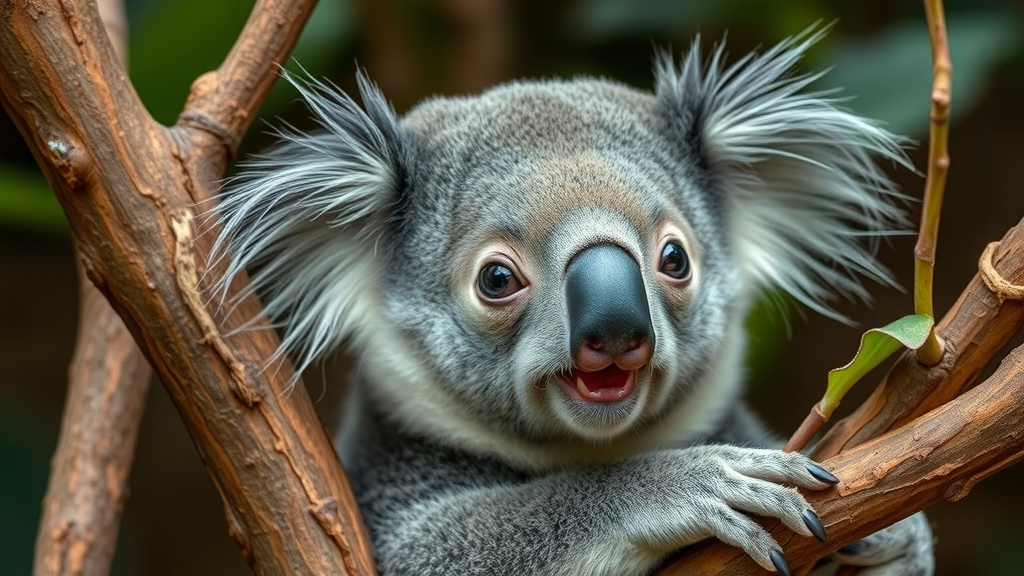
The koala carries within its genome the record of a viral invasion that is still unfolding. Koala retrovirus type A, or KoRV-A, is a gamma-retrovirus that has been inserting itself into the DNA of koalas both by infecting cells directly, passing from animal to animal, and by becoming a permanent, heritable fixture of the germline. A new study published in Genome Biology has reconstructed the evolutionary path of this virus across nearly the entire geographic range of the species, and the picture that emerges points to a specific birthplace for the endogenous form of the virus: the region around Coffs Harbour, on the Mid North Coast of New South Wales, close to the middle of the koala’s Australian distribution.
The research, led by Tianxiong Yu and Zhiping Weng of the University of Massachusetts Chan Medical School together with William E. Theurkauf, and conducted in collaboration with Michaela D. J. Blyton and Keith Chappell of the University of Queensland along with Birgit S. Koppetsch, Milky Abajorga and Jeremy Luban, rests on an unusually broad genomic survey. The team analyzed whole-genome sequencing data from 405 wild koalas, a sample set that spans nearly the entire range of the species. From these genomes they catalogued germline insertions of KoRV-A, the sites where the virus has stitched itself into koala chromosomes in cells that give rise to sperm and eggs, allowing the insertions to be passed down through generations.
Endogenous retroviruses occupy a special place in virology and genome biology. When a retrovirus infects a germ cell, the DNA copy it makes of its RNA genome can be permanently fixed into the host genome. From that moment the insertion behaves like any other genetic marker, inherited according to Mendelian rules. Older endogenous retroviruses accumulate in the genomes of virtually all vertebrates, but KoRV-A is remarkable because its endogenization appears to be geologically recent. Previous studies had estimated that KoRV-A first integrated into the koala genome roughly 300,000 years ago, a blink in evolutionary time for a process that in most lineages concluded tens of millions of years ago. That recency means koalas are living through a rare, observable transition: the conversion of an active infectious retrovirus into inherited genetic cargo.
By mapping where shared KoRV-A insertions occur across the range of sampled animals, the researchers could infer the geography of the virus’s expansion. Insertions that are shared by many koalas across broad areas are older, having had more time to spread, while insertions found in single individuals or narrow localities are younger. Tracing this gradient of sharedness and diversity, the analysis converged on a starting point near Coffs Harbour in New South Wales. From that mid-range epicenter, the virus appears to have radiated outward, generating the mosaic of insertion patterns that now distinguishes koala populations across the continent.
The study also documents how the virus diversified as it spread. As KoRV-A moved through wild populations, certain subtypes emerged and rose to prevalence, each carrying characteristic sequence variation in the long terminal repeats and coding regions that define retroviral strains. Two of these successful subtypes did something biologically striking: they recombined with an ancient endogenous retrovirus already resident in the koala genome, known as PhER. These recombination events produced distinct recombinant variants, termed recKoRV variants, and the analysis found that different recombinant forms characterize the northern and southern koala populations. Recombination between a young, active retrovirus and a deeply ancient endogenous element is a vivid illustration of how the koala genome functions as an arena in which viral lineages interact, exchange genetic material, and generate new variants.
Geography, as much as virology, shaped the resulting distribution. The researchers identified a barrier north of Sydney that appears to have slowed the southward spread of KoRV-A into Sydney and regions beyond. Such barriers to viral dispersal are critical to understanding the current and future burden of retroviral disease in koalas. KoRV infection is associated with serious health consequences in wild populations, including immune suppression and increased susceptibility to infections and cancers, so the pace and pattern of the virus’s southward march has direct implications for conservation. A population that has carried endogenous KoRV-A for longer may have evolved some degree of accommodation to the virus, while populations only recently exposed may face harsher impacts.
The technical foundation of the study is the systematic detection of insertion sites from short-read whole-genome sequencing data. At each candidate insertion, reads that span the junction between viral sequence and flanking koala DNA provide evidence for the insertion’s presence, and the number of supporting reads yields an estimate of the allele frequency, indicating how many chromosomes in the population carry that particular insertion. Insertions with high allele frequencies across many individuals represent ancient, deeply shared events, while those at low frequency in restricted localities mark recent integrations. The team supplemented this with analysis of the 5-prime long terminal repeat sequences of each insertion, which allowed them to assign insertions to KoRV-A subtypes and to track how subtype composition shifts across geography. Down-sampling analyses confirmed that these patterns were robust to variation in sequencing depth and sample density.
What makes the koala system scientifically valuable is that it compresses into a single living species a process that is usually visible only through deep evolutionary time. In mice, humans, and most other mammals, endogenous retroviruses are fossils, long-defanged remnants of infections that occurred before those species existed. In koalas, the endogenization process is young enough that both the infectious virus circulating between individuals and the fixed germline insertions inherited from ancestors can be studied side by side. The 405-genome dataset effectively turns the koala range into a natural time series, with geographic distance from the inferred origin at Coffs Harbour serving as a proxy for time since the virus arrived.
The evolutionary trajectory proposed by the authors therefore reads as a narrative with a defined beginning, a set of diversification events, and a partially constrained spread. The story begins with the initial integration of KoRV-A into the koala germline near Coffs Harbour, around the middle of the species’ range, consistent with a rough timescale of hundreds of thousands of years. As the virus dispersed, subtypes arose and became regionally dominant, and two of them captured sequence from the ancient PhER retrovirus, yielding recombinant variants that now mark the northern and southern populations respectively. Along the way, a barrier north of Sydney slowed the southern expansion, leaving populations south of that line with a different retroviral landscape than those to the north.
For conservation biologists, the practical value of this work lies in its detailed map of retroviral diversity across koala populations. Knowing where the virus began, which subtypes and recombinant variants prevail in which regions, and where natural barriers have limited spread provides a baseline for monitoring the ongoing epidemic and for anticipating how KoRV-A may continue to move through vulnerable southern populations. For virologists and genome biologists, the study offers a rare, range-wide portrait of endogenization in action, showing how a retrovirus spreads, diversifies, recombines with ancient residents of the host genome, and is gradually absorbed into the hereditary fabric of a species. The koala, an iconic and threatened marsupial, is thus also a living laboratory of viral evolution, and the trajectory reconstructed from these 405 genomes gives science its clearest view yet of where that story began.
Subject of Research: Evolutionary origins and spread of the koala retrovirus KoRV-A in the koala germline genome
Article Title: The trajectory of KoRV-A evolution suggests initial integration into the koala germline genome near Coffs Harbour in New South Wales
Article References: Yu, T., Blyton, M. D. J., Koppetsch, B. S., Abajorga, M., Luban, J., Chappell, K., Theurkauf, W. E., & Weng, Z. (2026). The trajectory of KoRV-A evolution suggests initial integration into the koala germline genome near Coffs Harbour in New South Wales. Genome Biology. https://doi.org/10.1186/s13059-026-04258-w
Image Credits: AI Generated
DOI: 10.1186/s13059-026-04258-w
Keywords: koala retrovirus, KoRV-A, endogenous retrovirus, koala genome, germline integration, viral evolution, genome biology, Coffs Harbour, recombination, PhER, New South Wales, whole-genome sequencing
Cite Scienmag News
Juliet Wilcox. (September 25, 2026). Koala retrovirus traced to a birthplace near Coffs Harbour. Scienmag. https://scienmag.com/koala-retrovirus-traced-to-a-birthplace-near-coffs-harbour/
Juliet Wilcox. "Koala retrovirus traced to a birthplace near Coffs Harbour." Scienmag, 25 September 2026, https://scienmag.com/koala-retrovirus-traced-to-a-birthplace-near-coffs-harbour/. Accessed 5 October 2026.
Juliet Wilcox. "Koala retrovirus traced to a birthplace near Coffs Harbour." Scienmag. September 25, 2026. https://scienmag.com/koala-retrovirus-traced-to-a-birthplace-near-coffs-harbour/


