


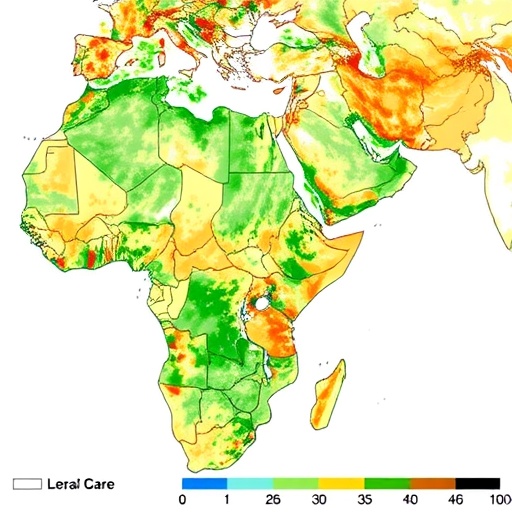
A new global analysis has revealed that the world’s food system is driving a concentrated, interconnected crisis for both climate protection and biodiversity. By mapping long-term carbon storage and biodiversity loss at unusually high spatial and product resolution, researchers have traced how agricultural land use connects farms, trade routes and consumer demand across the planet. Their findings suggest that the same places and products responsible for major carbon losses are frequently also linked to severe declines in biodiversity, creating opportunities for policies that address both problems at once.
The study, published in Nature Food, follows environmental impacts through global agricultural supply chains rather than examining land-use change in isolation. This approach makes it possible to connect a particular food product with the landscapes used to produce it and with the consumers whose demand ultimately drives production. The researchers assessed how converting or intensifying land for agriculture affects long-term carbon storage and biodiversity, then tracked those impacts across international trade and consumption networks.
The geographic pattern is striking. The Northern Hemisphere experiences greater carbon loss overall, while the Southern Hemisphere suffers higher biodiversity loss. Yet these two environmental pressures are not separated neatly by latitude. Areas with high carbon losses and areas with high biodiversity losses are often located in the same regions, meaning that protecting one environmental service could frequently help protect the other. The overlap also shows that food production is not creating evenly distributed damage: approximately two-thirds of total losses occur within just one-third of the total area examined.
This concentration is scientifically and politically important. Carbon storage is a major component of the climate system because vegetation and soils can retain carbon for long periods, preventing it from accumulating in the atmosphere. Biodiversity, meanwhile, reflects the variety of species, habitats and ecological functions that sustain resilient ecosystems. When natural land is converted for crops or pasture, both carbon-rich ecosystems and biological communities can be disrupted. The new mapping shows that these impacts can be traced to specific production zones instead of being treated as diffuse, global consequences.
The analysis also identifies food consumption as the dominant force behind the losses. Consumption is responsible for 83% of the carbon and biodiversity losses measured in the study. Animal-sourced foods alone account for 59% of carbon losses and 71% of biodiversity losses. This difference suggests that animal agriculture has a particularly strong connection to biodiversity damage, even though its contribution to carbon loss is also substantial. The results point to the importance of examining not only how food is produced, but also what foods are demanded and where that demand originates.
Bovine meat and milk stand out as the largest product-level contributors. Together, they account for 29% of carbon losses and 41% of biodiversity losses linked to the food system. Cattle production can require extensive land for grazing and feed, so its environmental footprint may extend far beyond the fields or pastures where animals are raised. A supply-chain perspective captures these indirect effects, revealing how consumer choices can influence land-use pressures thousands of kilometres away.
International trade further separates the locations of environmental damage from the locations of consumption. Brazil emerges as the world’s largest net exporter of both carbon and biodiversity losses, meaning that its agricultural production supplies overseas demand while transferring a large share of associated environmental impacts beyond its borders. China is identified as the largest net importer for both categories. In both countries, animal products dominate the relevant flows, illustrating how global trade can connect livestock production landscapes with distant markets and consumers.
The researchers’ high-resolution approach could help governments move beyond broad national averages. A country may appear to be reducing its domestic environmental pressure while importing products associated with land-use change elsewhere. Conversely, a producing region may bear the ecological costs of supplying food consumed abroad. By tracing impacts through products and trade, the study provides a way to identify where interventions could produce the greatest benefits. These interventions could include changes in consumer demand, improved production practices, stronger land-use protections and supply-chain policies targeting high-impact commodities.
The findings do not suggest that a single measure will solve the food system’s environmental footprint. Instead, they highlight the need for coordinated action focused on the regions and products responsible for the largest combined losses. Reducing pressure from high-impact animal products, protecting carbon-rich and biodiverse landscapes, and improving transparency in international supply chains could help align climate and conservation goals. Because the greatest losses are concentrated geographically and strongly linked to a limited group of foods, the study indicates that carefully targeted policies may deliver larger gains than unfocused global efforts. The message is clear: what appears on the plate can determine the fate of forests, soils, species and stored carbon far beyond the consumer’s immediate surroundings.
Cite Scienmag News
Margaret Porter. (August 6, 2026). High-resolution mapping reveals linked carbon and biodiversity losses across regions, crops. Scienmag. https://scienmag.com/high-resolution-mapping-reveals-linked-carbon-and-biodiversity-losses-across-regions-crops/
Margaret Porter. "High-resolution mapping reveals linked carbon and biodiversity losses across regions, crops." Scienmag, 6 August 2026, https://scienmag.com/high-resolution-mapping-reveals-linked-carbon-and-biodiversity-losses-across-regions-crops/. Accessed 3 September 2026.
Margaret Porter. "High-resolution mapping reveals linked carbon and biodiversity losses across regions, crops." Scienmag. August 6, 2026. https://scienmag.com/high-resolution-mapping-reveals-linked-carbon-and-biodiversity-losses-across-regions-crops/


