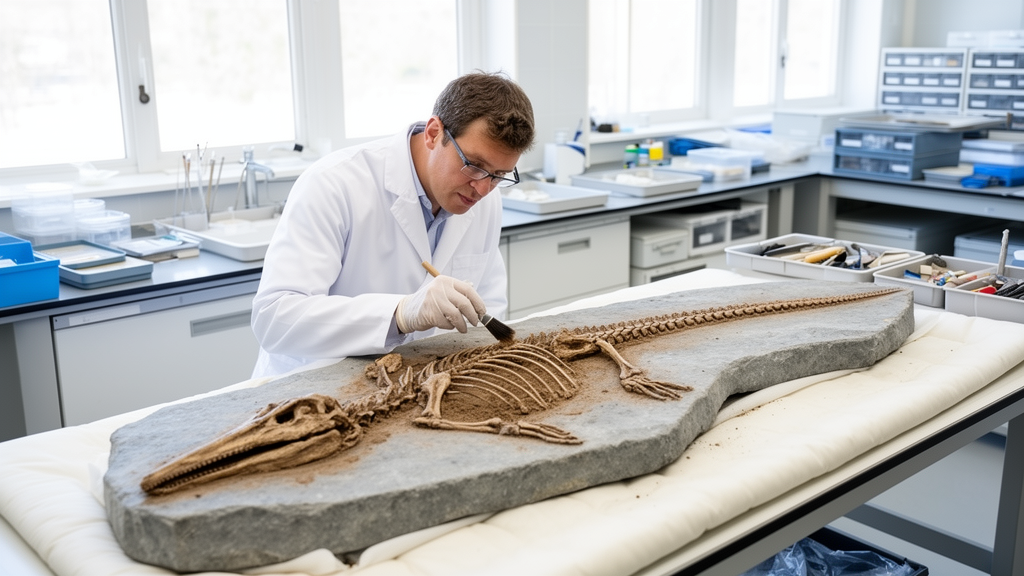
For nearly ten years, one of the most enigmatic marine reptiles of the Late Triassic has been known from a skull and a single, incomplete skeleton. Now, a remarkable fossil find from central Spain is rewriting what scientists know about Paludidraco multidentatus, a long-necked predator that swam the shallow seas covering the Iberian Peninsula more than 230 million years ago. In a new study published in the journal Fossil Record, palaeontologists describe the previously unpublished postcranial skeleton of the species’ paratype, a fossil that had been sitting in storage since its excavation, waiting for the right moment to tell its story.
The discovery is significant because simosaurids, the family to which Paludidraco belongs, are among the least understood of all Triassic sauropterygians. Sauropterygia is a diverse clade of aquatic reptiles that spans from the Lower Triassic to the very end of the Cretaceous, encompassing everything from shell-crushing placodonts to the iconic plesiosaurs. While complete or nearly complete skeletons are known for placodonts, pachypleurosaurs, nothosaurs and pistosauroids, the simosaurid postcranial skeleton has remained frustratingly fragmentary. Only two valid species are recognised: Simosaurus gaillardoti from the Middle Triassic of France and Germany, and Paludidraco multidentatus from the Late Triassic of Spain. Relatively complete simosaurid skeletons are limited to just two individuals of Simosaurus and the holotype of Paludidraco, and even those lack most of the cervical and caudal regions, as well as the lower limb bones of both fore-limbs and hind-limbs.
The newly described specimen, catalogued as MUPA-ATZ0103, corresponds to the paratype of Paludidraco multidentatus, an individual whose skull was documented when the species was first defined in 2018, but whose postcranial skeleton remained unstudied until now. The fossil comes from the El Atance fossil site in Guadalajara, central Spain, from the Keuper Facies of the El Puente Formation, assigned to the basal Julian age of the Carnian stage. Most of the skeleton was collected in 2015 during the same field campaign as the holotype, although some elements, including the left humerus, the left scapula and the skull, had been recovered as early as 2008. Preparation of the block containing most of the skeleton was not completed until 2025, which is why the paratype postcranium has remained unpublished until now.
The paratype preserves an impressive array of skeletal elements: the last cervical vertebrae, most of the dorsal vertebrae and ribs, some sacral and caudal vertebrae and ribs, partially articulated gastralia, and several girdle and limb bones. The specimen is larger than the holotype, allowing researchers to discuss intraspecific variability in Paludidraco for the first time. The dorsal vertebral series is particularly striking, with the paratype preserving between 36 and 38 dorsal vertebrae, most of them in articulation. The dorsal centra are amphicoelous and higher than long, with an oval morphology in the anterior and middle dorsals that becomes rounded in the posteriormost elements. The neural spines are moderately high, constricted at the base and gradually widened towards the top, reaching around 50 to 60 millimetres in height in the middle dorsal region.
One of the most remarkable features of the paratype is the extreme degree of pachyostosis, the swelling and thickening of bones, visible in the middle dorsal vertebrae and ribs. The dorsal ribs in the middle region are widely expanded, with a maximum distal width of 63 millimetres and a distal thickness of 23 millimetres, displaying conspicuously ornamented surfaces with longitudinal striae and distal pits. This pachyostotic condition is restricted to the anterior and middle dorsal regions, whereas the posteriormost dorsal, sacral and caudal ribs are not pachyostotic. The paratype also preserves caudal centra with chevron facets, a feature previously unknown for Paludidraco, and provides the most complete caudal vertebral count of any simosaurid specimen currently known.
The paratype postcranium confirms all postcranial character states considered in the diagnosis of the species, providing additional support for the identification of Paludidraco multidentatus. The specimen displays cervical infrazygapophyses and an angled posteromedial margin of the coracoid, traits considered autapomorphies of the taxon within Sauropterygia. It also shows the combination of postcranial characters present in the holotype but absent in Simosaurus gaillardoti, including amphicoelous and higher-than-long centra, highly pachyostotic dorsal vertebrae, a semi-lunate interclavicle, an extremely reduced or probably absent coracoid foramen, and a postacetabular process exceeding the posterior margin of the ilium. The paratype additionally allows researchers to recognise clavicular grooves lateral to the interclavicle for the first time in Paludidraco, a character never described for any other simosaurid or sauropterygian, potentially representing another autapomorphy of the species.
The pelvic girdle of the paratype is more complete than that of the holotype, preserving both left and right elements and allowing for correct pelvic orientation in both individuals by comparison with other articulated eosauropterygian skeletons. This has led to an important correction: the pubis and ischium preserved in the holotype, which were previously identified as left elements, are now recognised as right ones. The complete left ilium of the paratype, only slightly compressed, provides a more confident iliac morphology for Paludidraco, consistent with that of other nothosauroids. The proximal articular regions of the pubis and ischium are nearly complete in the paratype, allowing detailed characterisation and reconstruction of the acetabular region, which conforms to the pattern seen in other medium-to-large Triassic eosauropterygians but differs from that of plesiosaurs.
The limb bones of the paratype provide crucial new information. While the holotype was exclusively known from stylopodial elements, the paratype preserves zeugopodial hind-limb bones, including a probable left tibia and at least one fibula, elements so far unknown for Paludidraco. The tibial shaft is lateromedially more curved than in Simosaurus, with a slightly more concave postaxial margin, while the fibula displays a sigmoidal shape rather than the more curved condition in Simosaurus. The oblique fibular ridge in Paludidraco is located close to the postaxial margin, whereas in Simosaurus it develops close to the pre-axial margin. These differences in zeugopodial morphology provide further evidence of the distinctiveness of Paludidraco within Simosauridae.
Perhaps the most striking finding of the new study is the characterisation of intraspecific variability in Paludidraco for the first time. The paratype is around 18 percent larger than the holotype, as evidenced by the size of its interclavicle, vertebrae and ribs, and around 22 percent more robust, considering the width of neural spines, the distal thickness of dorsal ribs, the width of scapular blades and the diameters of limb bones. The dorsal vertebrae and ribs, as well as the scapulae, are comparably much more pachyostotic in the paratype than in the holotype. Posterior dorsal vertebrae at similar positions show marked differences in neural spine width, with the paratype’s spines reaching 21 millimetres compared to 14 millimetres in the holotype. The paratype’s zygapophyses are also notably pachyostotic, unlike those of the holotype.
The researchers interpret this variability as most likely related to ontogeny rather than sexual dimorphism, based on the size and pachyostotic differences generally observed throughout both the holotype and the paratype, along with the presence of a single humeral morphotype. The pachyostosis in Paludidraco may gradually increase throughout ontogeny, as documented for some other marine reptiles. However, the authors stress that histological studies considering different skeletal elements are essential to better characterise and understand the pachyostotic condition in this species, as different degrees of intraspecific, intraskeletal, intracolumnar and intrazonal variability related to secondary aquatic adaptations are present in sauropterygians and other marine reptiles. The new study represents a major step forward in understanding one of the least known Triassic marine reptile clades, and the paratype postcranium of Paludidraco multidentatus now stands as the most informative simosaurid skeleton ever described, offering a rare window into the anatomy, growth and ecology of these ancient aquatic predators.
Subject of Research: Viral science news
Article Title: New insights into the postcranial anatomy of Paludidraco multidentatus ( Sauropterygia , Simosauridae ), from the Late Triassic of Spain
Article References: Cabezuelo-Hernández, A., de Miguel Chaves, C., Ortega, F., & Pérez-García, A. (2026). New insights into the postcranial anatomy of Paludidraco multidentatus (Sauropterygia, Simosauridae), from the Late Triassic of Spain. Fossil Record, 29(1), 269-298. https://doi.org/10.3897/fr.29.189975
Image Credits: AI Generated
DOI: 10.3897/fr.29.189975
Keywords: insights, postcranial, anatomy, Paludidraco, multidentatus, Sauropterygia, Simosauridae, Late, Triassic, Spain, scientific research
Cite Scienmag News
Gavin Prescott. (October 17, 2026). Hidden Triassic Sea Reptile Skeleton Reveals Bone Secrets After Decade in Storage. Scienmag. https://scienmag.com/hidden-triassic-sea-reptile-skeleton-reveals-bone-secrets-after-decade-in-storage/
Gavin Prescott. "Hidden Triassic Sea Reptile Skeleton Reveals Bone Secrets After Decade in Storage." Scienmag, 17 October 2026, https://scienmag.com/hidden-triassic-sea-reptile-skeleton-reveals-bone-secrets-after-decade-in-storage/. Accessed 17 October 2026.
Gavin Prescott. "Hidden Triassic Sea Reptile Skeleton Reveals Bone Secrets After Decade in Storage." Scienmag. October 17, 2026. https://scienmag.com/hidden-triassic-sea-reptile-skeleton-reveals-bone-secrets-after-decade-in-storage/