


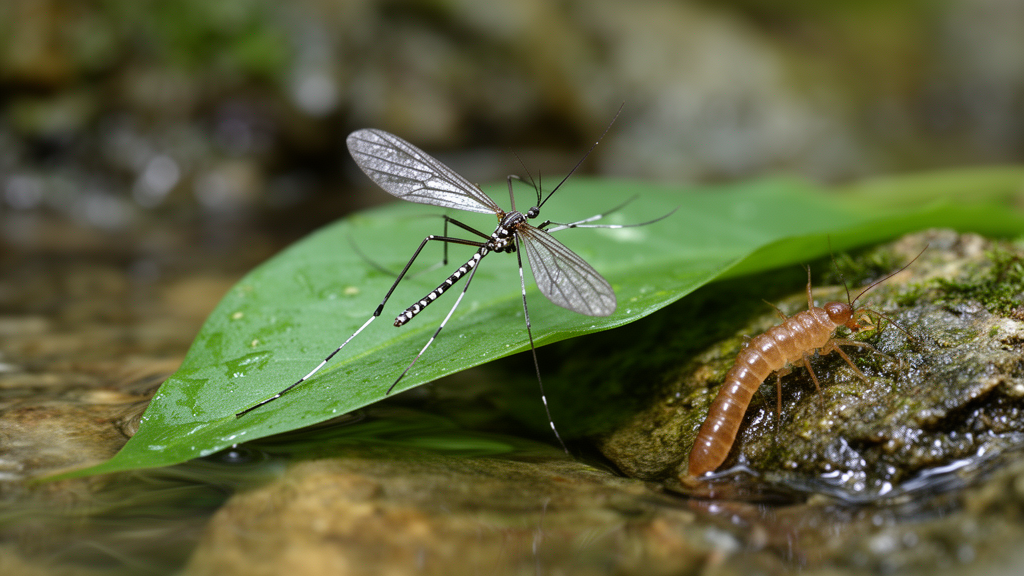
Deep in the mountain forests of South Korea, a slender, yellow-winged crane fly has been hiding in plain sight for decades. A new study published in the journal ZooKeys describes Nipponomyia kalbongsanica, a species new to science and the first representative of its genus ever recorded on the Korean Peninsula. More remarkably, the same paper delivers the first formal description of the larval stage of any Nipponomyia species, closing a century-old gap in knowledge about a genus named and defined back in 1924 by the prolific American dipterist Charles Paul Alexander.
Nipponomyia is a small and enigmatic genus of crane flies in the family Pediciidae, currently comprising just 17 described species. Its range is tightly restricted to the East Palaearctic and Oriental regions: Japan hosts the greatest diversity with four species, one has been described from China, two are known from the Russian Far East, and the remaining eleven occur in the Oriental tropics, from Nepal and northeastern India to Sumatra and Borneo. Until now, no specimen had ever been documented from the Korean Peninsula, making the discovery both a range extension and a genuine biodiversity surprise.
The adults of the genus are distinctive insects. They are medium-sized crane flies with bodies measuring roughly 10 to 16 millimeters and wings of 8.5 to 13.5 millimeters, generally yellow in color and often marked with black. Their compound eyes are essentially bare, a notable trait because hairy eyes are otherwise a diagnostic feature of Pediciidae as a whole. Their wings carry a conspicuous yellow longitudinal stripe along the anterior margin, bordered by dark brown shading and spots, and the male genitalia bear a gonostylus armed with two to fourteen black, chitinised spines. A recent revision of the Japanese species grouped them into two morphological species groups: the N. kuwanai group, whose members carry black transverse dashes in the costal cell of the wing, and the N. trispinosa group, which lacks those dashes.
The larval side of the family has been far less explored. Of the ten genera known in Pediciidae, larvae have been described for only six: Dicranota, Heterangaeus, Nasiternella, Pedicia, Tricyphona and Ula. Like other members of the superfamily Tipuloidea, pediciid larvae are hemicephalic and metapneustic, meaning they possess a slightly reduced head capsule and breathe through spiracles at the rear of the body. Larvae in the subfamily Pediciinae bear two spiracular lobes, while those in the subfamily Ulinae bear five. With the exception of the fungus-feeding genus Ula, pediciid larvae are predators, and most develop in aquatic habitats or wet soil near water. No preimaginal stage of Nipponomyia had ever been seen or described, leaving the genus’s early life history a complete blank.
The breakthrough came through years of patient fieldwork. Beginning in 2012, researchers collaborating with the National Institute of Biological Resources in Incheon launched an intensive survey of Korean crane flies, collecting annually from early spring to late autumn across the country and amassing tens of thousands of specimens. Intriguingly, only entomological nets proved effective for capturing Nipponomyia adults; not a single specimen turned up in the Malaise traps or light traps that also deployed during the surveys. In total, 46 adult specimens were secured from Korea, alongside a single last-instar larva collected in 2019 from mud accumulated on stones beneath leaf litter in a mountain stream in Gyeongsangnam-do province.
Linking that soft-bodied, whitish larva to the correct adult species posed exactly the kind of problem that DNA barcoding was invented to solve. The researchers extracted genomic DNA from an adult leg and from the larval abdominal segments, amplified a 658-base-pair region of the mitochondrial cytochrome c oxidase subunit I gene using the classic Folmer primers, and sequenced the products. The resulting maximum likelihood phylogenetic tree, built in MEGA 12 with a GTR+I+G model of evolution and 1000 bootstrap replicates, placed the adult male and the larva in a single cluster with strong support, and the Kimura 2-parameter genetic distance between the two sequences was a mere 0.0163, far below the distances separating recognized Nipponomyia species, which ranged from roughly 0.12 to 0.18 in the same analysis.
The larva itself proved to be a textbook Pediciinae, with telling differences. Measuring 15.8 millimeters long and 2.6 millimeters wide, it is covered in very short white pubescence that gives the body a whitish hue, a feature that immediately distinguishes it from Heterangaeus. Its head capsule, 1.3 millimeters long and 0.47 millimeters wide, is well sclerotised, dorsally depressed, narrow and elongate, with curved dorsal sutures directed outward, unlike the short straight sutures of most relatives. The large sickle-shaped mandible carries three dorsal and four ventral teeth, the hypostoma consists of two plates of three teeth each joined without a push-button articulation, and the terminal segment bears two conical spiracular lobes nearly three times as long as their basal width. Four long, segmented, fleshy anal papillae surround the anus, and inconspicuous ventral creeping welts run along abdominal segments four through seven.
Ecologically, the larva fits a familiar pattern. It was found in mud accumulated on stones beneath leaf litter in a stream, the same microhabitat reported for larvae of Heterangaeus and Tricyphona. Adults of the new species fly close to small, fast-running springs and mountain streams flowing over rocks coated with mosses or algae, surrounded by mixed forests or pine groves, and have been observed from late April through the end of August at elevations between roughly 100 and 600 meters. The species is named after its type locality, the Kalbongsan Natural Recreational Forest in Gyeonggi-do, where the holotype male was collected in June 2025, though some of the oldest specimens in the type series date back to 1954, collected by George W. Byers near Seoul and held in the Snow Entomological Museum at the University of Kansas.
Here, however, the story takes an unexpected twist that illustrates why modern taxonomy increasingly refuses to rely on morphology alone. Based on adult features, Nipponomyia kalbongsanica clearly belongs to the N. trispinosa species group: it lacks the transverse costal-cell dashes of the kuwanai group and matches that group’s shorter last palpomere, prominent ventrobasal gonocoxite lobe and acute aedeagus. Yet in the molecular tree, the new species clusters closer to members of the N. kuwanai group. This incongruence between morphological classification and mitochondrial relationships within the genus suggests that wing patterns and genital structures, long the backbone of crane fly taxonomy, may not perfectly track evolutionary history in Nipponomyia, and it flags the genus as a promising system for studying how such mismatches arise.
The genetic data raised one further puzzle. The two available COI sequences of the Japanese species N. trispinosa, from a male and a female, differ from each other by an amount comparable to the interspecific distances measured among other Nipponomyia species, hinting that what is currently treated as one widespread species may in fact conceal hidden diversity awaiting formal recognition. Combined with the new species description, the first larval diagnosis, and detailed ecological notes, the study expands knowledge of Pediciidae on several fronts at once and underscores a broader lesson for biodiversity science: in poorly surveyed regions and little-studied lineages, integrating careful morphology with molecular tools is often the only reliable way to connect the life stages of a species, and sometimes the only way to notice that a species exists at all.
Subject of Research: First larval description and a new species of the crane fly genus Nipponomyia from South Korea
Article Title: First larval description of Nipponomyia Alexander ( Diptera , Pediciidae ) with a new species from South Korea
Article References: Podenas, S., Podeniene, V., & Havelka, J. (2026). First larval description of Nipponomyia Alexander (Diptera, Pediciidae) with a new species from South Korea. ZooKeys, 1293, 95-119. https://doi.org/10.3897/zookeys.1293.201884
Image Credits: AI Generated
DOI: 10.3897/zookeys.1293.201884
Keywords: Nipponomyia, Pediciidae, crane flies, new species, larval morphology, DNA barcoding, COI, South Korea, taxonomy, phylogenetics, mountain streams, Diptera
Cite Scienmag News
Gavin Prescott. (October 17, 2026). Crane fly with unknown youth: DNA barcodes reveal first larva of Nipponomyia and a new Korean species. Scienmag. https://scienmag.com/crane-fly-with-unknown-youth-dna-barcodes-reveal-first-larva-of-nipponomyia-and-a-new-korean-species/
Gavin Prescott. "Crane fly with unknown youth: DNA barcodes reveal first larva of Nipponomyia and a new Korean species." Scienmag, 17 October 2026, https://scienmag.com/crane-fly-with-unknown-youth-dna-barcodes-reveal-first-larva-of-nipponomyia-and-a-new-korean-species/. Accessed 17 October 2026.
Gavin Prescott. "Crane fly with unknown youth: DNA barcodes reveal first larva of Nipponomyia and a new Korean species." Scienmag. October 17, 2026. https://scienmag.com/crane-fly-with-unknown-youth-dna-barcodes-reveal-first-larva-of-nipponomyia-and-a-new-korean-species/


