


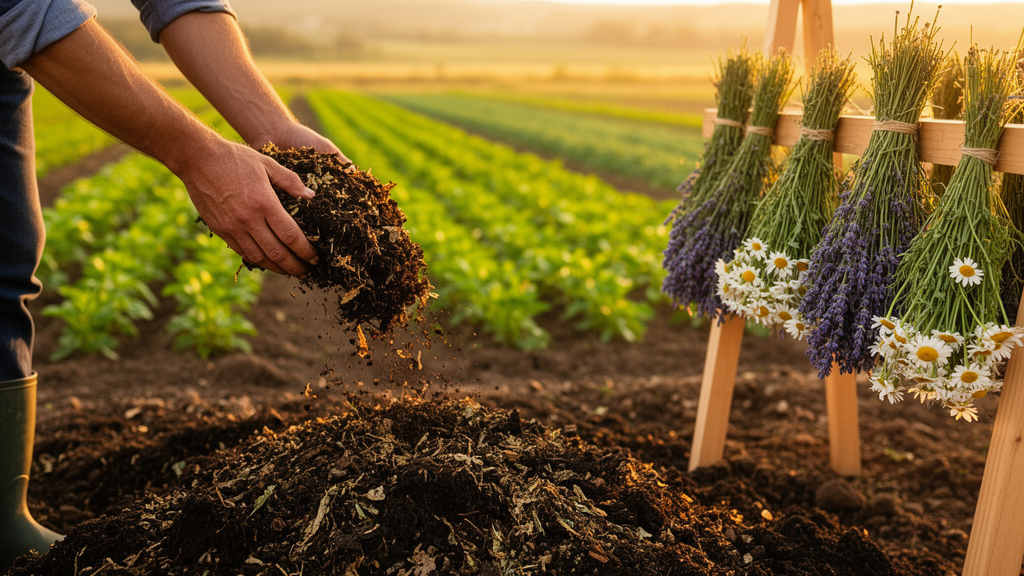
Every year, the global production chain for medicinal and aromatic plants generates staggering quantities of waste biomass that most people never think about. When lavender, mint, rosemary, and dozens of other species are distilled to extract their precious essential oils, only 0.5 to 8 percent of the plant’s dry matter actually ends up in the bottle. The remaining 92 to 99.5 percent becomes a massive pile of solid residue that is typically dumped in landfills, burned, or left to rot in fields. In China alone, the annual production of Chinese Medicinal Herbal Residue is estimated at 60 to 70 million tons. Now, a comprehensive review published in Discover Soil by Francesco Berruto of the University of Turin and colleagues suggests that this overlooked waste stream could become one of the most promising tools in sustainable agriculture, capable of improving soil health, boosting crop growth, suppressing weeds, and even fighting plant pathogens.
The research team systematically examined the scientific literature on the reuse and soil application of medicinal and aromatic plant residues, using the Web of Science database to capture studies reporting both the types of residues applied to soil and the resulting soil-related effects. After screening out studies that dealt with cultivation practices or with essential oils as main products rather than by-products, 39 studies were ultimately selected for detailed analysis. The review reveals a striking pattern: virtually no research existed on this topic before 2004, but interest has surged dramatically over the last five years, reflecting a broader shift toward circular economy thinking and waste valorisation across the agricultural sciences.
The bibliometric analysis showed that the People’s Republic of China contributed the largest number of publications on this topic, which aligns with the country’s well-established history of cultivating and utilizing medicinal and aromatic plants both in traditional medicine and modern applications. Considerable research interest was also evident in Mediterranean countries, a region characterized by high biodiversity of these plants and a long-standing tradition of using them for medicinal, culinary, and aromatic purposes. The review found that the plant families Asteraceae, Fabaceae, and Lamiaceae have received the greatest scientific attention, with European studies focusing mainly on Lamiaceae species while Asian investigations cover a wider range of families. Genera Mentha and Salvia attract high research interest worldwide.
The review identified four main categories of medicinal and aromatic plant waste used as soil amendments: fresh biomass, biochar, compost, and solid distillation residues. Each category carries distinct technical characteristics and produces different effects on soil properties and plant performance. The fresh biomass category involves incorporating aerial plant parts still rich in essential oils directly into soil, while biochar is produced through thermochemical conversion processes such as pyrolysis, gasification, and hydrothermal carbonization. Composting relies on microbial decomposition of organic waste into a stabilized material, and solid distillation residues are the lignocellulosic by-products left after essential oil extraction.
The effects of fresh biomass incorporation are particularly fascinating from a technical standpoint. Studies on spearmint, peppermint, Greek sage, and oregano showed that incorporating whole aboveground biomass into soil at rates of 2, 4, and 8 percent by weight produced measurable improvements in soil carbon-to-nitrogen ratio, boosted shoot length and plant dry weight in tomato seedlings, enhanced photosynthetic yield and chlorophyll content, and contained infections by Fusarium and Verticillium species. Spearmint application provided the best effects, especially at 4 percent by weight. However, rosemary exhibited negative impacts on plant growth, likely induced by compounds present in its essential oil, suggesting that microbe-mediated transformation of essential oil compounds appears necessary to achieve positive outcomes.
Perhaps the most commercially significant finding involves the exploitation of allelopathic metabolites, substances that influence the growth and development of neighbouring organisms and could help reduce reliance on synthetic herbicides. Apple mint residues showed adverse effects on germination and growth of dicotyledonous weed species such as Amaranthus retroflexus and Solanum nigrum, achieving nearly 100 percent inhibition rates, while also reducing monocotyledonous weeds like Digitaria sanguinalis by more than 95 percent and simultaneously increasing maize yield. Powdered leaf residues of Peganum harmala displayed potent herbicidal activity on seedling growth of Avena fatua and Convolvulus arvensis, alongside increases in soil electrical conductivity and available nitrogen, phosphorus, potassium, manganese, and copper content.
Pathogen suppression represents another critical dimension of this research. A pot experiment using dry biomass of Datura metel demonstrated that doses of soil amendment superior to 2 percent by weight completely controlled Southern blight of bell pepper caused by Sclerotium rolfsii. A mixed powder of Astragalus mongholicus roots, Epimedium acuminatum leaves, Atractylodes macrocephala rhizome, Cinnamomum verum bark, and Cnidium monnieri fruits reduced the disease index of ginseng root rot by 54.5 percent. Combined application of Xanthium strumarium biomass with two biofertilizers was found effective in increasing potato tuber yield and managing black scurf disease by increasing the activity of defence-related enzymes.
The composting pathway has received enormous attention, particularly regarding Chinese Medicinal Herbal Residue, the solid by-product generated after extraction of active pharmaceutical ingredients from medicinal plant materials. Key components of this herbal waste include carbohydrates, proteins, cellulose, polysaccharides, lignin, and nutrients essential for plant growth such as nitrogen, phosphorus, and potassium. Application of Chinese Medicinal Herbal Residue compost significantly increased cation exchange capacity, soil organic matter, total nitrogen, available potassium and phosphorus, and carbon-to-nitrogen and nitrogen-to-phosphorus ratios, indicating an overall improvement in soil fertility parameters. In trials with Chinese cabbage, maize, and tomato, plant growth parameters such as seedling height, stem diameter, root length, and aboveground and belowground biomass were positively affected, with 5 percent application rate increasing plant biomass production by 56 percent in tomato and 34 percent in cabbage.
Biochar derived from medicinal and aromatic plant distillation waste has also shown remarkable potential. Studies on biochar from Mentha arvensis distillation waste demonstrated that cation exchange capacity, pH, soil organic carbon, and nutrient availability increased with higher biochar application rates, while soil biological properties such as microbial biomass carbon and dehydrogenase activity improved in soil amended with both biochar and mint distillation waste. Researchers enriched biochar made from lemongrass distillation biomass with rock phosphate and waste mica minerals, significantly improving surface properties and nutrient content and showing positive impacts on Cassia angustifolia growth that were even more effective than conventional fertilizers in a highly weathered soil.
The review concludes that medicinal and aromatic plant residual biomasses represent valuable soil amendments contributing to sustainable waste management and circular economy principles in the industry. However, the authors caution that further research is required to find a proper balance between herbicide and biostimulant effects and to optimize the use of these residues in soil, especially at field scale. Most experiments reported in the review were mainly conducted in pots, and future studies need to be carried out at field scale, assessing long-term effects on soil ecosystems and evaluating safety and efficacy across diverse cropping systems. The risk of accumulating contaminants from immature compost and causing soil salinization should also be taken into account, alongside the need to evaluate economic sustainability and develop practical guidelines for farmers to facilitate widespread adoption of these promising soil management practices.
Subject of Research: Agricultural Science
Article Title: Valorisation of medicinal and aromatic plant residues for soil amendment purposes
Article References: Berruto, F., Nebbia, M., Ghignone, S., Lumini, E., Scariot, V., & Bianciotto, V. (2026). Valorisation of medicinal and aromatic plant residues for soil amendment purposes. Discover Soil, 3(1), Article 188. https://doi.org/10.1007/s44378-026-00348-0
Image Credits: AI Generated
DOI: 10.1007/s44378-026-00348-0
Keywords: medicinal plants, aromatic plants, soil amendments, circular economy, biochar, compost, allelopathy, sustainable agriculture, waste valorisation, plant pathogens, Valorisation, medicinal
Cite Scienmag News
Alan Morgan. (October 17, 2026). From Perfume Waste to Fertile Soil: How Medicinal Plant Residues Could Transform Farming. Scienmag. https://scienmag.com/from-perfume-waste-to-fertile-soil-how-medicinal-plant-residues-could-transform-farming/
Alan Morgan. "From Perfume Waste to Fertile Soil: How Medicinal Plant Residues Could Transform Farming." Scienmag, 17 October 2026, https://scienmag.com/from-perfume-waste-to-fertile-soil-how-medicinal-plant-residues-could-transform-farming/. Accessed 17 October 2026.
Alan Morgan. "From Perfume Waste to Fertile Soil: How Medicinal Plant Residues Could Transform Farming." Scienmag. October 17, 2026. https://scienmag.com/from-perfume-waste-to-fertile-soil-how-medicinal-plant-residues-could-transform-farming/


