


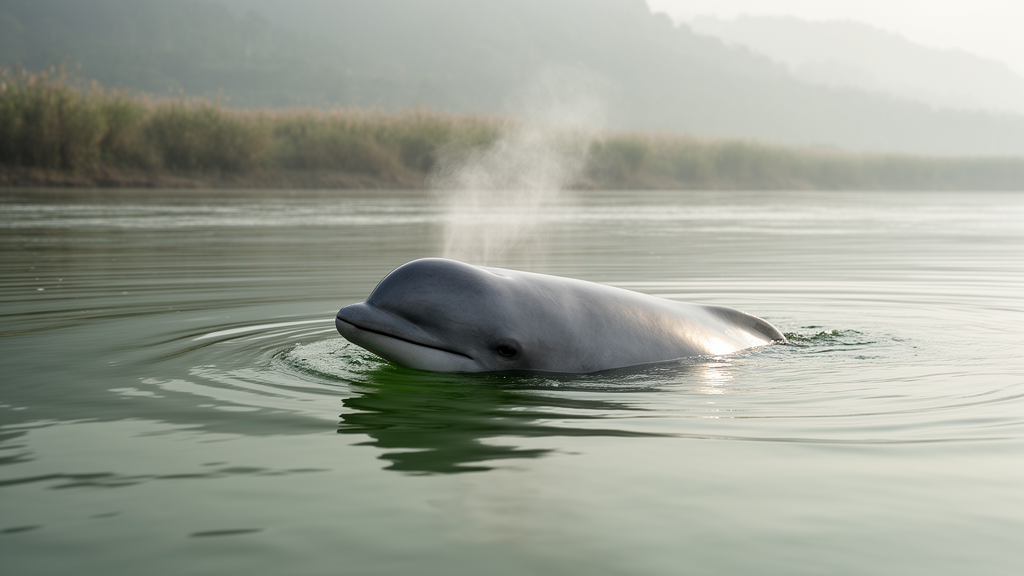
The Yangtze finless porpoise, the only cetacean that lives its entire life in a freshwater river, should be formally recognised as an independent species rather than a subspecies, according to a comprehensive review published in Nature Conservation. The synthesis draws on more than five decades of morphological, anatomical, physiological, genetic and genomic research to argue that the critically endangered porpoise is reproductively isolated from its marine relatives and represents an irreplaceable evolutionary lineage. With only about 1,426 individuals remaining in the Yangtze River, the authors contend that full species status is not a matter of academic tidiness but a prerequisite for the strongest legal and financial protections available.
Finless porpoises of the genus Neophocaena have puzzled taxonomists since the first skull was collected in India in 1829. For much of the twentieth century, porpoises across the Indo-Pacific were lumped into a single species, Neophocaena phocaenoides, subdivided into three subspecies. A three-species arrangement was proposed in the 1970s but never gained wide acceptance. In the past two decades, integrative analyses combining morphology and genetics settled on a two-species framework: the Indo-Pacific finless porpoise and the narrow-ridged finless porpoise, with the Yangtze population treated as a subspecies of the latter. The new review systematically synthesises studies from those foundational taxonomic revisions through to the most recent population genomic analyses, and concludes that the evidence now favours a three-species classification in which the Yangtze finless porpoise stands alone.
The geographic distribution of the genus already hints at deep separation. The Indo-Pacific finless porpoise occupies shallow coastal waters of the Indian Ocean, the South China Sea and the East China Sea, while the East Asian finless porpoise inhabits the Yellow Sea, Bohai Sea and coastal waters off Korea and Japan, with an overlap zone in the Taiwan Strait. The Yangtze finless porpoise, by contrast, is the sole obligate freshwater lineage in the genus, confined to roughly 1,800 kilometres of the middle and lower Yangtze River and its interconnected Poyang and Dongting Lake systems. This spatially restricted, ecologically specialised range underscores the distinctiveness of a lineage now regarded as a critically endangered evolutionarily significant unit.
Visible and skeletal differences reinforce the split. Adult East Asian finless porpoises are the largest of the three taxa, reaching about 2.00 metres and a maximum of 2.27 metres, whereas the Yangtze and Indo-Pacific porpoises measure roughly 1.70 metres. Finless porpoises lack a dorsal fin, carrying instead a dorsal ridge and a tuberculated area whose dimensions vary dramatically: the Indo-Pacific porpoise has a broad ridge with a tubercle area 48 to 120 millimetres wide and more than 10 rows of tubercles, while the Yangtze porpoise shows the most reduced condition, with a width of only 2 to 8 millimetres and 1 to 5 rows. Skull metrics tell a similar story. The Indo-Pacific porpoise has a short, broad rostrum, the East Asian porpoise a narrow, slender one, and the Yangtze porpoise an intermediate form with reduced tooth counts, elongated temporal fossae and widened occipital condyles. Discriminant analyses can reliably separate the Yangtze porpoise from its closest marine relative using braincase length, premaxillary width, orbital width and temporal fossa length.
Internal anatomy reveals adaptations to life in fresh water. The Yangtze porpoise has smaller kidney structures across several indices, including relative medullary thickness and area, and correspondingly weaker urine concentrating capacity than its marine counterpart, consistent with the challenge of excreting excess water in a hypotonic environment. Its visual system is also remodeled: shorter distances from eye centre to snout tip, reduced eye slit height, a smaller lens and fewer optic and eye muscle nerves, adaptations to the turbid, dim waters of the Yangtze. Recent ultrastructural studies of the epidermis add another layer, showing that the freshwater porpoise has a lipid-rich outermost skin layer with fewer cell layers and enlarged neutral lipid droplets that curb passive water influx, while the marine porpoise relies on densely packed keratin filaments and reinforced desmosomes to prevent water loss in salt water.
Life history traits diverge as well. Populations in the South China Sea mature earliest, with males breeding at about three years and females at four, and live up to 21 years. Yellow Sea porpoises mature around four years and can reach 24 years. The Yangtze porpoise shows the most protracted development, maturing at roughly five years with a maximum longevity of only 17 years, parameters that are critical for modelling the viability of a population hovering near extinction.
Molecular markers have documented significant genetic structure for decades. Analyses of the mitochondrial DNA control region, microsatellites, nuclear SNPs, MHC genes and AFLP fingerprints revealed very strong overall population structure in Sino-Japanese waters, with fixation indices as high as 0.61. Even where distributions overlap, gene flow between populations is very limited or absent. Crucially, the Yangtze porpoise shares no haplotypes with any marine population, a signature of long-standing reproductive isolation.
Population genomics has delivered the strongest evidence yet. In a landmark study, researchers sequenced one Yangtze porpoise de novo and re-sequenced 48 finless porpoises from Chinese waters, identifying more than 13 million high-confidence SNPs. Phylogenetic reconstruction resolved the Yangtze porpoise as a distinct clade, and population structure analyses, principal component analysis, linkage disequilibrium decay and demographic modelling all confirmed stable divergence. Bayesian species delimitation statistically favoured the three-species model. The wide-ridged and narrow-ridged lineages split about 100,000 years ago, while the Yangtze porpoise diverged from its marine narrow-ridged relatives between 5,000 and 40,000 years ago, a timing consistent with sea-level fluctuations during the Last Glacial Period that likely isolated the freshwater population. Most notably, the Yangtze porpoise carries significant positive selection signals in genes governing osmoregulation and the renin-angiotensin system, including ADCY1, DYNC2H1, SLC14A2 and ACE2, matching the earlier kidney morphology findings. Telomere-to-telomere gap-free genome assemblies confirmed substantial genomic divergence, with positively selected genes in the Yangtze porpoise linked to DNA damage repair and those in the East Asian porpoise tied to high-salinity tolerance.
The taxonomic stakes are profound. Species are the fundamental unit of biodiversity law, and in China elevation to full species status enables listing under the Wildlife Protection Law and the National List of Key Protected Wild Animals, unlocking legally mandated habitat preservation, captive breeding programmes and enforceable prohibitions on disturbance. Internationally, CITES regulates trade species by species and IUCN Red List assessments of independent species carry far greater weight in mobilising global action. The porpoise is already acknowledged as a species in China, where it has become a genuine flagship: the country established a dedicated Yangtze Finless Porpoise Conservation Day in 2019, the first for any single wildlife species, and a new ten-year action plan jointly issued by eight ministries designates it a flagship and umbrella species. Known popularly as the aquatic giant panda and the smiling angel, the porpoise is the sole surviving apex predator in the Yangtze, and its recovery from 1,012 individuals in 2017 to 1,426 in 2025, an increase of more than 40 percent, has become a headline indicator of the river’s health under the Yangtze River Protection Law and the ten-year fishing ban. A mature conservation infrastructure now integrates eight in-situ reserves, four naturalised ex-situ populations with over 150 managed individuals, and successful captive breeding including second-generation offspring, practices formally proposed as a global framework for endangered small cetaceans.
The authors close with a warning drawn from history. The extinction of the baiji, the Yangtze River dolphin, showed that conservation operates within a closing window: once a population collapses, the chance for recovery may vanish entirely. Recognising the Yangtze finless porpoise as a full species would affirm millions of years of unique freshwater evolution and trigger the most robust protections available, ensuring that the porpoise does not follow the baiji’s trajectory. Its umbrella effect means that measures taken on its behalf simultaneously promote the restoration of the entire riverine environment, making its formal recognition a decisive test of whether science-driven taxonomy can still outrun decline.
Subject of Research: Taxonomic review of the Yangtze finless porpoise's species status based on multidisciplinary evidence
Article Title: Evolutionary differentiation and adaptive divergence support the Yangtze finless porpoise as an independent species, a flagship of conservation value: A review
Article References: Lu, Y., Zhou, K., & Yang, G. (2026). Evolutionary differentiation and adaptive divergence support the Yangtze finless porpoise as an independent species, a flagship of conservation value: A review. Nature Conservation, 64, 77-92. https://doi.org/10.3897/natureconservation.64.193600
Image Credits: AI Generated
DOI: 10.3897/natureconservation.64.193600
Keywords: Yangtze finless porpoise, Neophocaena asiaeorientalis, species delimitation, taxonomy, population genomics, osmoregulation, adaptive evolution, freshwater cetacean, conservation policy, critically endangered, Yangtze River, flagship species
Cite Scienmag News
Margaret Porter. (October 17, 2026). Yangtze Finless Porpoise Deserves Full Species Status, Review Finds. Scienmag. https://scienmag.com/yangtze-finless-porpoise-deserves-full-species-status-review-finds/
Margaret Porter. "Yangtze Finless Porpoise Deserves Full Species Status, Review Finds." Scienmag, 17 October 2026, https://scienmag.com/yangtze-finless-porpoise-deserves-full-species-status-review-finds/. Accessed 17 October 2026.
Margaret Porter. "Yangtze Finless Porpoise Deserves Full Species Status, Review Finds." Scienmag. October 17, 2026. https://scienmag.com/yangtze-finless-porpoise-deserves-full-species-status-review-finds/


