
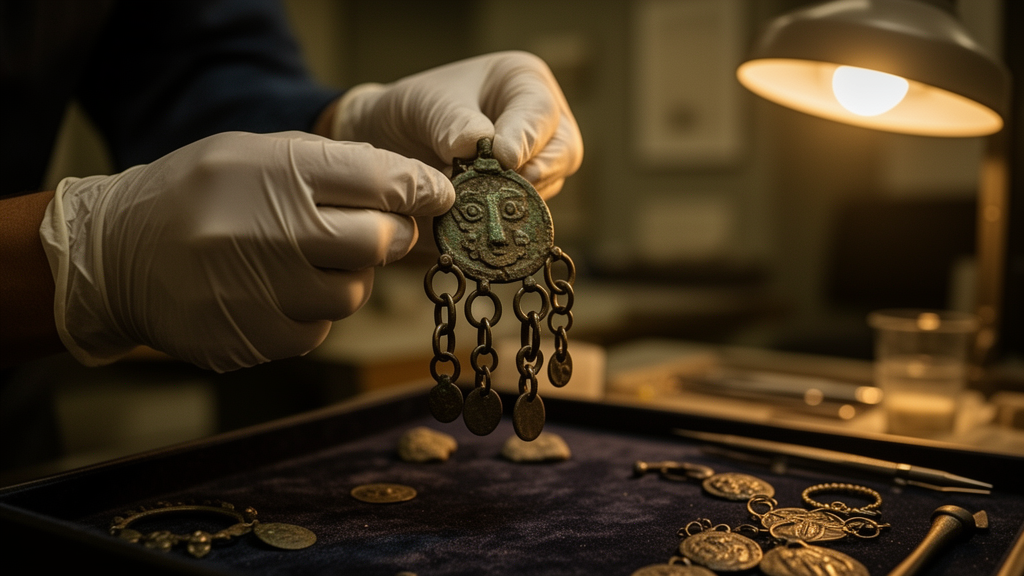
More than 2,500 years ago, the women buried in the Iron Age cemetery above the salt mines of Hallstatt, Austria, wore jewelry that announced their presence before anyone saw them. A new study published in the Annals of the Natural History Museum Vienna has subjected 19 ringing costume ornaments from the Hallstatt graveyard to detailed acoustic and psychoacoustic analysis, revealing for the first time how these objects actually sounded and what their noise may have communicated in the society of the early first millennium BCE. The work, carried out within the research project Metallic Idiophones between 800 BCE and 800 CE in Central Europe, funded by the Austrian Science Fund FWF, also stands as a memorial to Anton Kern, who led the Prehistoric Department of the Natural History Museum Vienna from 2001 to 2022 and resumed the excavation of the Hallstatt cemetery in 1992.
The objects examined include five crescent-shaped brooches fitted with chains and clanging plates, seven ring pendants made of interlinked rings, a unique double-shelled ornamental disc from grave 778 with paired anthropomorphic clapper plates, a lantern-shaped pendant from grave 733, a belt chain from grave 669 belonging to a belt of the Schrotzhofen type, a slitted crotal from a horse bridle in grave 196, a slitted poppy-shaped pendant, an ornamental phalera from grave 750, and a broad-rimmed bronze bowl from grave 496 that originally carried four clapper plates and a clapper ring on its rim. All were cast in copper alloys using the lost-wax method or hammered by hand, and all were recovered from women’s graves in the Hochtal cemetery. Three additional pieces from the museum’s collection, a ring pendant and two neck rings with clapper elements, originate from the Central Balkans and date to the transition from the Late Bronze Age to the earliest Iron Age.
Although these are costume ornaments rather than musical instruments, the researchers classified them using the Hornbostel-Sachs systematik of 1914 and its later revisions. Every object proved to be an idiophone, a self-sounding instrument in which the material itself, thanks to its stiffness and elasticity, produces the tone without membranes or strings. The brooches with chains and clapper plates belong to the frame rattles and pendulum rattles, while the crotal is a vessel rattle in which a loose rattling body, in this case a small white quartz pebble, strikes the vessel wall. The ornamental disc with its paired plates striking against each other also counts among the concussive idiophones, comparable to small cymbals. The classification, the study notes, remains cumbersome for archaeological sound objects and urgently requires a systematik adapted to the needs of archaeology.
To measure the sounds, the team recorded all 21 jewelry idiophones in a purpose-built sound-damped chamber while shaking them continuously. Three-second excerpts were filtered with a 500 Hz high-pass filter to remove low-frequency noise and then analyzed with professional software to extract acoustic and psychoacoustic parameters. These included the sound pressure level, the peak frequency, the spectral centroid as a measure of brightness, sharpness, roughness, tonality expressed as the tone-noise-ratio, and impulsiveness. Psychoacoustic parameters capture the subjective perception of the sounds by human listeners, expressed for example in units of loudness such as sone and phon.
The results divide the corpus into two acoustically distinct groups. The ten objects whose sound is generated by clashing plates, thin metal sheets on brooches, pendants and the belt chain, produce on average quiet and noise-dominated sounds with weakly pronounced partial tones. The nine objects with interlinked rings, the ring pendants and neck rings, are on average far heavier, weighing up to 378 grams per group average against 118 grams for the plate group, and produce louder sounds averaging 76.4 dB SPL and 25.7 sone, with clearly pronounced partial tones that make them sound more tonal. The plate objects average 62.2 dB SPL and 11.5 sone. The heaviest neck ring, a torc from Sinošević in Serbia with T-shaped terminals, hollow poppy-shaped elements and bird-head pendants, weighs a massive 1,503 grams and demands an upright posture to wear well, straining the cervical spine during prolonged use, as the author observed when donning the pieces herself.
Statistical analysis revealed strong correlations between loudness and tonality, between roughness and impulsiveness, and between brightness and peak frequency. Louder objects carry more tonal partials, objects with sharper impulses sound rougher, and objects with a high peak frequency are perceived as brighter. Only a weak correlation emerged between weight and sound pressure level, since the corpus mixes very different types of sound ornaments. A comparison between the Iron Age crotal from grave 196 and a Roman bell found in grave 765, which is clearly of Roman origin and probably lost by grazing cattle in the Hochtal centuries after the cemetery fell out of use, shows dramatic differences. The bell is subjectively about eight times louder, at 83.6 dB SPL and 62.1 sone against 64.8 dB SPL and 8.1 sone, and rings with a spectral centroid of 3.8 kHz, far darker than the crotal’s 10.6 kHz, with partial tones that sustain for several hundred milliseconds after a single strike.
The study argues that these ornaments were worn on festive occasions rather than during hard daily labor, comparable to a Sunday best, although visible wear traces on many objects suggest everyday use was also possible. Because the clapper elements strike against each other with every movement, the jewelry functioned as a rattle that announced the approach and presence of the wearer. The communicative and symbolic messages encoded in prehistoric dress were thus perceived not only visually but also acoustically. Ring pendants, known exclusively from women’s graves in Upper Austria, Salzburg and southern Bavaria, served as breast ornaments and may have symbolized wagon journeys, themselves markers of elite status in an age when wheeled transport was largely reserved for the upper strata of society.
The symbolism runs deeper still. Crotals and poppy-shaped pendants, found in the Hallstatt culture only in women’s graves, imitate capsule fruits such as opium poppy heads and pomegranates, both ancient emblems of fertility, prosperity and eternal life owing to their vast numbers of seeds. Rings embody the cycle of life, infinity, eternity and a particular kind of power, invested with magical, apotropaic and healing forces that transform them into psychological instruments of rule by divine legitimation. Anthropomorphic clapper plates may represent protective spirits and guardian figures, while the cymbal pairs on the magnificent brooch from grave 505, decorated with 18 pairs of point-bossed cymbals, may depict sun discs, the giver of life, a motif that appears in combination with water birds, interpreted by Georg Kossack as magical signs of salvation, throughout the religious imagery of the Hallstatt culture.
The psychological dimension of adornment completes the picture. As Georg Simmel observed, one adorns oneself for oneself, and can only do so by adorning oneself for others. Wearing jewelry strengthens the self-confidence of the wearer, and pieces with symbolic content may amplify this effect. The ringing costume ornaments of Hallstatt, the study concludes, served the self-enhancement of their wearers through ornament, color, sound and symbolism alike. All 19 objects from the Hallstatt graveyard were recovered from women’s graves, all testify to high craftsmanship, and all remind us that the soundscape of the Iron Age was not confined to instruments and rituals but resonated from the very bodies of its people. The sound recordings of the individual objects are available for listening in the repository of the Natural History Museum Vienna.
Subject of Research: Archaeology
Article Title: Klingender Trachtschmuck aus dem eisenzeitlichen Gräberfeld Hallstatt: Analysen und Diskussion zu Funden aus dem Bestand der Prähistorischen Abteilung, NHM Wien. In Memoriam Anton Kern, HR, Dr. (1957–2023) Abteilungsleiter i. R. der PA
Article References: Pomberger, B. M., Mühlhans, J., & Grömer, K. (2025). Klingender Trachtschmuck aus dem eisenzeitlichen Gräberfeld Hallstatt: Analysen und Diskussion zu Funden aus dem Bestand der Prähistorischen Abteilung, NHM Wien. In Memoriam Anton Kern, HR, Dr. (1957–2023) Abteilungsleiter i. R. der PA. Annals of the Natural History Museum Vienna, 126, 41-64. https://doi.org/10.3897/anhmw.169220
Image Credits: AI Generated
DOI: 10.3897/anhmw.169220
Keywords: Hallstatt, Iron Age, archaeology, acoustics, psychoacoustics, idiophones, jewelry, Natural History Museum Vienna, bronze, symbolism, Klingender, Trachtschmuck
Cite Scienmag News
Carl Richardson. (October 17, 2026). Ancient Hallstatt Grave Jewelry Was Built to Be Heard, New Acoustic Analysis Reveals. Scienmag. https://scienmag.com/ancient-hallstatt-grave-jewelry-was-built-to-be-heard-new-acoustic-analysis-reveals/
Carl Richardson. "Ancient Hallstatt Grave Jewelry Was Built to Be Heard, New Acoustic Analysis Reveals." Scienmag, 17 October 2026, https://scienmag.com/ancient-hallstatt-grave-jewelry-was-built-to-be-heard-new-acoustic-analysis-reveals/. Accessed 17 October 2026.
Carl Richardson. "Ancient Hallstatt Grave Jewelry Was Built to Be Heard, New Acoustic Analysis Reveals." Scienmag. October 17, 2026. https://scienmag.com/ancient-hallstatt-grave-jewelry-was-built-to-be-heard-new-acoustic-analysis-reveals/