


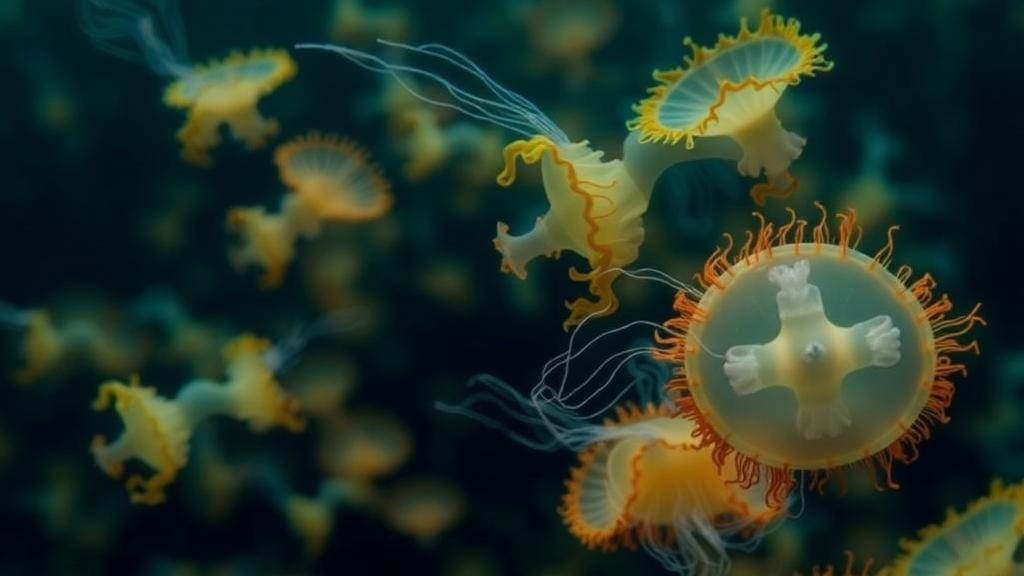
In the vast, warm waters of the South China Sea, a group of translucent, barrel-shaped animals has been quietly drifting through the plankton, largely invisible to science. Now, a two-cruise survey aboard the research vessel Shiyan 3 has delivered a result that has startled marine biologists: 28 species of thaliaceans, filter-feeding gelatinous zooplankton related to fish and, more distantly, to humans, recorded in a single study. That is the highest species richness ever documented for this group in the region, and it includes five species never before recorded in the South China Sea, along with an entire suborder appearing there for the first time.
Thaliaceans are strange animals even by the standards of the open ocean. The class contains three orders, Pyrosomatida, Salpida, and Doliolida, with 78 known valid species worldwide. Despite their jelly-like appearance, they are chordates, members of the same phylum as vertebrates. They feed by filtering seawater, and their ecological punch far exceeds their size. Their populations can explode into dense swarms that strip phytoplankton from the water, and they package the carbon they consume into fast-sinking fecal pellets and carcasses that transport it to the deep sea. In doing so, they influence the marine biological carbon pump, one of the planet’s key mechanisms for locking carbon away from the atmosphere.
Yet these animals are notoriously difficult to study. Their fragile, gelatinous bodies are easily shredded by plankton nets and disintegrate in preservation, making species-level identification a painstaking microscopic task. As a result, most research has focused on a handful of hardy species, while many doliolids, the most delicate of the three orders, remain almost unknown. The South China Sea, the largest subtropical marginal sea on Earth, exemplified this gap: the most detailed regional studies dated back more than a decade, and many recorded species lacked any distribution or environmental data at all.
To close that gap, researchers conducted two summer cruises in the western South China Sea, from late July to early August 2020 and from mid-August to early September 2022. At each station, they hauled a plankton net with an 80-centimeter mouth and a fine 330-micrometer mesh vertically from 200 meters depth, or from the seafloor where the water was shallower, at a towing speed of 0.8 meters per second. The catch was preserved in 5 percent formaldehyde, and thousands of specimens were sorted and identified under a stereo microscope, some stained with Rose Bengal to reveal their nearly transparent structures. In total, 4,090 individuals were identified.
The environmental backdrop was anything but uniform. In 2020, a low-salinity plume from the Mekong River spread across the southwestern sea while a warm eddy spun to the east, and the cooler Qiongdong Upwelling lifted nutrients along the western coast. Sea surface temperatures ranged from roughly 30 to 31.7 degrees Celsius, and chlorophyll concentrations varied tenfold between the upwelling zone and the eddy center. In 2022, sampling stations sat at the edge of another warm eddy. This hydrographic patchwork, the authors argue, creates a mosaic of niches that allows species with very different ecological preferences to coexist.
Among the 28 species recorded, five were new to the South China Sea, all doliolids: Dolioletta mirabilis, Dolioletta tritonis, Doliolina krohni, Doliolina sigmoides, and Doliolina indica. Some had been documented elsewhere only rarely. D. mirabilis and D. tritonis were both found at a single station in 2020, and both are so similar to the common Dolioletta gegenbauri that they have likely been misidentified for years; one is distinguished by a coiled testis near the stomach, the other by the precise attachment point of its branchial septum. D. krohni, by contrast, turned out to be widespread, appearing at nearly three-quarters of stations in 2020, a striking reversal given that its close relative D. muelleri had been reported repeatedly while krohni had never been recorded at all.
The most dramatic find was taxonomic, not just faunistic: specimens of the suborder Doliopsidina, never before reported from the South China Sea. This enigmatic group, first described in 1996, contains only three families, four genera, and five described species worldwide, all known from warm-temperate waters off Japan, the United States Pacific coast, the North Atlantic, the Mediterranean, and the Caribbean. Its members differ from the more familiar doliolids in having five slender muscle bands instead of eight. In the survey, Doliopsidina appeared at up to 54.55 percent of stations, an astonishingly high occurrence for a group that had gone entirely unnoticed. After staining, some specimens could be assigned to the genera Doliopsis and Paradoliopsis, but others hint at taxa that remain unresolved, and possibly undescribed.
Why is the South China Sea so rich in these animals? The study points to a convergence of factors. The sea sits at the heart of the Indo-Pacific biogeographic province and may function as a biological convergence zone where species from the tropical Indian Ocean, the western Pacific, and locally adapted lineages overlap. Doliolina indica, previously known mainly from the Indian Ocean, Arabian Sea, and Red Sea, fits this pattern neatly. Meanwhile, monsoon-driven currents, mesoscale eddies, fronts, and coastal upwelling generate pronounced environmental heterogeneity that supports species with divergent ecological niches. The authors also note a methodological contribution: earlier surveys used coarser 500-micrometer nets that let small doliolids slip through, while the finer 330-micrometer mesh retained them. But comparable mesh sizes elsewhere in the region have not produced similar richness, suggesting the diversity is real, not merely an artifact of better gear.
The abundance data reinforce the picture of a dynamic system. Total thaliacean abundance peaked at 9.63 individuals per cubic meter in 2020 at southwestern stations influenced by upwelling, and reached 17.22 individuals per cubic meter in 2022 along the warm eddy’s edge. The salp Thalia orientalis dominated both years, occurring at up to 100 percent of stations with mean abundances climbing from 0.83 to 2.68 individuals per cubic meter. Species richness itself ranged from 2 to 15 per station, with the highest values concentrated along the eddy boundary, a reminder that swirling oceanic structures can act as biodiversity hotspots in the open sea.
There are important caveats. Both cruises sampled only in summer, so the team cannot yet determine whether the exceptional diversity is a seasonal phenomenon or a lasting feature, and whether it reflects genuine shifts in species composition driven by climate change. The lack of long-term time series, multi-gear sampling, and standardized regional comparisons limits interpretation. Still, the message is provocative: at a time when biodiversity is declining globally under warming and acidification, a single well-designed survey revealed a gelatinous fauna far richer than anyone suspected. The authors call for long-term, cross-regional monitoring networks that integrate traditional net sampling with environmental DNA and in situ imaging, technologies better suited to animals that fall apart at a touch. If a routine plankton survey can rewrite the census of an entire class of chordates in one of the world’s most studied marginal seas, the true diversity of the ocean’s gelatinous life may be far greater than current estimates suggest.
Subject of Research: Thaliacean diversity and new species records in the South China Sea
Article Title: New species and suborder records reveal unusually high thaliacean ( Chordata , Tunicata ) diversity in the South China Sea
Article References: Lai, Y., Zheng, Z., Chen, M., & Tan, Y. (2026). New species and suborder records reveal unusually high thaliacean (Chordata, Tunicata) diversity in the South China Sea. ZooKeys, 1290, 147-170. https://doi.org/10.3897/zookeys.1290.188516
Image Credits: AI Generated
DOI: 10.3897/zookeys.1290.188516
Keywords: Thaliacea, tunicates, South China Sea, marine biodiversity, zooplankton, Doliolida, Doliopsidina, plankton survey, carbon cycle, gelatinous zooplankton, biogeography, new species records
Cite Scienmag News
Drew Townsend. (October 19, 2026). Hidden Swarm: South China Sea Survey Reveals Record 28 Gelatinous Tunicate Species. Scienmag. https://scienmag.com/hidden-swarm-south-china-sea-survey-reveals-record-28-gelatinous-tunicate-species/
Drew Townsend. "Hidden Swarm: South China Sea Survey Reveals Record 28 Gelatinous Tunicate Species." Scienmag, 19 October 2026, https://scienmag.com/hidden-swarm-south-china-sea-survey-reveals-record-28-gelatinous-tunicate-species/. Accessed 19 October 2026.
Drew Townsend. "Hidden Swarm: South China Sea Survey Reveals Record 28 Gelatinous Tunicate Species." Scienmag. October 19, 2026. https://scienmag.com/hidden-swarm-south-china-sea-survey-reveals-record-28-gelatinous-tunicate-species/


