


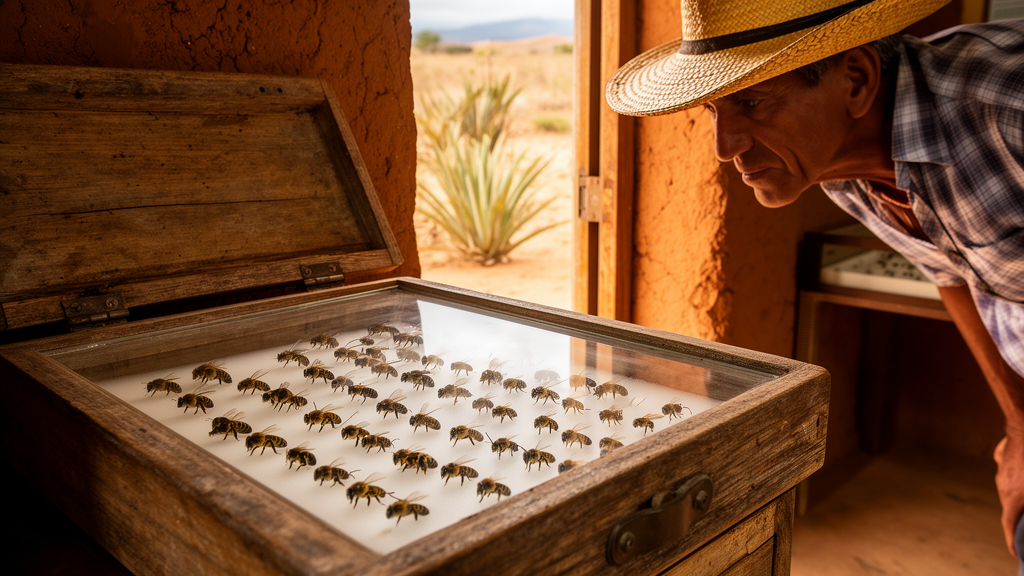
In one of Colombia’s most arid landscapes, where the tropical dry forest of the Magdalena River inter-Andean valley has been heavily transformed by erosion and habitat fragmentation, a small entomological exhibition has accomplished what many formal scientific publications cannot: it made local biodiversity visible, believable, and worth protecting. A new case study published in Natural History Collections and Museomics documents how a modest outreach project at the Tatacoa Natural History Museum in Villavieja, Huila, transformed an undergraduate research thesis on native bees into a viral science communication success, reaching national audiences and reshaping how a rural community understands its own environment.
The story began in 2018, when the study’s author conducted undergraduate fieldwork in the La Tatacoa Desert, a seasonally dry tropical forest ecosystem in the municipality of Villavieja. Over twelve months of sampling, the research analyzed how vegetation cover and seasonality shaped the diversity of native bees in this harsh environment. The results were striking: approximately 82 bee species were identified, with clear seasonal patterns and shifts in species composition between dry and rainy seasons and across different vegetation types. When combined with earlier inventory work that had documented new country records and even species new to science, the regional tally rose to 110 native bee species, roughly one fifth of all bee species known from Colombia.
That number surprised nearly everyone. Locals and tourists alike were skeptical that more than 80 bee species could survive in a landscape that appears almost lifeless compared with Colombia’s lush rain forests. This skepticism, rather than discouraging the project, became its catalyst. During a hot morning of bee collecting, two local brothers, Andrés and Rubén Vanegas, self-taught paleontologists whose childhood fossil collection had attracted the attention of the Smithsonian Tropical Research Institute and led to the formal establishment of the Tatacoa Natural History Museum, proposed dedicating a small section of their collection to bees. The researcher agreed, and what had begun as a conventional thesis project gained a second life as a public-facing exhibition.
The technical work behind the exhibition was substantial. After fieldwork concluded and the thesis earned its author a biology degree in 2019, the COVID-19 pandemic delayed the outreach phase through 2020 and the first half of 2021. Once back at the Biodiversity and Ecology of Wild Bees Lab at Universidad Militar Nueva Granada, where the collected specimens are officially housed, the team photographed bee specimens from La Tatacoa, including material from the earlier inventory project, and selected representative specimens for display. In total, 120 specimens representing 60 species were curated and permanently donated to the museum, organized into two Cornell-style entomological drawers. All 110 bee species recorded in the region were photographed and assembled into a large-format poster measuring 7.5 by 39.7 inches, designed to show details invisible to the naked eye in a group of insects that are often tiny and difficult to observe closely.
The exhibition opened on November 26, 2021, with a reception at the museum, which until then had been dedicated almost entirely to fossils. Dozens of residents from the rural community of La Victoria and local high school students attended a 20-minute talk on bee diversity and the role these insects play in dry forest ecosystems and crop pollination. Within days, photographs of the poster and the drawers were shared on social media, and the content went viral, reposted more than a thousand times in a single week. The story then crossed into national media when Radio Nacional de Colombia covered the research and the outreach effort, amplifying the message far beyond Huila: more than 110 bee species inhabit the Tatacoa Desert, and the arid landscape is far richer than it appears.
The viral moment translated directly into museum visits. In the weeks that followed, many visitors arrived drawn by the fossil exhibits but recognized the bee poster from social media, and some came specifically to see the bee display, still curious and skeptical that so many species could thrive in such an environment. The author notes that although official scientific reports had already documented the region’s high bee diversity, the exhibition proved instrumental in raising awareness among hundreds of visitors in a way that peer-reviewed publications never could. The experience highlighted a persistent gap in science: researchers publish primarily for other academics, using technical language, while outreach is often undervalued, perceived as low-status work carried out mainly by early-career researchers, disproportionately women.
Perhaps the most durable impact has been educational. A local teacher, Zamary Olaya, took the lead in promoting environmental education across Villavieja, and children in different grades now use the poster and the specimen collection to identify bees they observe and capture in their own backyards. With support from the local government, her initiatives have included creating a garden for bees and other pollinators planted with native flowers of La Tatacoa. Students cross-reference the collection, the poster, and online plant identification guides to recognize the most common plants and bees in the region, turning a museum drawer into a working field guide and grounding conservation in direct, personal experience with local species.
The museum itself has continued to evolve. By the end of 2024, still managed by the Vanegas brothers, the Tatacoa Natural History Museum earned an exhibit award from Parque Explora, an interactive science museum based in Medellín, which funded a renovation of its major exhibitions. The updated bee exhibit now features striking illustrations of native bees and plants from La Tatacoa, complementing the two display cases of specimens collected during the original research. Today, dozens of visitors explore the museum daily, leaving with an appreciation for both the ancient biodiversity preserved in the region’s fossils and the living diversity that persists in its dry forest.
From this case, the author distills two practical recommendations for researchers. First, every fieldwork-based project should incorporate the social needs and perspectives of local communities, whose generational knowledge of the landscape can enrich research design, improve site selection, and anchor conservation efforts in local stewardship. Second, visual media and social networks should be treated as core scientific tools rather than afterthoughts; engaging infographics and photographs can dramatically broaden the reach of research findings and improve public understanding of topics that are difficult to grasp from technical papers alone.
The broader lesson is one that resonates far beyond entomology. Scientific knowledge confined to journals rarely changes how people perceive the places they live, but accessible, visually engaging formats can bridge the gap between academic research and societal awareness. A pair of wooden drawers, a large poster, and a well-timed social media post turned a regional biodiversity survey into a community conservation movement in one of Colombia’s most threatened ecosystems. When knowledge is presented clearly and attractively, the study concludes, it can transcend academic boundaries and become a catalyst for environmental awareness, proving that the distance between a data table and a viral phenomenon is shorter, and more consequential, than most researchers assume.
Subject of Research: Public engagement with native bee biodiversity through museum outreach in Colombia
Article Title: Outreach drawer collections and visual science communication enhance public engagement with native bee diversity in Colombia
Article References: Herrera-Motta, A. F. (2025). Outreach drawer collections and visual science communication enhance public engagement with native bee diversity in Colombia. Natural History Collections and Museomics, 2, 1-8. https://doi.org/10.3897/nhcm.2.157562
Image Credits: AI Generated
Keywords: native bees, La Tatacoa Desert, Colombia, science communication, entomological exhibition, natural history museum, biodiversity, pollinators, tropical dry forest, community engagement, social media, conservation education
Cite Scienmag News
Kristina Jarvis. (October 19, 2026). How a Bee Drawer in a Rural Colombian Museum Went Viral and Changed How Locals See Their Desert. Scienmag. https://scienmag.com/how-a-bee-drawer-in-a-rural-colombian-museum-went-viral-and-changed-how-locals-see-their-desert/
Kristina Jarvis. "How a Bee Drawer in a Rural Colombian Museum Went Viral and Changed How Locals See Their Desert." Scienmag, 19 October 2026, https://scienmag.com/how-a-bee-drawer-in-a-rural-colombian-museum-went-viral-and-changed-how-locals-see-their-desert/. Accessed 19 October 2026.
Kristina Jarvis. "How a Bee Drawer in a Rural Colombian Museum Went Viral and Changed How Locals See Their Desert." Scienmag. October 19, 2026. https://scienmag.com/how-a-bee-drawer-in-a-rural-colombian-museum-went-viral-and-changed-how-locals-see-their-desert/


