


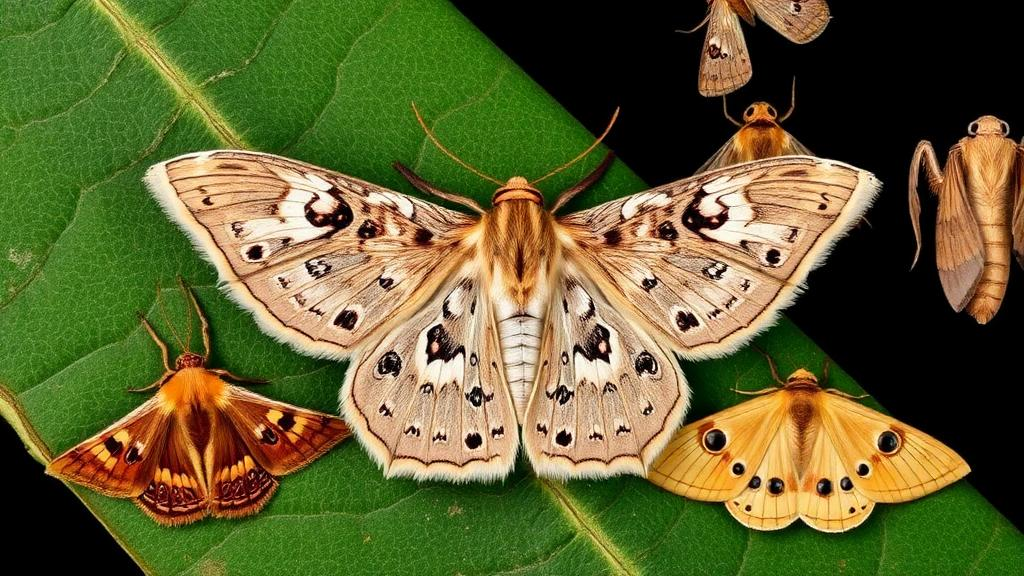
In one of southern Africa’s least understood biodiversity hotspots, an international team of lepidopterists has completed the most comprehensive survey ever attempted of a charismatic and ecologically important group of insects: the tussock moths. The study, published in the journal Nota Lepidopterologica, documents 168 species of the subfamily Lymantriinae across the wider Maputaland-Pondoland-Albany region, a sweep of coastal forest, mountain grassland and subtropical scrub stretching across South Africa, Eswatini, Lesotho and Mozambique. Among the headline findings is the first formal account of Mozambique’s tussock moth fauna, including seven genera never before recorded in the country, a result that reshapes how scientists understand the distribution of Afrotropical moths and underscores how much biodiversity remains hidden in poorly surveyed corners of the continent.
Maputaland-Pondoland-Albany is one of just three recently recognized biodiversity hotspots in southern Africa, and one of 35 worldwide. These hotspots are defined by two grim criteria: exceptional concentrations of endemic species, and severe habitat loss. The region’s most distinctive habitats, tropical and subtropical moist broadleaf forests along with mountain grasslands and scrublands, sit at a meeting point of six of the eight southern African biomes, an ecological crossroads that has produced remarkable evolutionary novelty. Yet only about 25 percent of the region’s original natural habitat survives today. For conservationists, that makes accurate inventories of its fauna not merely academic exercises but urgent prerequisites for deciding what can still be saved.
Tussock moths, with more than 2,600 species in nearly 360 genera distributed worldwide, are a diverse branch of the erebid moth family. Many are known for the tufts of hair-like scales that give the group its name and for caterpillars that can defoliate trees and shrubs, making them significant players in forest ecosystems. While South Africa’s tussock moth fauna has been catalogued repeatedly over more than a century, with species counts rising from 77 in Hampson’s 1905 catalogue to 187 in a 2002 overview, the neighbouring countries remained largely blank on the map. Roughly 50 species were known from Eswatini, five from Lesotho, and Mozambique’s tally of about 50 rested mainly on museum-based taxonomic work from the mid-twentieth century, much of it riddled with synonyms and identification errors that inflated the apparent diversity with what the authors call ghost species.
To cut through that fog, the researchers assembled presence and absence data for four countries and then went back to the specimens themselves. They revised collections held at the African Natural History Research Trust in Leominster, the Natural History Museum in London, the Museum Witt and the Bavarian State Collection of Zoology, both in Munich, and the Naturalis Biodiversity Centre in Leiden. In total, the team examined 2,352 specimens from South Africa, 2,079 from Mozambique, 61 from Eswatini and 18 from Lesotho, photographing each with a macro setup and cross-checking identifications against the modern literature. Field-collected material, gathered with light traps in locations ranging from the sand forests of Maputo Special Reserve to the montane slopes of Mount Namuli in Zambezia Province, anchored the historical records to verifiable, precisely georeferenced specimens.
The resulting inventory is striking. The wider hotspot harbours 168 tussock moth species in 43 genera, of which 158 occur in South Africa, 62 in Mozambique, 48 in Eswatini and 10 in Lesotho. By comparing species composition across countries using measures of nestedness, the degree to which one country’s fauna is a subset of another’s, and turnover, the rate at which species are swapped between faunas, the team identified 44 species potentially endemic to South Africa and six potentially endemic to Mozambique. The authors are careful with the term potential: these are species so far recorded from only a single country, but their presence in neighbouring territory cannot yet be ruled out. Even so, the numbers suggest that roughly 27.8 percent of South Africa’s tussock moth fauna and 9.6 percent of Mozambique’s may be confined to the hotspot.
The seven genera newly recorded for Mozambique, Euproctoides, Heteronygmia, Leucoma, Ogoa, Paraproctis, Polymona and Tamsita, each tell a biogeographic story. Most were expected, because they already occurred in South Africa or elsewhere in southern Africa, and the Mozambican records simply connect previously disjunct distribution ranges. One specimen of Leucoma ogovensis, for example, was taken in the sand forest of Maputo Special Reserve, extending a species known from West and Central Africa deep into the southern subcontinent. The genuine surprise was Tamsita habrotima, a species previously known only from Kenya and Uganda, captured on the slopes of Mount Namuli at 1,245 metres. Its presence in Zambezia marks the southernmost occurrence of the entire genus and hints at unexplored montane refugia in northern Mozambique.
The comparative analysis revealed distributional patterns that surprised even the authors. South Africa dominates the regional tally with 93 percent of all recorded species, yet its fauna shows the lowest species turnover of any country studied, just over 10 percent, and no faunal exchange at all with Eswatini and Lesotho in the pairwise comparisons. Instead, South Africa’s tussock moths form a gradient of nearly identical fauna along the Indian Ocean coast toward Mozambique, with a nestedness value indicating that almost 45 percent of Mozambique’s species are shared subsets of the South African pool. Lesotho, by contrast, is a paradox: its tiny fauna of 10 species is deeply nested within South Africa’s, as geography would predict for a high-altitude kingdom encircled by that country, yet it exhibits the highest species turnover of all, nearly 38 percent, reflecting a distinctive assemblage of alti-montane specialists from the Drakensberg grasslands.
These patterns carry practical weight beyond taxonomy. Verified distribution data are the raw material of conservation planning, and identifying potentially endemic species flags the places where restricted-range moths, and the habitats they depend on, are most vulnerable. The authors argue that their pilot snapshot of Lymantriinae endemicity provides a foundation for future conservation efforts in the hotspot, where a quarter of the original habitat remains and ongoing species loss continues across the region’s forests and grasslands. Moths are also sensitive bioindicators: because many species are tied to particular host plants and habitat types, shifts in tussock moth distributions can signal broader ecological change before it becomes visible in better-studied groups such as birds or large mammals.
The study is also a reminder of how much of science depends on dusty drawers. Specimens collected decades ago and housed in European museums supplied much of the raw data, and modern digital databases of African moth occurrences allowed the team to evaluate endemicity without new expeditions to every corner of the hotspot. At the same time, fresh light-trapping in Mozambique’s protected areas, from mangrove-woodland mosaics to dune forests, produced the type of georeferenced, habitat-annotated records that century-old literature cannot provide. The combination of historical depth and contemporary fieldwork proved essential for separating real diversity from the ghost diversity created by past taxonomic errors.
For a region where six biomes converge and endemism runs high, the message of this inventory is double-edged. On one hand, the tussock moths of Maputaland-Pondoland-Albany turn out to be richer and more distinctive than the existing literature suggested, with dozens of species found nowhere else on Earth. On the other, the fact that it took until 2022 for Mozambique’s tussock moth fauna to receive its first systematic summary illustrates how unevenly the map of life is filled in, even in places under acute threat. As habitat loss accelerates across the hotspot’s forests and grasslands, studies like this one make the case that the smallest and least glamorous inhabitants, down to a single male moth drawn to a light trap on a mountainside in Zambezia, deserve a place on the conservation ledger.
Subject of Research: Diversity and endemism of tussock moths (Lymantriinae) in the Maputaland-Pondoland-Albany biodiversity hotspot
Article Title: Diversity of the tussock moths ( Lepidoptera , Erebidae , Lymantriinae ) of the wider Maputaland-Pondoland-Albany, with special reference to the fauna of Mozambique
Article References: Rindoš, M., Schintlmeister, A., & Fric, Z. F. (2022). Diversity of the tussock moths (Lepidoptera, Erebidae, Lymantriinae) of the wider Maputaland-Pondoland-Albany, with special reference to the fauna of Mozambique. Nota Lepidopterologica, 45, 87-99. https://doi.org/10.3897/nl.45.61588
Image Credits: AI Generated
DOI: 10.3897/nl.45.61588
Keywords: tussock moths, Lymantriinae, Lepidoptera, biodiversity hotspot, Maputaland-Pondoland-Albany, Mozambique, endemism, species turnover, museum collections, conservation, southern Africa, faunistics
Cite Scienmag News
Margaret Porter. (October 19, 2026). Hidden Moth Diversity Revealed in One of Africa’s Rarest Biodiversity Hotspots. Scienmag. https://scienmag.com/hidden-moth-diversity-revealed-in-one-of-africas-rarest-biodiversity-hotspots/
Margaret Porter. "Hidden Moth Diversity Revealed in One of Africa’s Rarest Biodiversity Hotspots." Scienmag, 19 October 2026, https://scienmag.com/hidden-moth-diversity-revealed-in-one-of-africas-rarest-biodiversity-hotspots/. Accessed 19 October 2026.
Margaret Porter. "Hidden Moth Diversity Revealed in One of Africa’s Rarest Biodiversity Hotspots." Scienmag. October 19, 2026. https://scienmag.com/hidden-moth-diversity-revealed-in-one-of-africas-rarest-biodiversity-hotspots/


