


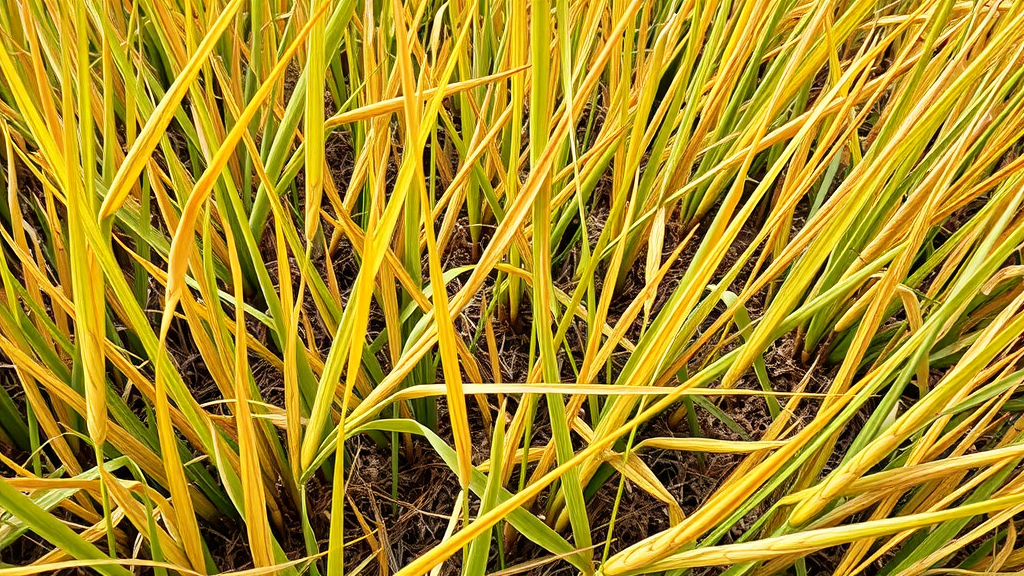
Rice feeds more than half of humanity, yet the crop faces a future in which heat waves and drought increasingly arrive not as separate threats but as simultaneous ones. In the field, a rice plant rarely battles one stress at a time; a scorching, dry afternoon imposes both burdens at once, and the molecular response to that combination is not simply the sum of the responses to each stress alone. A new study published in Molecular Genetics and Genomics has now mapped a layer of gene regulation that operates quietly beneath the well-known stress-response genes: a family of ring-shaped RNA molecules called circular RNAs, or circRNAs, that appear to help rice reorganize its post-transcriptional machinery when heat and drought strike together.
Circular RNAs are an unusual class of molecules. Unlike ordinary linear messenger RNAs, which are transcribed, translated, and degraded in a straightforward sequence, circRNAs are formed when the splicing machinery of the cell joins the downstream end of an RNA molecule back to its upstream end, a process known as back-splicing. The result is a covalently closed loop with no free ends, which makes the molecule remarkably resistant to degradation by the exonucleases that normally chew up RNA. First noticed decades ago as rare splicing accidents, circRNAs are now recognized as abundant, conserved, and often functional components of the transcriptomes of animals and plants alike, with roles that include sponging microRNAs, modulating transcription, and in some cases even serving as templates for translation.
In the new work, Behzad Hajieghrari of Jahrom University and Mousa Torabi Giglou of the University of Mohaghegh Ardabili in Iran systematically reanalyzed strand-specific RNA sequencing data from rice exposed to simultaneous heat and drought stress. Because circRNAs lack the poly-A tails and defined ends of linear transcripts, detecting them requires specialized computational approaches. The researchers subjected the sequencing reads to rigorous quality control, mapped them to the rice genome, and then ran two independent circRNA prediction algorithms, CIRI2 and CIRCexplorer2, in parallel. Only candidates supported by both methods were retained, a dual-algorithm strategy designed to filter out false positives arising from repetitive sequence or misaligned reads. The screen yielded 208 high-confidence circRNAs distributed across all twelve rice chromosomes.
The comparative profiling revealed a striking pattern of stress-dependent circularization. Eighty-three circRNAs were detected exclusively in unstressed control samples, fifty-one appeared only in stressed samples, and seventy-four were shared between the two conditions. In other words, the circular transcriptome is not a static backdrop; it is remodeled when the plant senses combined stress. Junction-read analysis, which counts the sequencing reads that span the diagnostic back-splice junction, exposed a spectrum of circularization strength, from highly abundant circRNAs whose junction reads dominate their genomic loci to low-confidence candidates whose signals are partially masked by the background of linear transcripts from the same genes.
Genomic annotation showed that most of the identified circRNAs originated from exonic regions, with a substantial contribution from intergenic regions, and displayed a pronounced bias toward the negative DNA strand. Several host genes produced multiple distinct circRNA isoforms through alternative back-splicing, meaning that a single gene can generate a small family of circular molecules with potentially different regulatory partners. This isoform diversity adds a layer of complexity to the rice transcriptome that linear RNA analysis alone cannot capture, and it hints that alternative circularization may itself be a regulated process that the plant tunes under stress.
To infer what these circRNAs might be doing, the team performed functional enrichment analysis on their host genes. The results pointed to involvement in protein folding, nutrient reservoir activity, RNA degradation, and branched-chain amino acid catabolism. Each of these categories makes biological sense in the context of combined heat and drought. Protein folding machinery, including heat shock proteins, is central to surviving thermal damage; nutrient reservoir proteins reflect the metabolic reallocation that stress demands; RNA degradation pathways govern how quickly stress transcripts turn over; and amino acid catabolism connects to nitrogen mobilization and osmotic adjustment. The enrichment pattern suggests that circRNAs are not random byproducts but are embedded in the metabolic and proteostatic circuits that determine whether a rice plant tolerates or succumbs to compound stress.
Differential expression analysis between control and stressed libraries identified seven circRNAs specifically induced under combined heat and drought conditions. These stress-responsive candidates represent the most direct leads for future experimental work, since their induction implies that the plant actively upregulates their production as part of its adaptive program. Whether they act by sequestering microRNAs, interacting with RNA-binding proteins, or influencing the splicing of their own host genes remains to be determined, but their stress-specific behavior marks them as priority targets for functional validation.
The most intriguing part of the study concerns the predicted regulatory network built around these molecules. Drawing on the competing endogenous RNA, or ceRNA, hypothesis, the researchers predicted which microRNAs could bind each circRNA and which messenger RNAs those microRNAs could in turn regulate. In the ceRNA framework, a circRNA with binding sites for a particular microRNA can act as a molecular sponge, soaking up that microRNA and thereby relieving repression of the microRNA’s genuine mRNA targets. Network topology analysis of the resulting three-layer circRNA-microRNA-mRNA circuit pinpointed several microRNAs, including osa-miR414, osa-miR1439, and osa-miR2919, as candidate topological hubs, meaning they occupy central positions with many connections and could exert outsized influence over the network’s behavior. The predicted targets of these hub microRNAs encode stress-responsive transcription factors and signaling proteins, suggesting a plausible route by which circRNA abundance changes could ripple outward to reshape the expression of entire stress-response gene programs.
The authors are careful to frame these network findings as predictive. The ceRNA relationships were inferred computationally rather than demonstrated experimentally, and microRNA target prediction in plants, while reasonably accurate due to near-perfect base pairing requirements, still generates false positives. Nevertheless, the study delivers the first comprehensive map of circRNAs in rice under combined heat and drought stress, and it does so with a methodological transparency that should make follow-up work straightforward: the full lists of predicted circRNAs, their genomic coordinates, sequences, host gene annotations, differential expression results, and predicted interaction networks are all provided in supplementary data files. The researchers also note that the work received no external funding and was carried out with resources covered by the authors themselves.
The broader significance lies in what this means for crop improvement. Extreme weather events increasingly combine heat and water deficit during the rice growing season, and breeding for tolerance to each stress individually has not reliably produced varieties that withstand the combination. If circRNA-mediated regulation proves to be a genuine coordinating mechanism, it opens a new class of molecular markers and, eventually, engineering targets: circRNAs or the splicing elements that control their production could be tuned to bolster the plant’s post-transcriptional defenses. For now, the seven stress-induced circRNAs and the hub microRNAs osa-miR414, osa-miR1439, and osa-miR2919 constitute a concrete experimental agenda. Validating their interactions, confirming their sponging activity, and testing their effects on stress tolerance in living rice plants will determine whether these molecular rings are merely correlates of stress or true architects of the crop’s resilience.
Subject of Research: Circular RNA-mediated post-transcriptional regulation in rice under combined heat and drought stress
Article Title: Circular RNAs orchestrate integrated post-transcriptional responses to combined heat and drought stress in rice
Article References: Hajieghrari, B., & Giglou, M. T. (2026). Circular RNAs orchestrate integrated post-transcriptional responses to combined heat and drought stress in rice. Molecular Genetics and Genomics, 301(1), Article 183. https://doi.org/10.1007/s00438-026-02516-x
Image Credits: AI Generated
DOI: 10.1007/s00438-026-02516-x
Keywords: circular RNAs, rice, heat stress, drought stress, ceRNA network, microRNAs, back-splicing, RNA-seq, Oryza sativa, post-transcriptional regulation, plant stress responses, Molecular Genetics and Genomics
Cite Scienmag News
Alan Morgan. (September 13, 2026). Hidden RNA Circles Help Rice Survive Heat and Drought Together. Scienmag. https://scienmag.com/hidden-rna-circles-help-rice-survive-heat-and-drought-together/
Alan Morgan. "Hidden RNA Circles Help Rice Survive Heat and Drought Together." Scienmag, 13 September 2026, https://scienmag.com/hidden-rna-circles-help-rice-survive-heat-and-drought-together/. Accessed 4 October 2026.
Alan Morgan. "Hidden RNA Circles Help Rice Survive Heat and Drought Together." Scienmag. September 13, 2026. https://scienmag.com/hidden-rna-circles-help-rice-survive-heat-and-drought-together/


