


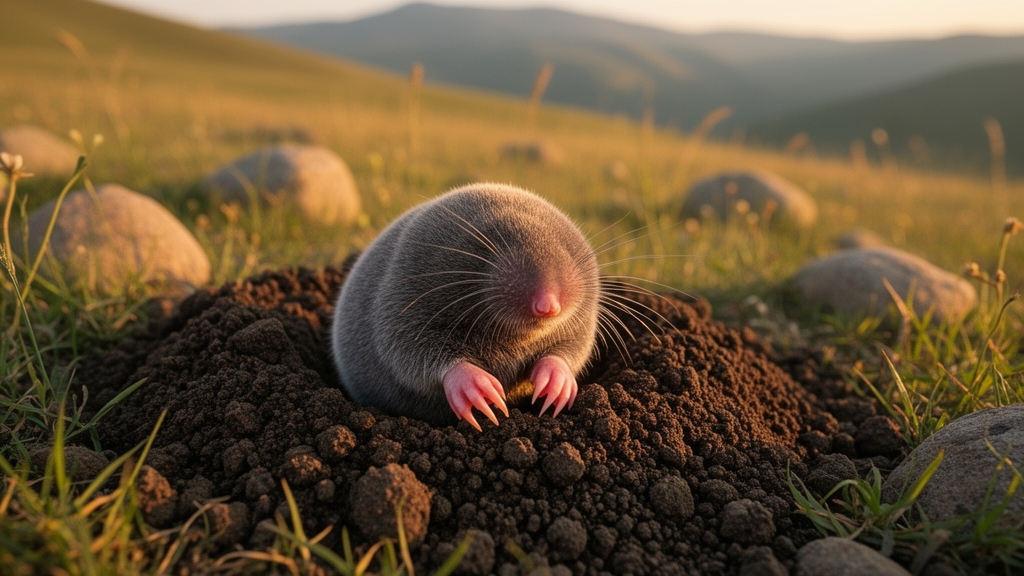
Beneath the grasslands and cultivated fields of eastern Türkiye, an unassuming rodent is quietly rewriting what biologists thought they knew about speciation. Blind mole rats of the genus Nannospalax spend nearly their entire lives in underground tunnel systems, and their bodies reflect that lifestyle: cylindrical torsos, short limbs, no visible external ears, vestigial tails, and eyes buried beneath the skin. Yet it is not their anatomy that has fascinated evolutionary biologists for decades. It is their chromosomes. A new cytogenetic study from Muş Province in the Eastern Anatolia Region has documented a previously unrecorded chromosomal form of these animals, adding a striking new piece to one of the most intricate speciation puzzles in European and Middle Eastern mammals.
The research, published in the journal Comparative Cytogenetics, reports on five blind mole rat specimens captured at two localities in Muş Province: three individuals, one female and two males, from Dilimli village, and two females from Nadaslık. Conventional staining of bone marrow chromosomes revealed that all five animals shared the same karyotype, with a diploid chromosome number of 2n = 52, a fundamental chromosome number of NF = 84, and a total of 80 autosomal arms. Those arm numbers, the authors note, rank among the highest ever recorded for blind mole rats in Türkiye, a country that already hosts one of the most chromosomally diverse mammal populations on the continent.
What makes the finding remarkable is not simply the chromosome count itself. Populations with 2n = 52 have been documented before in the region. In 2010, researchers described a blind mole rat population near Karlıova in neighboring Bingöl Province with the same diploid number but a fundamentally different chromosomal architecture, with only 74 chromosomal arms. The Muş animals, by contrast, carry ten additional arms distributed across their autosomes. The study’s authors suggest that this difference likely arose through pericentric inversions or other structural rearrangements that converted acrocentric chromosomes, which have their centromere near one end, into bi-armed forms with centromeres closer to the middle. Such changes do not alter the number of chromosomes but dramatically reshape how genetic material is organized, and they can play a decisive role in reproductive isolation.
Chromosomal rearrangements of this kind are considered a principal engine of speciation in rodents. Robertsonian fusions, centromeric shifts, and inversions can reduce the fertility of hybrids between populations carrying different karyotypes, effectively building reproductive barriers without any physical separation. In Nannospalax, these mechanisms appear to have operated repeatedly and independently across the genus’s range, producing what biologists call cryptic species: lineages that look outwardly identical but are genetically and reproductively distinct. More than 20 chromosomal forms of Turkish blind mole rats have been identified so far, including 13 within N. xanthodon alone, spanning diploid numbers from 36 to 62, and the true species count is almost certainly higher.
The new study also mapped the geographic pattern of chromosomal diversity across Muş and its surroundings, and the picture that emerges is one of a natural laboratory of microevolution. To the south of the study area, populations carrying 2n = 54 chromosomes, assigned to N. tuncelicus, form a nearly continuous distribution. Moving north and east, diploid numbers drop progressively to 52, then 50, and finally to 48, the lowest value recorded, in localities such as Malazgirt and Hınıs. Alongside these shifts in chromosome number, the morphology of individual chromosomes also changes, as reflected in the varying numbers of chromosomal arms. The authors propose that the mountainous terrain and fragmented habitats of Eastern Anatolia may have restricted gene flow between populations, allowing chromosomal divergence to accumulate in geographic isolation.
Beyond the standard karyotype, the researchers used silver nitrate staining to locate active nucleolus organizer regions, or NORs, the chromosomal sites where ribosomal RNA genes are transcribed. In all five specimens, active NORs appeared on the telomeric regions of the short arms of three bi-armed autosomal pairs, specifically pairs 5, 8, and 12. This detail matters because NOR distribution varies among blind mole rat chromosomal forms and can serve as an additional marker for distinguishing lineages. Previous studies had reported two NOR-bearing chromosome pairs in the Malazgirt population with 2n = 48 and in the Bitlis population with 2n = 54, but no NOR data existed for the Karlıova 2n = 52 population, preventing a direct comparison with the newly described form.
The sex chromosomes of the Muş animals follow a pattern consistent with other blind mole rat populations: a medium-sized submetacentric X chromosome and a small acrocentric Y. The specimens were captured using a method that exploits the animals’ own burrowing behavior, excavating a mound in the middle of the tunnel system and intercepting the mole rat as it rushed to seal the breach. Skull and skin specimens are now deposited at Batman University’s Biology Department, providing a permanent physical reference for future studies.
Taxonomically, the new population is considered part of the N. nehringi species complex, a group whose boundaries remain contested. The history of blind mole rat classification in Türkiye is a story of shifting names and overlapping diagnoses. Early researchers recognized only two species in the country, N. leucodon and N. ehrenbergi, while later work suggested that N. xanthodon occupies most of Anatolia. Populations from Malazgirt with 2n = 48 have been assigned to N. nehringi by some authors and to N. xanthodon by others, illustrating how morphological similarity and chromosomal divergence complicate classification. The genus name itself carries a taxonomic history: Microspalax was found to be a junior homonym preoccupied by a mite genus, and Nannospalax was proposed as its replacement in 1981.
What the Muş discovery underscores is that biodiversity hotspots can hide in plain sight, even in regions that have been surveyed repeatedly. A single province can harbor multiple chromosomal forms separated by tens of kilometers, each potentially representing an independently evolving lineage. Because many of these forms are proposed cryptic species whose taxonomic status remains unresolved, the authors argue that confirming species boundaries will require integrative taxonomy: combining cytogenetics with molecular phylogenetics, morphometrics, and ecological data. Chromosomes alone can reveal divergence, but they cannot by themselves settle whether a population constitutes a distinct species.
For now, the blind mole rats of Dilimli and Nadaslık stand as a vivid example of how much evolutionary change can accumulate beneath a seemingly uniform landscape. Their karyotype, with its unusually high number of chromosomal arms, hints at a history of structural rearrangement that may eventually earn them formal recognition as a distinct species. As researchers continue to sample the valleys and mountains of Eastern Anatolia, the subterranean world of Nannospalax promises to keep yielding surprises, one chromosome at a time.
Subject of Research: Chromosomal diversity and cryptic speciation in blind mole rats of eastern Türkiye
Article Title: Additional data of cryptic species of the blind mole rat ( Nannospalax , Rodentia ) (2n = 52, NF = 84) from the Eastern Anatolia Region of Türkiye
Article References: Yürümez, G. (2026). Additional data of cryptic species of the blind mole rat (Nannospalax, Rodentia) (2n = 52, NF = 84) from the Eastern Anatolia Region of Türkiye. Comparative Cytogenetics, 20, 115-126. https://doi.org/10.3897/compcytogen.20.185104
Image Credits: AI Generated
DOI: 10.3897/compcytogen.20.185104
Keywords: blind mole rat, Nannospalax, cytogenetics, karyotype, cryptic species, chromosomal speciation, Eastern Anatolia, Türkiye, NORs, pericentric inversion, rodents, Muş Province
Cite Scienmag News
Drew Townsend. (October 17, 2026). Hidden chromosomes reveal new cryptic blind mole rat lineage in eastern Türkiye. Scienmag. https://scienmag.com/hidden-chromosomes-reveal-new-cryptic-blind-mole-rat-lineage-in-eastern-turkiye/
Drew Townsend. "Hidden chromosomes reveal new cryptic blind mole rat lineage in eastern Türkiye." Scienmag, 17 October 2026, https://scienmag.com/hidden-chromosomes-reveal-new-cryptic-blind-mole-rat-lineage-in-eastern-turkiye/. Accessed 17 October 2026.
Drew Townsend. "Hidden chromosomes reveal new cryptic blind mole rat lineage in eastern Türkiye." Scienmag. October 17, 2026. https://scienmag.com/hidden-chromosomes-reveal-new-cryptic-blind-mole-rat-lineage-in-eastern-turkiye/


