


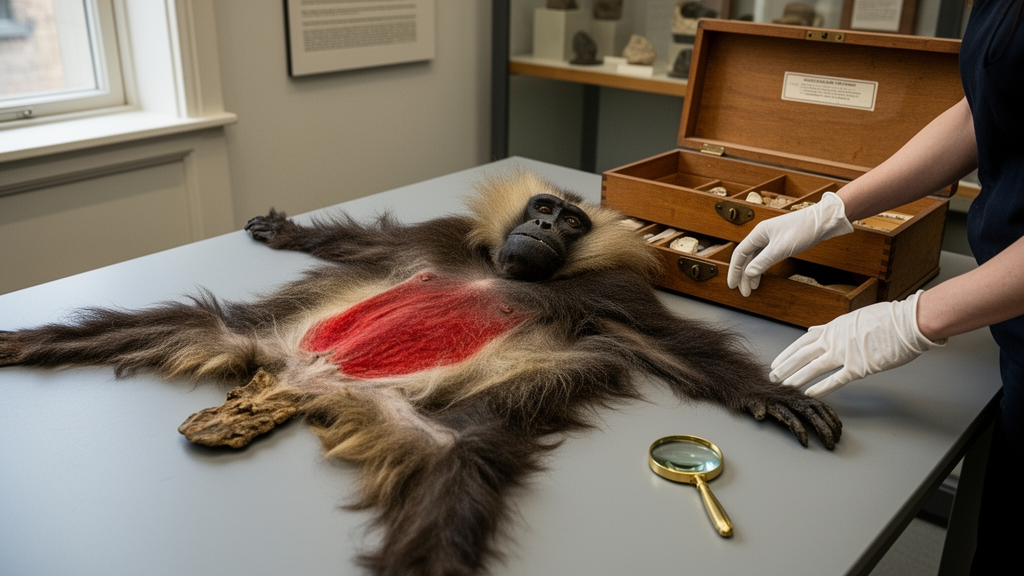
The gelada is one of the most striking primates of the Ethiopian highlands, and its biology makes the question of where it once occurred particularly consequential. Unlike most other papionin monkeys, geladas are grazing specialists, feeding predominantly on grasses and forbs found in the Afroalpine meadows and grassy plateaus above roughly 2,350 meters. This ecological specialization ties the species tightly to a specific kind of terrain, and it means that the boundaries of its distribution are not arbitrary lines on a map but reflections of where suitable high-altitude grassland habitat exists and where it is interrupted by deep river gorges, lakes, and the escarpments of the Great Rift Valley. The Blue Nile gorge, which cuts a dramatic chasm through the Ethiopian plateau, has long been recognized as one of the most effective barriers to mammal dispersal in the region, and the reassessment of the Field Museum specimens underscores just how much weight biogeographers have placed on that barrier when reconstructing the historical range of the central subspecies.
The subspecies-level partition of Theropithecus gelada into northern, central, and southern populations, separated by major hydrological features such as the Tekezé River gorge, the Blue Nile, and the Rift Valley, was first proposed on the basis of subtle differences in pelage and external morphology. Subsequent genetic work has largely vindicated this arrangement, with molecular analyses revealing patterns of differentiation consistent with long-term isolation of populations on either side of these barriers. This convergence between morphological and molecular evidence is itself instructive: it demonstrates how physical geography can structure genetic divergence in montane primates, and it explains why a single putative record from west of the Blue Nile carried such biogeographic significance. If geladas had indeed persisted in Gojjam, it would have implied either that the gorge was passable to them at some point in the recent past, or that a relict population had survived on the western side of the barrier, raising questions about connectivity, gene flow, and the timing of range fragmentation.
The removal of the Gojjam and Ambo Mineral Springs records from the verified distribution of the species therefore does more than correct a catalog entry. It restores coherence to the biogeographic picture, in which the Blue Nile gorge functions as a genuine limit to the central subspecies, and it narrows the historical range of geladas to the highlands east and north of that barrier. At the same time, the unconfirmed report by Rüppell, who described the species in 1835 and mentioned its occurrence in Gojjam without ever visiting the region himself, remains an intriguing loose end. Such indirect historical reports, which circulated widely in the natural history literature of the nineteenth century, often reflected secondhand accounts from travelers and local informants. They can preserve genuine memory of vanished populations, but they can also propagate errors, and the distinction between the two is precisely what museum-based verification is designed to resolve.
The 1926–1927 Abyssinian expedition itself deserves attention as an artifact of the history of science. Led by Wilfred H. Osgood, then Curator of Zoology at the Field Museum, and staffed by a remarkably diverse team that included an ornithologist, a celebrated wildlife illustrator, a newspaper reporter, and a documentary filmmaker, the expedition exemplified an era when large natural history institutions mounted ambitious surveys to fill gaps in the world’s faunal knowledge. The breadth of documentation the party produced, from personal diaries and published books to newspaper dispatches and motion picture footage, is unusually rich for its time, and it is exactly this redundancy of records that made the present reassessment possible. Where a specimen tag alone might be ambiguous, a diary entry describing the day’s route and the animals collected can anchor a specimen to a specific place and date with high confidence.
The ten gelada specimens gathered during the expedition span a meaningful geographic and temporal range. Several were collected in February 1927 along the Mugher River and near the Blue Nile on the northern bank, in localities within the central Ethiopian plateau that fall squarely within the expected range of the central subspecies. Others were taken in late March 1927 in the Simien Mountains of Begemdir, at elevations around 10,500 feet, placing them firmly in the territory of the northern subspecies. This pattern of collection, concentrated along the margins of the great gorges and in the northern massifs, mirrors the modern understanding of gelada distribution and provides a coherent snapshot of the species as encountered by field biologists nearly a century ago. The three specimens whose provenance was reassessed, originally cataloged as coming from Gojjam and the Ambo Mineral Springs, are now attributed to the Muger River Canyon in Shewa, with a collection date of October 1926, a locality that lies comfortably within the central subspecies’ range east of the Blue Nile.
The mechanism behind the mislabeling is a familiar one in the history of natural history collections. During extended expeditions, specimens were often collected, prepared, and tagged in the field under conditions that were far from ideal, and the information recorded on tags was later transcribed into catalog ledgers, sometimes weeks or months afterward and sometimes by personnel other than the original collector. Errors could creep in at any of these steps: a locality name might be misremembered, coordinates might be transposed, or specimens from different parts of a journey might be conflated during shipment or accessioning. Once an error entered the catalog record, it tended to persist, because subsequent researchers typically consulted the catalog rather than the raw field documentation. The result is that a single transcription mistake can shape scientific understanding for a century, as it did here, where the erroneous Gojjam attribution was repeated in distributional syntheses and conservation assessments for decades.
This case is a particularly clear illustration of what has come to be called the extended specimen approach. Under this framework, a museum specimen is understood not merely as the physical object on the shelf, whether a skin, skull, or skeleton, but as the entire constellation of associated data that gives it meaning: the field tags, the catalog entries, the collector’s diary, the expedition reports, the photographs taken in camp, the correspondence between expedition members, and even the published accounts that followed. Each of these elements can independently constrain or corroborate the specimen’s provenance, and when they are integrated, the reliability of the resulting record increases enormously. In the gelada case, it was the convergence of diary entries, original tags, catalog records, and historical photographs that allowed the researchers to demonstrate that the three problematic specimens were collected at the Muger River Canyon rather than west of the Blue Nile, a conclusion that no single source could have established on its own.
The broader implications for primatology and for conservation science are worth emphasizing. Historical specimens are increasingly recognized as irreplaceable baselines for understanding how species ranges have shifted over time, particularly in regions like the Ethiopian highlands where habitat transformation has been rapid and extensive over the past century. The IUCN Red List assessments that inform conservation policy depend fundamentally on knowing where a species occurred historically and where it occurs today, and inflated or erroneous historical ranges can distort priority-setting. Conversely, a rigorously verified historical record can justify continued search effort in areas where a species might yet persist. The 2015 surveys that failed to detect geladas in Gojjam illustrate the stakes: had those surveys been conducted in the knowledge that the only physical evidence for geladas there was a cataloging error, resources might have been directed elsewhere, or alternatively, the absence of geladas might have been interpreted with greater confidence as a genuine biogeographic pattern rather than a possible local extinction.
The case also resonates with a growing body of primatological studies in which genomic data have revealed that museum specimens, even those collected long ago, can overturn assumptions about taxonomy, provenance, and population history. Mislabeling and misassignment of specimens have been documented across many primate groups, and the increasing accessibility of ancient DNA techniques means that historical skins and bones can now yield genetic information that was unavailable to earlier generations of researchers. For the gelada specimens at the Field Museum, the corrected provenance opens the possibility that future genetic work could compare the Muger River Canyon animals with modern populations across the species’ range, testing whether the central subspecies shows the kind of geographic structuring that the subspecies framework predicts.
Finally, the episode is a reminder that museum collections are not static archives but living research infrastructure whose value grows as new methods and new questions are brought to bear on old material. The specimens collected by Osgood, Bailey, and their colleagues in 1926 and 1927 were gathered in a colonial-era scientific milieu very different from today’s, yet the material they produced continues to generate knowledge, and the archival ecosystem surrounding it continues to yield corrections. The gelada, as the last surviving member of a genus that once included much larger Pleistocene relatives, occupies a unique position in the fauna of the Ethiopian highlands, and every refinement in the understanding of its historical distribution contributes to a more accurate picture of how this remarkable grazing primate came to occupy the fragmented grassland plateaus it inhabits today. The extended specimen approach, by binding together object, document, and image, ensures that such refinements remain possible for future generations of researchers.
Subject of Research: On the origin of the Theropithecus gelada specimens from the Field Museum 1926–1927 Abyssinian expedition: a case for the extended specimen approach
Article Title: On the origin of the Theropithecus gelada specimens from the Field Museum 1926–1927 Abyssinian expedition: a case for the extended specimen approach
Article References: Mercuri, G., Gippoliti, S., & Capelli, C. (2026). On the origin of the Theropithecus gelada specimens from the Field Museum 1926–1927 Abyssinian expedition: a case for the extended specimen approach. Natural History Collections and Museomics, 3, 1-17. https://doi.org/10.3897/nhcm.3.185998
Image Credits: AI Generated
Keywords: origin, Theropithecus, gelada, specimens, Field, Museum, Abyssinian, expedition, case, extended, specimen, approach
Cite Scienmag News
Juliet Wilcox. (October 17, 2026). Century-old museum mystery solved: gelada specimens from 1926 Field Museum expedition were mislabeled. Scienmag. https://scienmag.com/century-old-museum-mystery-solved-gelada-specimens-from-1926-field-museum-expedition-were-mislabeled/
Juliet Wilcox. "Century-old museum mystery solved: gelada specimens from 1926 Field Museum expedition were mislabeled." Scienmag, 17 October 2026, https://scienmag.com/century-old-museum-mystery-solved-gelada-specimens-from-1926-field-museum-expedition-were-mislabeled/. Accessed 17 October 2026.
Juliet Wilcox. "Century-old museum mystery solved: gelada specimens from 1926 Field Museum expedition were mislabeled." Scienmag. October 17, 2026. https://scienmag.com/century-old-museum-mystery-solved-gelada-specimens-from-1926-field-museum-expedition-were-mislabeled/


