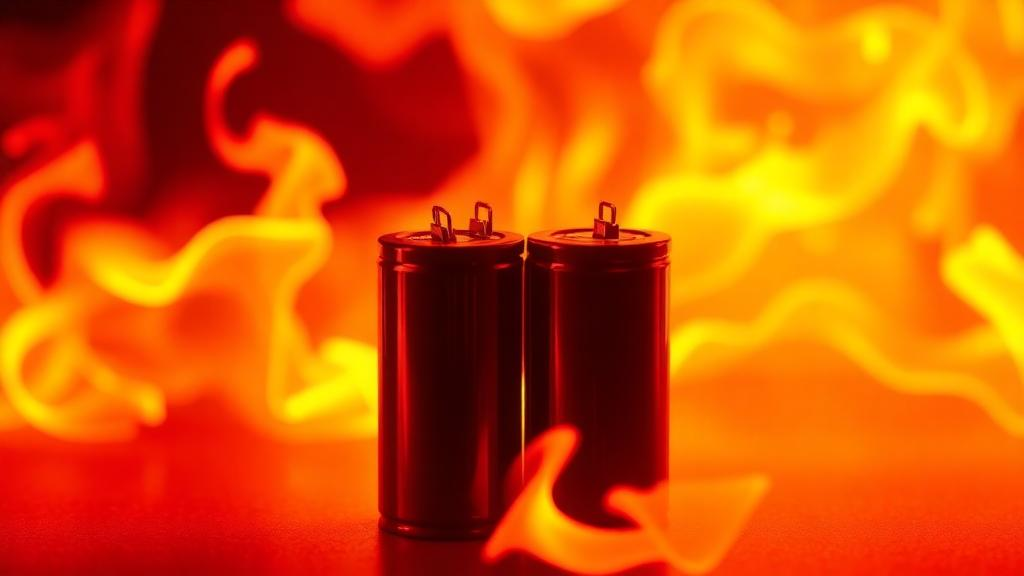
Supercapacitors have quietly become the workhorses of modern power electronics. They deliver bursts of energy in electric vehicles, stabilize renewable power grids, and recharge in seconds where batteries take hours. But according to a comprehensive new review published in Frontiers in Thermal Engineering, these devices carry a thermal Achilles heel: for every 10 kelvin of temperature rise above 298 K, their lifespan is cut roughly in half. A team of mechanical engineers at Wichita State University, led by Asonganyi Atayo and Muhammad Rahman, has now synthesized more than 150 studies into a systematic account of how heat degrades supercapacitors and what can be done about it, and their findings reveal both surprising physics and a clear roadmap for the field.
The thermal problem begins with a deceptively simple mechanism. During every charge and discharge cycle, current flowing through the electrolyte and electrode materials encounters the equivalent series resistance, or ESR, generating Joule heat inside the cell. That internal heat accumulates, and at elevated temperatures it accelerates the decomposition of electrolytes and electrodes, speeds up self-discharge, and in extreme cases can trigger electrolyte breakdown, gas evolution, or even thermal runaway. Cold is no friend either: at low temperatures, ionic conductivity in the electrolyte drops, viscosity rises, and the accessible capacitance shrinks. The result is a bidirectional thermal challenge in which both extremes of the operating envelope degrade performance, just through different mechanisms.
What makes the review particularly timely is a counterintuitive discovery from recent research. Li and colleagues identified a negative Joule heat effect in supercapacitor modules under specific conditions, namely high-frequency charge-discharge cycling at low current densities in multi-cell configurations. In other words, under certain operating regimes the modules do not simply heat up as expected, adding a layer of complexity to thermal behavior prediction that existing models struggle to capture. This phenomenon underscores how much remains unknown about heat generation in devices that are often assumed to be thermally simpler than batteries.
The degradation story is told at the level of individual components. Electrolytes, which transport ions between electrodes, follow Arrhenius-type behavior in which ionic conductivity increases with temperature, but only up to a point: at high temperatures, decomposition, solvent evaporation, and rising internal pressure take over. Organic electrolytes typically operate between roughly 233 K and 343 K, aqueous systems between 273 K and 333 K, while ionic liquids can function up to about 450 K, making them increasingly attractive for high-temperature applications. Electrodes made of activated carbon or carbon nanotubes face their own thermal limits, and the binders that hold them together, such as polyvinylidene fluoride, can soften or melt, causing delamination between active material and current collectors. Separators, the ion-permeable membranes between electrodes, can lose structural integrity at high temperatures, risking short circuits, while below about 243 K ion mobility through their pores becomes severely restricted.
The aging mechanisms are particularly insidious because they feed on themselves. High temperatures generate gases such as hydrogen and carbon monoxide that build internal pressure, sometimes venting through safety valves before the conventional 20 percent capacitance-loss end-of-life threshold is even reached. Solid decomposition products block the pores of the carbon electrodes, reducing the effective surface area and thus capacitance. Joule heating accelerates electrochemical degradation, which raises ESR, which in turn generates more Joule heat, a positive feedback loop that progressively elevates internal temperature. Current collectors oxidize at high temperatures, increasing contact resistance, and acetonitrile-based cells have been reported to lose roughly 25 percent of their weight through electrolyte evaporation after 12,000 seconds at 3 V and 343 K, an accelerated stress condition well beyond normal operating limits.
Against this backdrop, the review evaluates the arsenal of thermal management strategies, dividing them into passive and active systems. Passive approaches, which consume no parasitic electrical energy, include natural convection, heat pipes, and phase change materials, or PCMs. Heat pipes exploit a closed two-phase cycle in which a working fluid evaporates at the hot end and condenses at the cool end, achieving near-isothermal heat transport. In supercapacitor-specific experiments, heat pipe cooling reduced peak cell temperature by 7.5 to 11.7 percent and improved capacitance retention by about 2.1 percent compared with natural convection. PCMs, typically paraffin wax with melting points in the 303 to 333 K range, absorb latent heat during high-power bursts and release it during rest, buffering temperature excursions, though their low intrinsic thermal conductivity of 0.1 to 0.3 watts per meter-kelvin limits heat transfer rates unless enhanced with metal foams, fins, or conductive meshes.
Active systems trade simplicity for performance. Forced air cooling is the most widely implemented active approach, and careful engineering pays dividends: Voicu and colleagues found that a staggered module with cell spacing of 1.25 times the cell diameter optimizes heat removal, while Soltani and colleagues identified an optimal air speed of 5 meters per second and 5-millimeter spacing for a 12-cell lithium-ion capacitor module, with predicted and measured temperatures agreeing within 2 K. Liquid cooling, with water’s thermal conductivity roughly 25 times that of air, offers the highest heat removal capacity, achieving up to 35 percent lower maximum temperatures in supercapacitor-specific experimental studies. But it brings complexity, weight, sealing requirements, and leakage risks. The most striking results come from hybrid systems: combining PCMs with heat pipes achieved approximately 35 percent lower peak cell temperatures and 86 percent lower temperature non-uniformity than PCM-only cooling, a configuration well matched to the burst-and-rest duty cycles that characterize supercapacitor applications.
The review does not shy away from the field’s shortcomings. The authors identify critical research gaps, including limited understanding of molecular-level degradation mechanisms, an absence of standardized testing protocols that would make results from different laboratories directly comparable, and insufficient development of cost-effective thermal interface materials. The numbers are telling: thermal interface resistance between cells and aluminum cold plates is estimated at 10 to 50 K cm²/W for commercial silicone pads, comparable in magnitude to the cell-level thermal resistance itself. Meanwhile, the longest calendar aging studies span only 12 to 18 months, yet the Arrhenius rule is routinely used to project 10-to-15-year lifetimes, an extrapolation of nearly an order of magnitude beyond validated data.
The future directions the authors outline are equally concrete. They call for hybrid and adaptive thermal management systems that co-optimize PCM melting point, layer thickness, heat pipe geometry, and condenser configuration as a coupled system, along with adaptive control strategies that modulate cooling intensity based on real-time temperature and state-of-health estimates. They also highlight the need for non-invasive in-situ temperature mapping, noting that although the electrode is the dominant thermal resistance in supercapacitor stacks, nearly all reviewed studies measure surface temperature only, leaving internal gradients to be inferred from models. Fiber Bragg grating-based internal temperature mapping of a 20-cell module during fast cycling, with spatial resolution of 5 millimeters or better, is proposed as a measurable milestone.
For engineers designing the next generation of energy storage, the message is clear: no single cooling approach is universally optimal, and the choice depends on power density, available volume, cost constraints, and operating temperature range. As supercapacitors push into ever more demanding roles, from regenerative braking to grid-scale stabilization, the invisible battle against heat will increasingly determine whether these remarkable devices fulfill their potential. The Wichita State team’s synthesis provides both a warning and a blueprint, showing that thermal management is not an afterthought but a first-order design constraint for the future of high-power energy storage.
Subject of Research: Thermal management strategies and temperature effects in supercapacitors
Article Title: Thermal management of supercapacitors: a review of thermal challenges, management strategies, future directions
Article References: Atayo, A., Subeshan, B., Asmatulu, E., & Rahman, M. (2026). Thermal management of supercapacitors: a review of thermal challenges, management strategies, future directions. Frontiers in Thermal Engineering, 6, Article 1783912. https://doi.org/10.3389/fther.2026.1783912
Image Credits: AI Generated
DOI: 10.3389/fther.2026.1783912
Keywords: supercapacitors, thermal management, Joule heating, phase change materials, heat pipes, liquid cooling, electrolyte degradation, thermal runaway, aging mechanisms, lithium-ion capacitors, energy storage, cooling systems
Cite Scienmag News
Denise Maddox. (October 16, 2026). Heat Is the Hidden Enemy of Supercapacitors, and Engineers Are Fighting Back. Scienmag. https://scienmag.com/heat-is-the-hidden-enemy-of-supercapacitors-and-engineers-are-fighting-back/
Denise Maddox. "Heat Is the Hidden Enemy of Supercapacitors, and Engineers Are Fighting Back." Scienmag, 16 October 2026, https://scienmag.com/heat-is-the-hidden-enemy-of-supercapacitors-and-engineers-are-fighting-back/. Accessed 16 October 2026.
Denise Maddox. "Heat Is the Hidden Enemy of Supercapacitors, and Engineers Are Fighting Back." Scienmag. October 16, 2026. https://scienmag.com/heat-is-the-hidden-enemy-of-supercapacitors-and-engineers-are-fighting-back/