


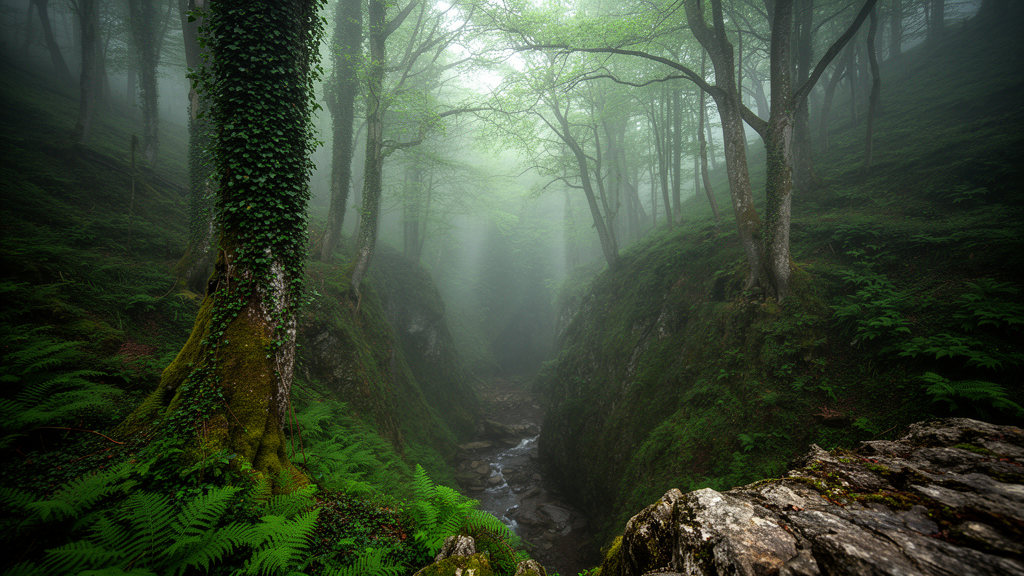
Deep in the gorges and shaded ravines of western Georgia, scientists have uncovered a hidden layer of botanical diversity that has survived since the age of the dinosaurs’ decline. A new study published in Vegetation Classification and Survey reveals that the ravine forests of Colchis, a region nestled along the Black Sea coast and the slopes of the Caucasus, represent a distinct and previously unrecognized alliance of forest vegetation. These forests, dominated by noble hardwood trees such as wych elm, Cappadocian maple, and begonia-leaved lime, shelter a wealth of endemic and Tertiary relict species that have persisted through millions of years of climatic upheaval. The findings not only reshape our understanding of Caucasian forest diversity but also carry urgent implications for the conservation of one of the Northern Hemisphere’s most remarkable living archives.
Colchis is no ordinary landscape. This narrow strip of coastal lowlands and mountain foothills has acted as a biological time capsule, allowing entire communities of broadleaved deciduous forests to persist through the Last Glacial Maximum while much of Europe lay under ice. The region’s warm-temperate, year-round humid climate, fed by moisture-laden air rising from the Black Sea and shielded from cold northeastern air masses by the Greater Caucasus barrier, created conditions of unusual climatic stability. This stability was critical for the survival of numerous Tertiary plant lineages, including laurophyllous shrubs with glossy evergreen leaves and woody lianas that evoke a subtropical past. Yet despite this extraordinary heritage, the ravine forests of Colchis, confined to steep, rocky, and unstable slopes, had never been systematically studied using modern vegetation science methods.
Ravine forests are azonal plant communities, meaning they are not tied to a particular climatic zone but instead colonize specific landforms such as gullies, ravines, and hillsides with skeletal and colluvial soils. They are shaped by frequent natural disturbances including landslides, debris flows, and solifluction, the slow downhill creep of waterlogged soil. Their soils are often nutrient-rich and well-aerated, developed on a variety of bedrock types. In Western Eurasia, these forests are characterized by a canopy of shade-tolerant deciduous noble hardwoods, particularly species of maple, ash, lime, and elm, which cope with unstable substrates through extensive root systems and considerable regenerative capability. Their understories are extraordinarily diverse, reflecting the parent rock, disturbance regime, and climatic and biogeographic factors.
The research team, led by Pavel Novák and colleagues, conducted field surveys across the Colchic region of Georgia between 2017 and 2023, recording 38 original vegetation plots using the Braun-Blanquet approach, the gold standard of European vegetation science. They focused on stands dominated by noble hardwood trees typical of ravine forests, while trees of zonal forests such as hornbeam, sweet chestnut, and oriental beech were absent or reached only low cover. Each plot measured 100 square meters, and the team estimated cover percentages for tree, shrub, herb, and moss layers, measured soil pH, recorded slope inclination, aspect, elevation, and rock cover, and collected topsoil subsamples for analysis. The plots were digitized and stored in the Transcaucasian Vegetation Database.
To unravel the diversity of these forests, the researchers compiled two datasets. The first, containing 45 plots of Colchic ravine forests, combined the original field data with seven published plots. The second, an extended dataset of 134 plots, included additional Caucasian ravine forests and the alliance Alnion barbatae, a group of alluvial forests dominated by Caucasian alder. The team applied beta-flexible clustering, an agglomerative classification method based on Bray-Curtis distance, which was identified as the optimal approach using OptimClass1, a tool that searches for the partitioning yielding the highest number of diagnostic species. Diagnostic species were identified according to the phi coefficient, a measure of species-to-cluster fidelity, and statistically insignificant concentrations were excluded using Fisher’s exact test. Non-metric multidimensional scaling was employed to visualize patterns of similarity among the communities.
The classification of the Colchic dataset revealed three distinct associations, each reflecting a unique combination of climate and bedrock. The first, Polysticho woronowii-Ulmetum glabrae, occupies windward slopes of the volcanic Adjara-Imereti Range in a warm and wet climate averaging 13.2 degrees Celsius and 2,756 millimeters of annual precipitation. Its canopy is dominated by Cappadocian maple and wych elm, with an admixture of Caucasian alder and sweet chestnut, while the understory exhibits an extraordinarily high cover of evergreen species including Colchic holly and Pontic rhododendron. Oceanic ferns such as Dryopteris affinis and Blechnum spicant thrive in the herb layer, alongside Aruncus dioicus, a tall forb well-adapted to solifluction.
The second association, Polysticho aculeati-Tilietum begoniifoliae, newly described in this study, colonizes less rocky limestone slopes in a cooler and drier climate averaging 11.3 degrees Celsius and 1,808 millimeters of precipitation. It is associated with leeward areas of hills and plateaus distant from the Black Sea coast, mainly in the Imereti Region. Begonia-leaved lime dominates the canopy, with an admixture of hornbeam and sweet chestnut. The shrub layer mixes laurophyllous and deciduous species, while the herb layer contains nemoral herbs such as Cardamine bulbifera and Lathyrus vernus, alongside rock-crevice specialists including Polystichum aculeatum. Notably, this community harbored the lowest share of alien species, averaging just 0.4 per plot.
The third association, Pterido creticae-Tilietum begoniifoliae, also newly described, thrives in low limestone hills of the Caucasian forehills in the Samegrelo Region and the Guria Range, closer to the coastline. It experiences higher precipitation and temperature, averaging 2,461 millimeters and 13.1 degrees Celsius respectively. These stands are the rockiest of the recognized communities, related to topographically diverse karst landscapes. Begonia-leaved lime prevails in the canopy, while zonal trees are scarce or missing. The herb layer is diverse, featuring stoloniferous and rhizomatous species that cope with moving substrates, frequent ferns including Asplenium scolopendrium and Pteris cretica, and indicators of humid rock outcrops such as Adiantum capillus-veneris. This community harbored the highest species richness, averaging 32.8 species per plot, and the highest share of alien species at 1.8 per plot.
When the researchers extended their analysis to the regional dataset, the results were striking. The classification produced two main clusters, one for ravine forests and one for alluvial forests. Colchic ravine forests were found to be more closely related to Caucasian ravine forests than to the Colchic alliance Alnion barbatae, indicating that fundamental similarities in site conditions outweighed climatic and biogeographic factors. A further partitioning distinguished between Caucasian and Colchic ravine forests, revealing significant floristic differences. Colchic stands were positively delimited by a group of laurophyllous species and Colchic endemics, while Caucasian stands were richer in broadly distributed nemoral and Eastern Caucasian-Hyrcanian species. This division led the team to describe a new alliance, Pterido creticae-Tilion begoniifoliae, which unites the three Colchic ravine forest associations and is characterized by an absolute character taxon, Polystichum woronowii, a Colchic endemic fern found nowhere else in this combination.
The implications for conservation are profound. These forests shelter a wealth of endemic taxa limited to Colchic or Colchic-Caucasian areas, including herbs such as Polystichum woronowii and Symphytum grandiflorum, evergreen shrubs like Prunus laurocerasus, deciduous shrubs including Staphylea colchica, and even trees such as Tilia begoniifolia. Some species appear to reach their optimum in Colchic ravine forests, making their adequate protection of the utmost importance for conserving the genetic heritage of the Colchic forest biota. Although some stands fall within protected areas such as Machakhela and Mtirala national parks, the majority remain outside formal protection. While Georgian law grants protection status to forests on slopes steeper than 35 degrees, ensuring compliance remains challenging throughout the Caucasus. The newly described alliance complements the so-far known vegetation diversity of the Colchic forests, one of the hotspots of Tertiary relict flora in the Northern Hemisphere, and provides a baseline for future habitat monitoring, management planning, and biodiversity conservation in this extraordinary refuge of ancient life.
Subject of Research: Vegetation Science
Article Title: Ravine forests in Colchis (Georgia) – Azonal forests in a Tertiary relict flora hotspot
Article References: Novák, P., Kalníková, V., Taraška, V., Memiadze, N., & Kharazishvili, D. (2025). Ravine forests in Colchis (Georgia) – Azonal forests in a Tertiary relict flora hotspot. Vegetation Classification and Survey, 6, 191-208. https://doi.org/10.3897/vcs.154417
Image Credits: AI Generated
DOI: 10.3897/VCS.154417
Keywords: Colchis, Georgia, ravine forests, Tertiary relict flora, biodiversity hotspot, phytosociology, Caucasus, vegetation classification, Ravine, forests, Azonal, Tertiary
Cite Scienmag News
Margaret Porter. (October 16, 2026). Ravine Forests of Colchis: Georgia’s Hidden Tertiary Relict Sanctuaries. Scienmag. https://scienmag.com/ravine-forests-of-colchis-georgias-hidden-tertiary-relict-sanctuaries/
Margaret Porter. "Ravine Forests of Colchis: Georgia’s Hidden Tertiary Relict Sanctuaries." Scienmag, 16 October 2026, https://scienmag.com/ravine-forests-of-colchis-georgias-hidden-tertiary-relict-sanctuaries/. Accessed 16 October 2026.
Margaret Porter. "Ravine Forests of Colchis: Georgia’s Hidden Tertiary Relict Sanctuaries." Scienmag. October 16, 2026. https://scienmag.com/ravine-forests-of-colchis-georgias-hidden-tertiary-relict-sanctuaries/


