


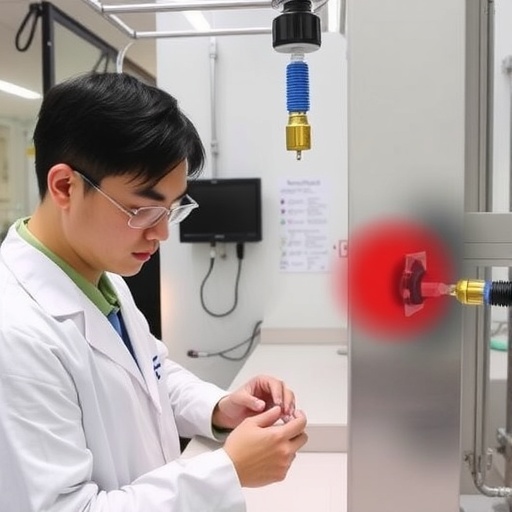
In a groundbreaking advancement for the treatment of abdominal aortic aneurysms, researchers have unveiled an innovative ultrathin flexible sensor designed to detect Type-I endoleaks during and after endovascular aneurysm repair procedures. This minimally invasive approach offers a solution to a persistent medical dilemma: the surveillance of potential endoleaks that can occur post-surgery, which pose a serious risk of recurrence and require careful monitoring. Traditionally, surveillance relies heavily on imaging techniques that are often inconsistent and cumbersome for patients, exposing them to radiation or requiring them to undergo frequent visits to medical facilities.
The development of this newly integrated sensor, led by Dr. Yei Hwan Jung, represents a significant shift in how healthcare providers can monitor patients who have undergone this critical procedure. Dr. Jung, an Associate Professor at Hanyang University in South Korea, emphasizes the sensor’s design, which integrates seamlessly with the standard stent graft without compromising its overall form or function. This capability is particularly noteworthy, as it allows for the transformation of a passive implant into an active monitoring device, addressing the silent threat of endoleaks without burdening patients with additional invasive procedures.
In the realm of vascular health, the repercussions of untreated endoleaks can be dire, leading to catastrophic outcomes such as rupture of the aneurysm. Existing methods of monitoring such complications have relied predominantly on imaging techniques like computed tomography angiography (CTA) and magnetic resonance imaging (MRI). Although these methods are valuable, they are often fraught with limitations, such as accessibility issues, high costs, and the risks associated with radiation exposure. Consequently, patients may face significant challenges in adhering to follow-up protocols that are crucial for identifying potential complications in a timely manner.
The ultrathin flexible sensor represents a paradigm shift, capitalizing on cutting-edge materials science to provide real-time monitoring directly within the blood vessel environment. Designed to be robust enough to withstand the stress of crimping and deployment, the sensor is expected to remain consistently reliable while maintaining long-term stability. This innovation is particularly exciting because it circumvents the traditional limitations of monitoring endoleaks, providing continuous insights that can inform immediate clinical decisions.
What sets this sensor apart is its unique ability to wirelessly communicate data about the patient’s condition. By integrating advanced technologies, this sensor allows healthcare providers to monitor for leaks as soon as they develop, which could ultimately change the trajectory of patient care. Patients will no longer need to endure the anxiety of waiting for periodic scans that may miss critical changes in their condition. Instead, the sensor works around the clock to collect important data, ensuring that potential complications can be addressed promptly.
Moreover, Dr. Jung and his team have validated their approach through rigorous experimental studies, confirming that the sensor does not induce any adverse effects such as blood leakage. This stability under dynamic vascular conditions supports the hypothesis that such technology could be adapted for various other medical applications beyond vascular surgeries, expanding its impact on the healthcare landscape. For instance, similar technology could also be applied to other medical devices used in gastroenterological or urological procedures, further advancing patient safety in interventions across various specialties.
The authors of the study published their findings in the journal Science Advances, indicating a strong foundation of research behind this innovation. The study also provides a comprehensive look at the potential real-life applications of the sensor, including its integration into standard surgical practice for all patients undergoing endovascular aneurysm repairs. This technology could become an integral component of medical devices, contributing significantly to postoperative patient monitoring and management.
Looking forward, the vision of connected healthcare is promising. The integration of smart sensors à la this innovative device could usher in an era where patient monitoring is not confined to hospital settings. With potential for remote access, patients might soon have the ability to receive alerts about their device directly on their smartphones, allowing them to share their status seamlessly with healthcare providers. This removes barriers to access for patients in rural areas, elderly patients, and others who may struggle to attend regular appointments for assessments.
The researchers are optimistic that within the next five to ten years, the integration of such technologies will be commonplace, transforming the landscape of vascular surgery. The traditional stent graft without integrated monitoring capabilities could soon become obsolete, replaced by advanced alternatives that place patient safety and comfort at the forefront. Continuous post-operative monitoring will likely become the standard of care, ushering in a new age of proactive disease management in the field of vascular health.
As advancements in sensor technology continue to unfold, we can expect these innovations to not only enhance outcomes for patients with abdominal aortic aneurysms but also signify a major leap towards more sophisticated medical devices across various disciplines. These developments highlight the potential to significantly improve patient care and outcomes by mitigating risks associated with surgical interventions.
This research represents a vital step in the evolution of medical technology, reinforcing the importance of interdisciplinary approaches that merge engineering with healthcare to solve long-standing medical challenges. The implications of these advancements extend beyond vascular surgery, hinting at a future where smart medical devices play an integral role in patient care across a wide array of conditions.
As we continue to strive for safer, more effective healthcare solutions, the need for innovative monitoring devices becomes increasingly apparent. The ultrathin sensor is not merely a technological advancement; it is a beacon of hope for patients and healthcare providers alike, opening avenues for better management of a challenging condition that has plagued patients for years. With continued research and development, the future of patient monitoring looks promising and poised for rapid growth.
Keywords
- Vascular diseases
- Medical technology
- Biomedical engineering
- Aneurysms
- Blood vessels
- Patient monitoring
- Clinical research
- Surgery
Cite Scienmag News
Ophelia Keating. (October 22, 2025). Hanyang University Scientists Unveil Innovative Sensor for Ongoing Endoleak Surveillance. Scienmag. https://scienmag.com/hanyang-university-scientists-unveil-innovative-sensor-for-ongoing-endoleak-surveillance/
Ophelia Keating. "Hanyang University Scientists Unveil Innovative Sensor for Ongoing Endoleak Surveillance." Scienmag, 22 October 2025, https://scienmag.com/hanyang-university-scientists-unveil-innovative-sensor-for-ongoing-endoleak-surveillance/. Accessed 3 September 2026.
Ophelia Keating. "Hanyang University Scientists Unveil Innovative Sensor for Ongoing Endoleak Surveillance." Scienmag. October 22, 2025. https://scienmag.com/hanyang-university-scientists-unveil-innovative-sensor-for-ongoing-endoleak-surveillance/


