


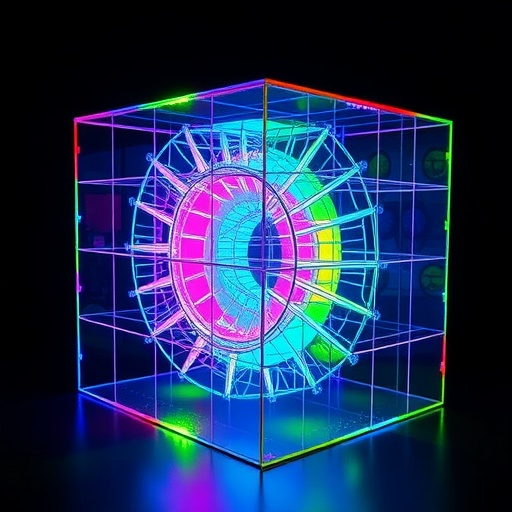
In a groundbreaking advancement set to revolutionize additive manufacturing and optical fabrication, researchers have unveiled a high-efficiency, multi-scale holographic volumetric 3D printing technology using a phase light modulator. This novel approach promises to redefine how complex three-dimensional structures are created by harnessing the unparalleled precision and speed offered by holographic methods combined with phase modulation techniques. As industries increasingly demand rapid prototyping with microscale to macroscale features, this technology emerges as a critical enabler for next-generation manufacturing applications.
Traditional 3D printing techniques, although transformative, often face limitations concerning speed, resolution, and scalability. Layer-by-layer methods can be time-consuming and prone to mechanical artifacts that compromise structural integrity. In contrast, volumetric 3D printing addresses these drawbacks by polymerizing an entire three-dimensional structure in a single exposure, significantly accelerating fabrication. The integration of holographic volumetric printing harnesses spatial light modulation to sculpt the photopolymerization volume at once, thereby achieving complex geometries without mechanical movement.
The innovation presented hinges on the use of a phase light modulator as a central component, which imparts precise phase shifts onto an input laser beam. This modulation allows the encoding of desired three-dimensional light patterns into volumetric interference fields within a photosensitive resin. By manipulating light at the phase level rather than amplitude alone, the system attains higher diffraction efficiencies and greater control over the resulting energy distribution. This leads to improved printing resolution and reduced optical power requirements.
The researchers meticulously designed the holographic system to optimize multi-scale performance, enabling seamless transitions between micro- and macro-scale features in a single print job. The ability to capture multi-scale details is essential for applications spanning biomedical devices, microfluidics, and structural components in aerospace engineering. By capitalizing on phase light modulation combined with tailored holographic projections, the system dynamically adjusts voxel sizes and shapes without physical alterations to the setup, offering unprecedented versatility in manufacturing design.
Central to the achievement of high printing efficiency was the refinement of hologram calculation algorithms tailored for phase modulation. These computational methods optimize phase patterns that produce high-fidelity volumetric intensity distributions consistent with the target 3D model. The team implemented iterative Fourier transform algorithms adjusted to minimize errors and energy losses, ensuring that the modulated light fields deliver maximum photoinitiation efficiency within the resin. This computational prowess is critical for overcoming the challenges of complex light-matter interactions in volumetric printing.
Another technical milestone in this work is the ability to maintain uniform exposure throughout thick resin volumes. The phase light modulator’s capacity to sculpt volumetric intensity fields enables uniform polymerization across various depths, avoiding the common issue of uneven curing seen in conventional photopolymerization systems. This uniformity is vital for producing mechanically robust parts that do not suffer from gradient weaknesses or delamination, which is frequently encountered when curing layers sequentially or with simple amplitude modulation.
The experimental setup was characterized by compactness and integration potential for industrial scalability. Using a phase light modulator in conjunction with a low-power laser source and real-time hologram generation hardware, the system inherently supports rapid cycle times. This contrasts favorably with systems requiring high-energy pulsed lasers or mechanical scanning, positioning the technology as a candidate for high-throughput 3D production lines. Additionally, the print resolutions achieved approach the diffraction limit of the optical system, providing remarkable detail fidelity for intricate designs.
Materials science also benefits from this holographic volumetric printing technique. The use of photosensitive resins compatible with the phase modulated light fields allows the creation of a wide range of polymeric compositions. This versatility enables tuning mechanical, optical, and chemical properties of the final printed components to match specific application needs. Furthermore, the volumetric nature of the curing process reduces internal stresses and anisotropy, typically introduced by layer-by-layer methods, improving functional performance in final products.
The implications for biomedical engineering are profound, where complex tissue scaffolds and organ models require high-resolution 3D architectures with multi-scale features. The ability to print these structures rapidly and accurately in a volumetric manner could accelerate regenerative medicine and personalized healthcare solutions. Moreover, the gentle exposure conditions compliant with biological materials extend the usability of this technology to bioprinting applications where cell viability and material integrity are paramount.
From an optical engineering perspective, this new approach offers exciting avenues for fabricating complex photonic devices with embedded multi-scale refractive index patterns. The phase light modulator enables volumetric patterning of optical materials that can produce advanced micro-optical elements, waveguides, and holographic components with enhanced performance and miniaturization. Such devices stand to transform communications, sensing, and imaging technologies.
Environmental sustainability is another benefit associated with high-efficiency volumetric holographic printing. By reducing print times and energy consumption, this technology lowers the carbon footprint associated with additive manufacturing processes. Additionally, the precision afforded by phase modulation reduces material waste by minimizing support structures and enabling near-net-shape fabrication directly from digital models. This aligns well with global efforts to promote greener manufacturing practices.
Looking toward the future, the integration of machine learning algorithms for real-time hologram optimization and closed-loop control of volumetric curing processes could further enhance printing accuracy and adaptability. The convergence of advanced computing, photonics, and materials science embodied in this technology marks a pivotal step toward fully automated, smart manufacturing environments capable of fabricating complex, functional devices at scale.
In conclusion, the introduction of high-efficiency multi-scale holographic volumetric 3D printing using phase light modulators stands at the forefront of additive manufacturing innovation. By overcoming traditional constraints related to speed, resolution, and structural integrity, this technology unlocks new opportunities across diverse industries including biomedical engineering, photonics, aerospace, and sustainable manufacturing. The combination of computational optics, precise phase control, and volumetric photopolymerization lays the foundation for a new era in 3D printing where complexity and scalability coexist seamlessly.
The potential impact of this technology resonates not only in academic research but also in industrial applications poised to leverage its advantages for rapid prototyping and customized manufacturing. As development progresses, one can envision compact, user-friendly systems available outside specialized labs, democratizing access to cutting-edge volumetric 3D printing capabilities. This democratization could catalyze a wave of innovation across sectors, empowering creators and engineers to realize intricate designs unattainable by conventional means.
Finally, the research encapsulates the intersection of physics, computer science, and materials engineering, showcasing the power of interdisciplinary collaboration to solve long-standing challenges in 3D fabrication. The work spearheaded by Álvarez-Castaño, Rizzo, Sgarminato, and colleagues sets a precedent for future explorations into phase-modulated holographic manipulation and its applications. Their pioneering contributions herald a transformative era in how we conceptualize and execute three-dimensional manufacturing.
Cite Scienmag News
Denise Maddox. (May 19, 2026). High-Efficiency Multi-Scale 3D Volumetric Holography. Scienmag. https://scienmag.com/high-efficiency-multi-scale-3d-volumetric-holography/
Denise Maddox. "High-Efficiency Multi-Scale 3D Volumetric Holography." Scienmag, 19 May 2026, https://scienmag.com/high-efficiency-multi-scale-3d-volumetric-holography/. Accessed 3 September 2026.
Denise Maddox. "High-Efficiency Multi-Scale 3D Volumetric Holography." Scienmag. May 19, 2026. https://scienmag.com/high-efficiency-multi-scale-3d-volumetric-holography/


