


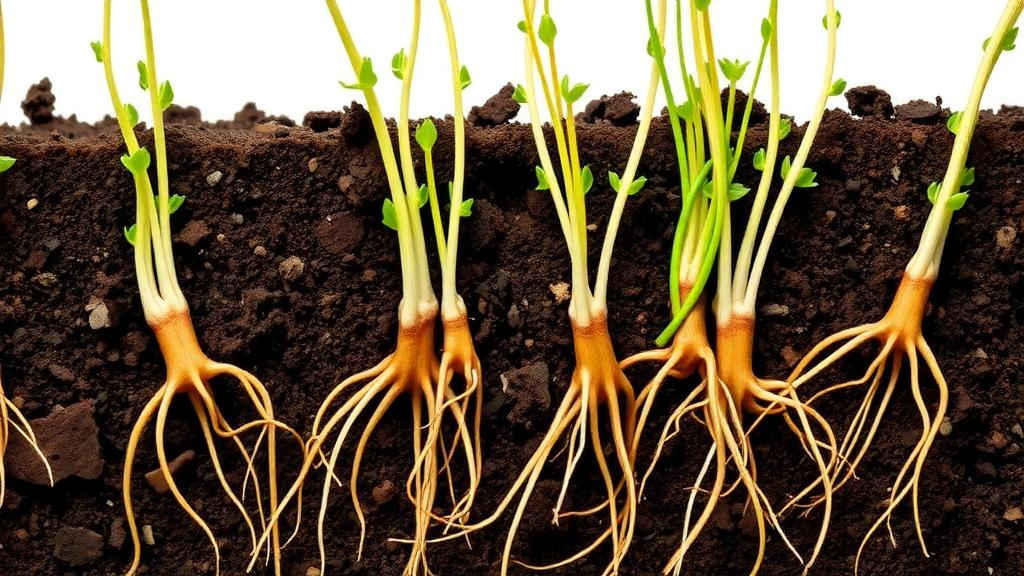
In the salt-scorched soils of arid Northwest China, a quiet revolution is taking place beneath the feet of desert plants. New research published in Plant and Soil reveals that halophytes—the hardy plants that thrive where most vegetation would perish—do not simply tolerate salty ground. Instead, each species appears to engineer its own distinct salinity micro-environment in the rhizosphere, the narrow zone of soil hugging its roots, and in doing so triggers a dramatic, nonlinear reorganization of the microbial communities living there. The study, led by Zhirong Ma and supervised by Xian Xue of the Northwest Institute of Eco-Environment and Resources at the Chinese Academy of Sciences, offers one of the most detailed portraits yet of how plants and microbes jointly negotiate life along a salinity gradient.
The research team surveyed eight native plant species, including six halophytes, distributed across multiple salinity levels in a natural salinity gradient. At each sampling point, they collected paired samples of rhizosphere soil—the soil directly influenced by roots—and bulk soil from further away. This paired design allowed the researchers to separate the influence of the plant itself from the influence of the surrounding environment, a distinction that has long frustrated ecologists studying stressed ecosystems. The samples were then subjected to a battery of physicochemical measurements and high-throughput genetic sequencing of bacterial 16S rRNA genes and fungal internal transcribed spacer regions, providing a census of who lives where.
The first major finding concerns what the authors call rhizosphere salinity differentiation. Rather than the salt content around roots simply mirroring that of the surrounding soil, the degree to which plants modified salinity in their immediate root zone proved strongly species-dependent. The researchers classified the plants into three apparent phenotypes: a late-transition phenotype, an early-transition phenotype, and a persistent salt-avoidance phenotype. In practical terms, some species allowed the salinity of their rhizosphere to track background soil conditions until relatively high salt levels were reached, others diverged from the background early on the gradient, and a third group appeared to maintain a consistently lower-salt environment around their roots regardless of how salty the surroundings became.
This differentiation matters because the rhizosphere is where the action happens chemically. Roots exude sugars, organic acids, and other compounds that feed microbes and alter soil chemistry, and different salt-tolerance strategies—such as salt secretion through specialized glands, ion exclusion at the root surface, or salt accumulation in tissues—leave different chemical fingerprints in the surrounding soil. The study’s classification of salinity phenotypes suggests that these physiological strategies, long studied at the level of individual plants, scale up to create recognizable and repeatable soil environments that differ from species to species even within the same salty landscape.
To disentangle the forces shaping microbial communities, the team employed a suite of statistical tools, including marginal PERMANOVA, variation partitioning, and Threshold Indicator Taxa Analysis, known as TITAN. The results painted a two-layer picture. Background soil electrical conductivity, a standard measure of salinity, was significantly associated with both bacterial and fungal community composition in rhizosphere and bulk soils alike, indicating that salinity acts as a broad environmental filter across the landscape. But plant identity showed a significant independent association only in the rhizosphere. In other words, once you move into the root zone, the host plant adds its own signature on top of the environmental filtering imposed by salt.
TITAN revealed something particularly striking about how microbial taxa respond to increasing salinity: the transition is not a gentle drift but a turnover of players. As salinity rose, relatively salt-sensitive taxa were replaced by halotolerant ones, and the pattern of replacement varied depending on the host plant. This host-dependent microbial reassembly suggests that the same salinity level can support different microbial assemblages depending on which plant is growing there, a finding that complicates simple models that treat soil salinity as the sole determinant of microbial life in saline environments.
Function, not just identity, was also reshuffled. Using FAPROTAX to infer bacterial functional potentials and FUNGuild to assign fungal ecological guilds, the researchers found that predicted functions and guilds were redistributed across host species and salinity levels rather than declining uniformly as salt increased. This redistribution echoes a broader principle in microbial ecology: taxonomic composition can shift dramatically while functional capacity is maintained through compensation, with different taxa stepping into equivalent roles. In saline soils, the functional reshuffling appears to be organized partly by the host plant, hinting that halophytes may recruit microbial capabilities suited to their particular survival strategies.
Perhaps the most visually compelling result came from co-occurrence network analysis, which maps the potential interactions among microbial taxa as nodes connected by edges. The topology of these networks reorganized nonlinearly along the salinity gradient. Rather than networks simply becoming simpler or more fragmented in step with rising salt, the structure changed in abrupt, nonlinear ways, suggesting that microbial communities in saline soils may pass through thresholds or transition zones where the architecture of their interactions is rapidly rebuilt. Nonlinear reorganization of this kind has implications for ecosystem stability, because communities that reorganize suddenly may respond to further environmental change in unpredictable ways.
The broader significance of the work lies in its implications for managing salinized land. Soil salinization is a growing global problem, driven by irrigation practices, climate change, and natural aridity, and it threatens agricultural productivity across vast dryland regions. Halophytes are increasingly viewed as candidates for saline agriculture and as tools for ecological restoration of degraded saltlands. This study suggests that the value of a given halophyte species for restoration may depend not only on its own tolerance of salt but on the salinity phenotype it creates in its rhizosphere and the microbial community it assembles around itself. A plant that persistently lowers salinity around its roots, for example, might facilitate soil improvement in ways that a salt-accumulating species does not.
The findings also refine how scientists think about the respective roles of environment and host in structuring soil life. By showing that background salinity filters microbes in both rhizosphere and bulk soils while host-associated processes contribute an additional rhizosphere-specific signal, the study supports a layered model of microbial assembly: broad environmental sorting first, followed by host-mediated selection in the root zone. As salinization intensifies worldwide, understanding this layering could help researchers predict which plant–microbe combinations will persist on salt-degraded land, and potentially guide the design of microbial inoculants or planting strategies that accelerate the recovery of arid saline ecosystems. The sequence data from the study are publicly available through the NCBI database, allowing other researchers to build on this growing picture of life at the salty edge.
Subject of Research: Rhizosphere salinity differentiation and microbial community reassembly in halophytes along soil salinity gradients
Article Title: Species-specific rhizosphere salinity differentiation and nonlinear microbial network reorganization along salinity gradients in halophytes
Article References: Ma, Z., Liang, B., Guo, P., Gao, Y., & Xue, X. (2026). Species-specific rhizosphere salinity differentiation and nonlinear microbial network reorganization along salinity gradients in halophytes. Plant and Soil. https://doi.org/10.1007/s11104-026-09173-4
Image Credits: AI Generated
DOI: 10.1007/s11104-026-09173-4
Keywords: halophytes, rhizosphere, soil salinity, microbial communities, 16S rRNA, fungal ITS, co-occurrence networks, TITAN, FAPROTAX, FUNGuild, arid ecosystems, soil salinization
Cite Scienmag News
Morgan Morrow. (October 7, 2026). Halophyte Roots Rewrite Their Microbial Worlds as Soil Salt Shifts. Scienmag. https://scienmag.com/halophyte-roots-rewrite-their-microbial-worlds-as-soil-salt-shifts/
Morgan Morrow. "Halophyte Roots Rewrite Their Microbial Worlds as Soil Salt Shifts." Scienmag, 7 October 2026, https://scienmag.com/halophyte-roots-rewrite-their-microbial-worlds-as-soil-salt-shifts/. Accessed 7 October 2026.
Morgan Morrow. "Halophyte Roots Rewrite Their Microbial Worlds as Soil Salt Shifts." Scienmag. October 7, 2026. https://scienmag.com/halophyte-roots-rewrite-their-microbial-worlds-as-soil-salt-shifts/


