


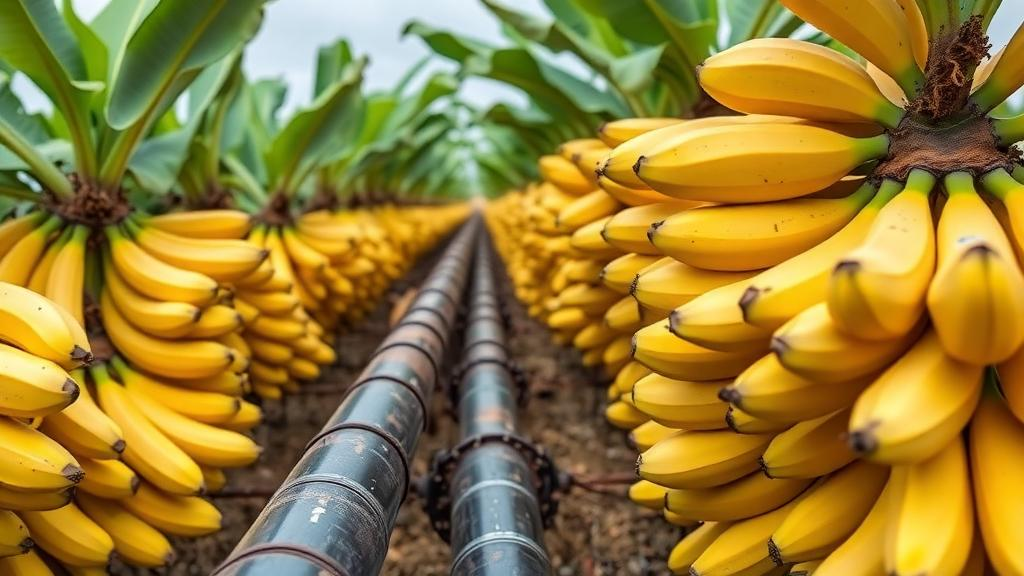
Australia’s banana industry throws away perfectly edible fruit for reasons that have surprisingly little to do with farming skill or bad weather. A new qualitative study published in the Journal of Agriculture and Food Research argues that the real driver of food waste in the sector is something far less visible: how well the industry coordinates the supply and demand for labour. Drawing on in-depth interviews across four Queensland banana operations of very different sizes, the research shows that workforce continuity, training, and role-specific capability shape whether bananas reach supermarket shelves, get downgraded, or end up as cattle feed.
The stakes are considerable. Australia produced roughly 369,000 tonnes of fresh bananas in the 2023–24 season, worth an estimated $697.8 million, and about 94 per cent of that output comes from Far North Queensland. The industry is built around approximately 540 family farms alongside a smaller number of corporate enterprises, and despite decades of mechanisation it remains fundamentally labour-intensive. Harvesting, de-handing, grading, packing, and ripening all depend on timely, skilled human intervention. When labour is unavailable, mismatched, or insufficiently trained, fruit loses market value quickly, even while remaining nutritionally sound.
What makes the study distinctive is its mesoeconomic lens. Rather than treating food waste as a technical failure at a single point in the supply chain, the researchers examine the intermediate layer of institutions and organisations, such as farms, packing sheds, labour pipelines, and market channels, that connects individual farm decisions to economy-wide outcomes. Food waste, in this framing, is the emergent result of coordination, or miscoordination, between labour supply, production schedules, quality standards, and market access. The study deliberately distinguishes waste generation from value recovery, treating bananas diverted to processing, secondary markets, donations, or animal feed as recovered rather than simply discarded.
The four case studies span the industry’s full structural range. Farm 1 is a small family operation under 50 acres relying almost entirely on household labour, selling directly to local and interstate markets and reporting waste of only about 5 per cent, much of it diverted to animal feed. Farm 2 is a small-to-medium enterprise dependent on rotating visa-based crews of Pacific Island workers and backpackers. Farm 3 is a medium-to-large centralised packing shed serving seven growers with a mixed workforce of permanent staff, long-term migrants, backpackers, and PALM scheme workers. Farm 4 is a vertically integrated giant with more than 500 workers, its own institutionalised PALM pipeline, robotic packing, and processing facilities that recover roughly 60 per cent of its off-spec fruit.
One of the study’s most important findings is that labour shortages rarely translate directly into unharvested bananas. Instead, the labour–waste relationship operates through subtler channels: workforce continuity, farm-specific knowledge, training requirements, and task accuracy. On Farm 2, each new intake of visa workers must be retrained in precise tasks such as bell injection, spraying, bagging, and harvesting, where mistakes cause cosmetic damage that leads to downgrading. Farm 3 reported that its real bottlenecks were not general labour but role-specific positions in maintenance, logistics, and semi-technical work, where instability could disrupt equipment reliability, grading consistency, and transport coordination. Farm 4, by contrast, deliberately engineered workforce stability through its PALM scheme, keeping around 250 workers active from a rotating pool of about 400 trained returnees, so that only about 10 per cent of each intake were new and unskilled.
Skill itself emerged as a system property rather than a fixed attribute of individual workers. On the smallest farm, competence was embedded in lived, intergenerational experience, with the grower explaining that misplaced chemical injections during bell injection could directly damage fruit and create waste. On the larger farms, skill was formalised through induction, licensing, structured toolbox talks, and in-house agronomy, with Farm 4 describing a philosophy of constant retraining so that workers do not create waste in the first place. The progression from tacit know-how to precision-based craft to process-managed competence mirrors the farms’ increasing organisational complexity, and demonstrates that training is simultaneously a workforce-development strategy and a food-waste prevention intervention.
Market structures proved just as decisive as labour. Farm 2’s waste was driven primarily by supermarket cosmetic grading regimes and domestic oversupply rather than any failure of production, with rejected bananas described as nutritionally perfect yet commercially unsaleable. The grower deliberately limited second-grade sales, fearing that cheap downgraded fruit would erode first-grade prices in a market supplied entirely domestically. Farm 3’s packing shed quantified the seasonal rhythm of loss, with waste rising to 25–30 per cent in the summer months and falling to 15–18 per cent in winter, compounded by bruising from transport. Strikingly, the shed found that packing to different retailer specifications changed both waste rates and kilograms packed per worker, a direct illustration of how downstream retail standards propagate upstream into labour productivity and reject volumes.
The study also uncovered a non-linear relationship between technology and waste that challenges assumptions about agricultural modernisation. The smallest farm achieved low waste with almost no technology, relying on rapid market turnover and close supervision. The intermediate farms adopted sensors, drones, and digital monitoring, yet experienced higher waste because deeper integration into supermarket supply chains exposed them to stricter grading and logistics pressures. Only at the highest level of integration, exemplified by Farm 4’s mechanised sheds, robotic pallet stacking, cold-chain infrastructure, and processing plants that convert imperfect bananas into peeled product for banana bread manufacturing and skins into cattle feed, did technology combine with organisational capability to recover substantial value. Even there, recovery decisions were governed by cost structures rather than technical feasibility alone.
The researchers are careful to note the limits of their evidence. The four cases were selected for analytical diversity rather than statistical representativeness, the design is qualitative and cross-sectional, and the perspectives of workers, retailers, and processors were not directly captured. They also caution that the operational benefits of the PALM scheme should not be read as an endorsement of its broader social performance, given documented concerns about worker rights, employment conditions, and dependency on employers under temporary migration arrangements.
Nevertheless, the policy implications are clear. Reducing food waste in perishable horticulture requires integrated interventions that go well beyond farm-level technology adoption: strengthening labour pipelines, supporting skill development, expanding economically viable secondary markets, and investing in processing infrastructure. Interventions should be differentiated by scale, since small farms face affordability constraints while large enterprises face pipeline governance and retention challenges. Above all, the study reframes food waste as a mesoeconomic coordination outcome, produced at the interface between farms and markets, and shows that whether a banana becomes waste depends less on how it was grown than on how the whole system of labour, grading, logistics, and recovery is organised around it.
Subject of Research: Labour demand–supply coordination and food waste generation and recovery in the Australian banana industry
Article Title: From plantation to secondary market: A mesoeconomic thematic analysis on labour demand–supply coordination and food waste reduction in the Australian banana industry
Article References: Roy, M., Akbar, D., Rahman, A., Rajapaksa, D., & Rixon, C. (2026). From plantation to secondary market: A mesoeconomic thematic analysis on labour demand–supply coordination and food waste reduction in the Australian banana industry. Journal of Agriculture and Food Research, 31, Article 103329. https://doi.org/10.1016/j.jafr.2026.103329
Image Credits: AI Generated
DOI: 10.1016/j.jafr.2026.103329
Keywords: food waste, banana industry, labour coordination, mesoeconomics, Queensland agriculture, circular economy, PALM scheme, supermarket grading standards, secondary markets, workforce training, supply chain, value recovery
Cite Scienmag News
Alan Morgan. (October 7, 2026). Labour Pipelines, Not Just Machines, Decide Whether Bananas Become Waste. Scienmag. https://scienmag.com/labour-pipelines-not-just-machines-decide-whether-bananas-become-waste/
Alan Morgan. "Labour Pipelines, Not Just Machines, Decide Whether Bananas Become Waste." Scienmag, 7 October 2026, https://scienmag.com/labour-pipelines-not-just-machines-decide-whether-bananas-become-waste/. Accessed 7 October 2026.
Alan Morgan. "Labour Pipelines, Not Just Machines, Decide Whether Bananas Become Waste." Scienmag. October 7, 2026. https://scienmag.com/labour-pipelines-not-just-machines-decide-whether-bananas-become-waste/


