


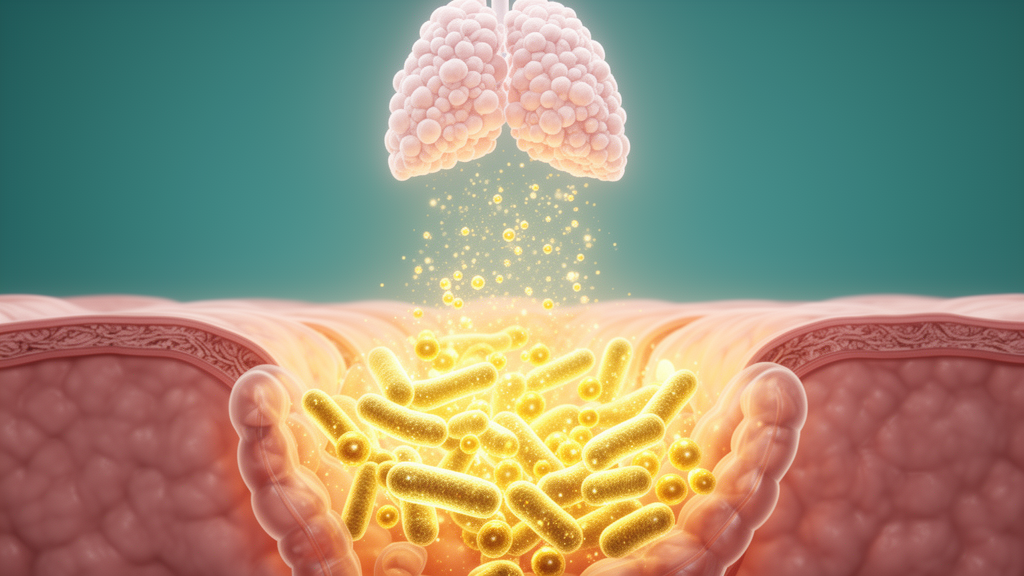
Could the bacteria living in your gut influence whether you develop lung cancer? It sounds far-fetched, but the gut–lung axis — the bidirectional communication network linking intestinal microbes to pulmonary immunity — has become one of the most provocative frontiers in cancer research. Now, a team from Guangxi Medical University in China has taken a genetically rigorous swing at the question, combining Mendelian randomization with laboratory experiments on a key microbial metabolite. Their findings, published in Frontiers in Genetics, are a masterclass in scientific caution: six suggestive microbial links to non-small cell lung cancer (NSCLC) risk, none of which survive strict statistical scrutiny, alongside striking but exploratory evidence that sodium butyrate can reprogram macrophages exposed to a lung tumor environment.
Lung cancer remains a leading cause of cancer mortality worldwide, and NSCLC — comprising mainly adenocarcinoma and squamous cell carcinoma — accounts for most cases. Despite advances in surgery, systemic therapies and immune checkpoint inhibitors, resistance and immune escape continue to frustrate treatment. Observational studies have hinted that gut microbiome composition may shape responses to PD-1-based immunotherapy in NSCLC patients, and antibiotic exposure has been associated with poorer outcomes during checkpoint inhibitor treatment. But those studies concern treatment response or survival, not cancer susceptibility, and they are vulnerable to confounding by diet, smoking, antibiotics and environmental factors. Reverse causation is also possible: cancer and its systemic effects may themselves alter the gut microbiome.
To sidestep these pitfalls, the researchers turned to Mendelian randomization (MR), a technique that uses genetic variants as instrumental variables for an exposure. Under assumptions of instrument relevance, independence from confounders and absence of effects on the outcome through other pathways, MR can inform causal hypotheses in a way observational studies cannot. The team drew exposure summary statistics from the MiBioGen consortium meta-analysis of 16S rRNA gene profiles in 18,340 participants across 24 cohorts, and outcome data from FinnGen release 5 via OpenGWAS, comprising 1,627 NSCLC cases and 217,165 controls. Because few microbiome variants reach conventional genome-wide significance, they used a relaxed exposure threshold of P < 1 × 10^(−5), with linkage disequilibrium clumping at r^(2) < 0.001 and a 10,000 kb window, and excluded instruments with F < 10. The retained dataset contained 1,421 SNP–exposure records across 119 genera.
Inverse variance weighting (IVW) served as the primary estimator, with Benjamini–Hochberg false discovery rate (BH-FDR) correction applied across all 119 genera. Sensitivity analyses included MR-Egger, weighted median, mode-based methods, Cochran’s Q, MR-Egger intercept, MR-PRESSO and leave-one-out analyses. Six genera showed nominal inverse IVW associations with NSCLC risk at unadjusted P values ranging from 0.0120 to 0.0498: Alistipes (OR 0.574), Methanobrevibacter (0.751), Bacteroides (0.629), Ruminococcus gauvreauii group (0.671), Ruminococcus 1 (0.680) and Peptococcus (0.790). All six odds ratios below 1 suggest that higher genetically proxied abundance of these genera is associated with lower NSCLC risk.
But here is the crucial caveat: none of these associations survived BH-FDR correction across 119 genera, with q values ranging from 0.6072 to 0.9819. None survived Bonferroni correction either. Sensitivity tests did not detect heterogeneity or directional pleiotropy for the six genera — IVW Cochran’s Q P values ranged from 0.2469 to 0.8964, MR-Egger intercept P values from 0.3582 to 0.8993, and MR-PRESSO global P values from 0.249 to 0.901 — but alternative estimators and leave-one-out analyses did not consistently retain nominal significance. Weighted median estimates were inverse for all six genera, yet only Peptococcus reached nominal P < 0.05 with this estimator. MR-Egger estimates were not nominally significant for any of the six, and the Bacteroides MR-Egger point estimate was positive while its IVW estimate was inverse. Leave-one-out point estimates remained inverse, but 95% confidence intervals crossed zero after removing some SNPs for five of the six genera; only Peptococcus retained nominal significance across all 16 exclusions.
The authors are careful to frame these as suggestive rather than established protective effects. The relaxed instrument threshold may increase susceptibility to weak-instrument bias and winner’s curse despite F statistics above 10. Differences between the multi-ancestry exposure data, Finnish outcome data and European LD reference panel may influence the estimates, and participant overlap could not be quantified. Genus-level data limit species- and strain-specific attribution, and Methanobrevibacter is an archaeal genus rather than a bacterial one. Reverse MR and Steiger directionality testing were not performed, and the outcome was analyzed as overall NSCLC without histological stratification. No positive IVW association reached nominal P < 0.05 in this dataset, though the authors note this does not establish that risk-increasing taxa do not exist.
Separately from the genetic analysis, the team conducted exploratory experiments with sodium butyrate (NaB), a representative microbial metabolite rather than a taxon-specific product. Butyrate, a short-chain fatty acid produced by gut bacteria, is known to inhibit histone deacetylases (HDACs) in intestinal macrophages, and published work has identified HDAC-related effects of butyrate in that context. The researchers cultured THP-1 human monocyte-derived macrophages and exposed them to tumor-conditioned medium (TCM) from A549 NSCLC cells, then applied 1 mM NaB for 24 hours. TCM reduced TNF-α, CD86 and iNOS transcript levels — markers associated with pro-inflammatory M1 polarization — and increased Arg-1, TGF-β and CD206, markers associated with alternative M2 polarization. Addition of NaB shifted these markers in the opposite direction, with Tukey-adjusted P values < 0.0001 for both TCM versus Control and TCM plus NaB versus TCM for all six markers.
The CCK-8 assay, a measure of metabolic viability, told a complementary story. Mean relative CCK-8 signals were 100.00% ± 1.51% for Control, 129.10% ± 2.89% for TCM and 92.95% ± 1.98% for TCM plus NaB. TCM increased the signal relative to Control (Tukey-adjusted P < 0.0001), whereas NaB reduced it relative to both TCM (P < 0.0001) and Control (P = 0.000158). Western blot densitometry showed mean acetylated histone H3 (Ac-H3)/GAPDH fold changes of 1.00 ± 0.17 for Control, 0.62 ± 0.09 for TCM and 1.71 ± 0.07 for TCM plus NaB. TCM reduced the signal relative to Control (Tukey-adjusted P = 0.0190), and NaB increased it relative to TCM (P = 0.0000765) and Control (P = 0.000844). Increased Ac-H3 is consistent with altered histone acetylation, though the authors caution that Ac-H3/GAPDH does not distinguish changes in histone acetylation from changes in total H3 abundance.
Physiological exposure is a critical consideration for interpreting the NaB experiments. Gut-derived butyrate is used by intestinal cells and undergoes substantial splanchnic metabolism before reaching systemic tissues; a human stable-isotope study reported approximately 2% systemic availability of colon-delivered butyrate. The experiments used a single pharmacological concentration of 1 mM, and plasma and tissue concentrations were not measured. Concentration–response studies and direct exposure measurements would clarify whether comparable effects occur at concentrations attainable in the lung. The authors also note that A549 cells served as the source of TCM, but cancer-cell viability and macrophage-mediated cancer-cell killing were not assessed. Direct HDAC activity measurements, total-H3 normalization and receptor perturbation would help distinguish HDAC-dependent effects from GPR41/GPR43 signaling.
The study’s design considerations should guide further work. The cellular observations derive from one macrophage cell-line model, one NaB concentration and small biological replicate groups — n = 4 per group for RT-qPCR, n = 6 for CCK-8 and n = 3 for Western blotting. Functional assays and validation in additional models are needed to assess the persistence, mechanism and biological relevance of these responses. Translation to screening or prevention would require independent validation and evaluation of predictive performance, efficacy and safety. Strain-resolved functional analysis and direct metabolite measurements could help prioritize the associations for further study. The genetic and cellular analyses address related but distinct questions and were interpreted separately: the MR analysis addresses NSCLC risk, not treatment response, checkpoint inhibitor efficacy, progression-free survival or overall survival.
What emerges is a two-pronged framework for investigating the gut–lung axis in lung cancer. On the genetic side, six suggestive microbial associations with NSCLC risk require independent replication before any causal claim can be made. On the cellular side, NaB alters polarization-associated transcripts, metabolic viability signals and histone acetylation in TCM-exposed THP-1-derived macrophages, providing a basis for further study of microbial metabolites in the tumor microenvironment. The findings support treating microbial associations and metabolite responses as distinct components of the gut–lung axis — a distinction that will be essential as researchers work to determine whether the bacteria in our guts truly shape our lung cancer risk, or whether the story is more about the metabolites they produce and the immune cells they influence.
Subject of Research: Genetics
Article Title: Genetic associations in the gut–lung axis: a Mendelian randomization study and in vitro assessment of sodium butyrate in non-small cell lung cancer
Article References: Genetic associations in the gut–lung axis: a Mendelian randomization study and in vitro assessment of sodium butyrate in non-small cell lung cancer. (n.d.). https://doi.org/10.3389/fgene.2026.1900040
Image Credits: AI Generated
DOI: 10.3389/fgene.2026.1900040
Keywords: gut-lung axis, Mendelian randomization, non-small cell lung cancer, gut microbiota, sodium butyrate, macrophages, histone acetylation, FinnGen, MiBioGen, tumor microenvironment, Genetic, associations
Cite Scienmag News
Nathaniel Bowman. (October 16, 2026). Gut Microbes and Lung Cancer: Genes Point to Six Suggestive Links, But Butyrate Experiments Steal the Show. Scienmag. https://scienmag.com/gut-microbes-and-lung-cancer-genes-point-to-six-suggestive-links-but-butyrate-experiments-steal-the-show/
Nathaniel Bowman. "Gut Microbes and Lung Cancer: Genes Point to Six Suggestive Links, But Butyrate Experiments Steal the Show." Scienmag, 16 October 2026, https://scienmag.com/gut-microbes-and-lung-cancer-genes-point-to-six-suggestive-links-but-butyrate-experiments-steal-the-show/. Accessed 16 October 2026.
Nathaniel Bowman. "Gut Microbes and Lung Cancer: Genes Point to Six Suggestive Links, But Butyrate Experiments Steal the Show." Scienmag. October 16, 2026. https://scienmag.com/gut-microbes-and-lung-cancer-genes-point-to-six-suggestive-links-but-butyrate-experiments-steal-the-show/


