


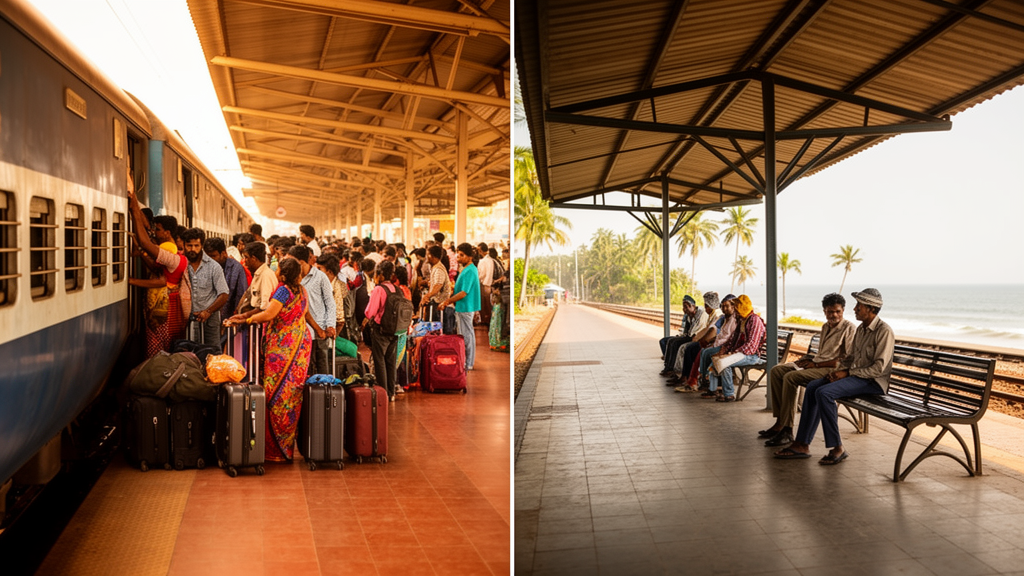
International labour migration from Kerala and West Bengal to Gulf Cooperation Council countries followed opposing trends in a comparative study published in 2026 in SN Social Sciences. Analysis of Ministry of External Affairs data found an upward trend for West Bengal and a downward trend for Kerala. Kerala was the leading source state through 2014, but West Bengal emerged as one of the leading contributors from 2015 onward. The findings concern recorded migration from these two states and do not amount to evidence that Gulf destinations or Indian overseas migration as a whole changed in the same way.
Researchers Abbasuddin Sk and Subrata Purkayastha examined the volume, trend and pattern of labour emigration from Kerala and West Bengal to GCC countries. The statistical analysis included the Mann–Kendall method to assess whether the migration series displayed a monotonic trend and Sen’s slope analysis to evaluate the magnitude of that trend. The abstract reports the direction of the trends but does not explicitly state that either was statistically significant, nor does it provide confidence intervals or other uncertainty estimates. Likewise, the available research summary does not report the underlying annual migration totals, the numerical slope estimates, or the period over which the time series was calculated.
The study went beyond trend detection by considering five indicators associated with changes in the volume and pattern of migration. Relevant data were drawn from the Reserve Bank of India; the Directorate of Economics and Statistics within the Department of Agriculture and Farmers Welfare; the Ministry of Agriculture; the National Sample Survey Office; the Census of India; and the Kerala Migration Survey. Independent-samples t-tests were used to test the significance of differences in the selected indicators. According to the authors, all five indicators differed significantly between Kerala and West Bengal. However, the supplied evidence does not identify the individual indicators, their values or units, or the effect sizes associated with those differences, so it cannot establish which specific economic or demographic conditions were most closely connected to the change.
The results point to a change in the relative position of the two states within a particular migration corridor. Kerala’s recorded flow to GCC countries was described as leading until 2014, after which West Bengal emerged as one of the leading states. The authors interpret the combined indicator analysis as helping explain this shift in both trend and migration volume. At the same time, the reported comparisons demonstrate differences and associations rather than proving that a single indicator caused Kerala’s downward trend or West Bengal’s upward trend. The accessible summary also does not distinguish the contributions of individual Gulf countries, distinguish migrant counts from rates, or explain whether changes in the size of each state’s working-age population affected the recorded totals.
Because the analysis is a two-state comparison, it cannot by itself characterize migration from every part of India or establish a nationwide change in labour migration to the Gulf. The evidence also does not quantify the size of the post-2014 reversal in state rankings, identify changes in migrant wages, employment conditions or remittances, or evaluate policy responses. The authors conclude that support from government agencies and policymakers is important for regulating migration trends and volumes. Subject to those limits, the study’s central measured finding is clear: over the series examined, Kerala moved from leading Gulf migration to a declining trend, while West Bengal showed an increasing trend and became one of the leading source states from 2015.
Subject of Research: Comparative trends in labour migration from Kerala and West Bengal to Gulf Cooperation Council countries
Article Title: An assessment of the volume, trend, and pattern of international labour migration to gulf countries from India: a comparative study between Kerala and West Bengal
Article References: Sk, A., & Purkayastha, S. (2026). An assessment of the volume, trend, and pattern of international labour migration to gulf countries from India: a comparative study between Kerala and West Bengal. SN Social Sciences, 6(11), Article 571. https://doi.org/10.1007/s43545-026-01818-6
Image Credits: AI Generated
DOI: 10.1007/s43545-026-01818-6
Keywords: international labour migration, Gulf Cooperation Council, Kerala, West Bengal, India, Ministry of External Affairs, Mann–Kendall test, Sen’s slope, statistical trends, t-test, assessment, volume
Cite Scienmag News
Courtney Benton. (October 22, 2026). Gulf migration trends diverge between Kerala and West Bengal. Scienmag. https://scienmag.com/gulf-migration-trends-diverge-between-kerala-and-west-bengal/
Courtney Benton. "Gulf migration trends diverge between Kerala and West Bengal." Scienmag, 22 October 2026, https://scienmag.com/gulf-migration-trends-diverge-between-kerala-and-west-bengal/. Accessed 22 October 2026.
Courtney Benton. "Gulf migration trends diverge between Kerala and West Bengal." Scienmag. October 22, 2026. https://scienmag.com/gulf-migration-trends-diverge-between-kerala-and-west-bengal/


