


A five-day course of enrofloxacin temporarily cleared Mesomycoplasma ovipneumoniae from the nasal cavities of experimentally infected lambs, but the pathogen returned in most treated animals during the following month. The pilot study found no significant differences between treated and untreated lambs in overall health scores or average daily weight gain, although enrofloxacin accelerated the decline in body temperature and was associated with less severe lung changes on microscopic examination. Results also showed that M. ovipneumoniae persisted in the middle ears of every lamb at the experimental endpoint, identifying a possible reservoir beyond the nasal passages.
The researchers randomly assigned 10 specific-pathogen-free lambs, each about three months old, to an enrofloxacin group or an untreated control group, with five animals in each. All were inoculated with fresh nasal wash collected from sheep naturally infected with M. ovipneumoniae. The wash was treated with ceftiofur to remove viable M. haemolytica and other Pasteurellaceae before administration. Colonization with M. ovipneumoniae was confirmed by quantitative polymerase chain reaction, or qPCR, in every lamb one week after inoculation. By the time treatment began four weeks later, all 10 animals were positive for M. ovipneumoniae, while nine of the 10 had also become colonized by M. haemolytica.
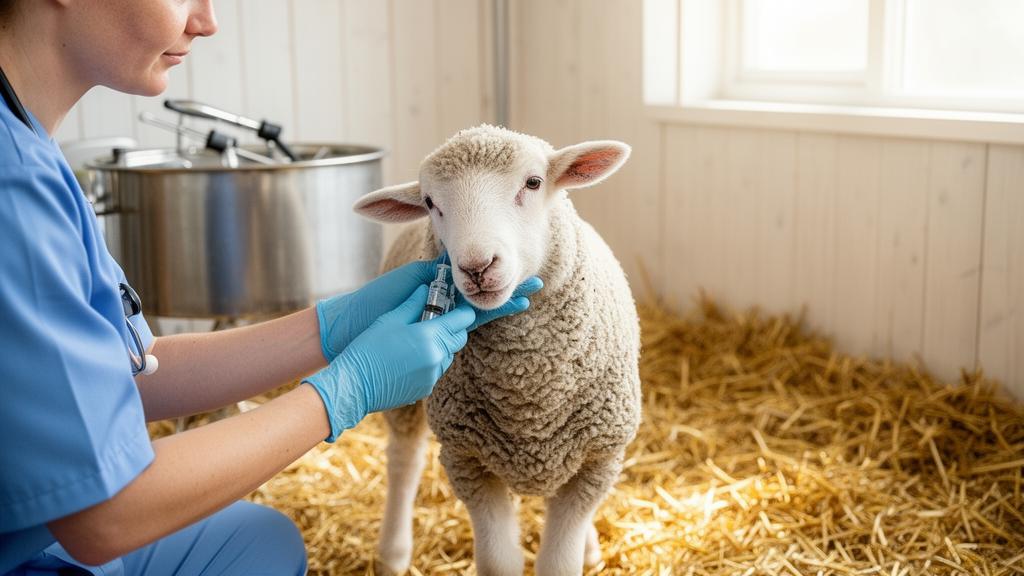
The treated lambs received enrofloxacin every 24 hours for five consecutive days through two routes. Each animal received a 0.5 mg/kg dose diluted in 200 mL of saline for intranasal administration, with the solution introduced into one nostril and then the other after 60 seconds, as well as a 5 mg/kg subcutaneous injection. Researchers assessed respiratory and behavioral signs twice daily, measured body temperature every two weeks, recorded weight weekly and collected nasal swabs weekly for qPCR detection of both bacteria. After the four-week treatment period, all animals were euthanized and samples were collected from the nasal cavities, paranasal sinuses, trachea, bronchi, lungs and middle ears. Gross and microscopic lung examinations, as well as antimicrobial susceptibility testing of recovered isolates, complemented the molecular measurements.
One week after the first enrofloxacin dose, all five treated lambs tested negative for M. ovipneumoniae in nasal swabs, and all five were also negative for M. haemolytica. The disappearance was temporary, however. One treated lamb, or 20%, was positive for M. ovipneumoniae two weeks after treatment; two, or 40%, were positive at week three; and three, or 60%, were positive by week four. Every lamb in the untreated control group remained positive for M. ovipneumoniae throughout the experiment. M. haemolytica followed a similar pattern: its nasal detection disappeared temporarily in the treated group and returned in the same three lambs at the experimental endpoint. All untreated controls remained positive for that secondary bacterium. The results therefore support a short-lived suppression of both organisms rather than sustained clearance of the experimental infection.
Clinical outcomes did not clearly distinguish the groups. Neither group developed major respiratory disease beyond occasional sneezing and elevated body temperature, although the treated animals generally had lower health scores. A mixed-effects model found that the interaction between treatment and time was not statistically significant for health score, yielding an incidence rate ratio of 0.79, a 95% confidence interval of 0.48 to 1.30 and P = 0.338. The endpoint analysis could not formally confirm the visual trend toward recovery because all treated animals reached zero health scores at week four, creating complete separation in the data. Body temperature declined significantly faster after treatment: the treatment-by-time interaction had an estimate of 0.16, a 95% confidence interval of 0.04 to 0.28 and P = 0.007. That difference in the rate of decline did not translate into a significant difference between weeks zero and four. Average daily weight gain also showed no significant treatment-by-time interaction, either longitudinally or at the endpoint, and final outcomes in the two groups were statistically similar.
Pathology at necropsy provided evidence of a modest treatment effect. Gross lung abnormalities were limited and inconsistent, with no apparent difference between the groups; two treated and two untreated lambs had no visible pulmonary lesions. Blinded histological scoring, however, identified lower pulmonary edema and congestion in treated lambs, with a mean score of 0.8 compared with 1.7 in controls, P = 0.040. The combined histological lung score was also lower after treatment, at 1.1 compared with 3.8, P = 0.032. Treated animals showed trends toward less bronchiolar inflammation, less inflammation in alveolar and interstitial spaces and less bronchus-associated lymphoid tissue hyperplasia, although the individual comparisons for those measures did not reach statistical significance. Transmission electron microscopy of tracheal tissue from two animals per group also found disrupted cilia in both untreated lambs and intact cilia with a recognizable microtubule core in the two treated lambs examined. Because only four animals were examined ultrastructurally, that observation was descriptive rather than a formal group comparison.
Testing at the endpoint suggested that the nasal cavity did not represent the only site of infection. qPCR detection of M. ovipneumoniae was inconsistent across the nasal cavity, paranasal sinus, trachea and bronchi, and there was no significant difference in pathogen detection between treated and untreated animals in the upper or lower respiratory tract. Although pathogen loads in treated lambs trended lower, most swabs from both groups were negative. By contrast, every middle-ear swab from every lamb was positive for M. ovipneumoniae, including those from animals that had remained negative in serial nasal testing. Middle-ear samples were negative for M. haemolytica. The findings suggest that the middle ear may provide a protected niche from which nasal infection can recur, but the study did not directly trace organisms between the ear and nasal cavity. Enrofloxacin was associated with a significant reduction in M. haemolytica in the caudal nasal cavity at the endpoint, with P no higher than 0.0001, while detection of the secondary bacterium at other sites remained inconsistent.
The investigators cultured 11 M. ovipneumoniae isolates from lung tissue: four from one treated lamb and seven from three untreated controls. Enrofloxacin minimum inhibitory concentrations varied widely, from 0.005 to 8.1 micrograms per milliliter overall. One of the four isolates from the treated lamb with recurrent infection initially produced an MIC of 20 ± 0.00 micrograms per milliliter in two independent experiments after ten culture passages. The same isolate yielded a much lower value, 0.134 ± 0.039 micrograms per milliliter, after it had been frozen for a year and tested at passage 12 in three experiments. MICs among isolates from untreated controls ranged from 0.010 to 0.055 micrograms per milliliter, while the Y98 reference strain measured 0.004 ± 0.001 micrograms per milliliter. Five M. haemolytica isolates had MICs of 0.001 to 0.25 micrograms per milliliter, all within the susceptible range under the cited clinical guidelines. Because clinical interpretation criteria for M. ovipneumoniae MIC values are unavailable, the high result cannot be classified as confirmed resistance. It could reflect acquired resistance, selection of a less-susceptible strain already present in the mixed inoculum, or changes during culture.
Several limitations prevent the study from identifying why infection returned. The lambs were housed by group rather than individually, leaving unresolved whether recurrence resulted from transmission among animals, re-exposure in the animal room, or continuous infection at levels below the limits of routine nasal detection. Nasal swabs before treatment were unsuitable for recovering culturable M. ovipneumoniae, preventing comparison of strains carried before and after therapy. The sample size of five lambs per group also limited statistical power, while the mild clinical illness and potentially low-virulence organisms in the inoculum may have left little room to detect differences in health or growth. The authors note that biofilms might contribute to persistence, but that possibility was not tested. A larger experiment with individual housing and whole-genome comparison of isolates before and after treatment would be needed to distinguish reinfection from persistent colonization. Taken together, the findings show that enrofloxacin can temporarily reduce nasal detection of M. ovipneumoniae and may lessen microscopic lung injury in infected lambs, but a five-day course did not reliably eradicate the pathogen from all anatomical sites or prevent its later return.
Subject of Research: Experimental evaluation of enrofloxacin against Mesomycoplasma ovipneumoniae infection in domestic lambs
Article Title: Limited efficacy of enrofloxacin against Mesomycoplasma ovipneumoniae infection in domestic lambs
Article References: Sonar, S., Throolin, M., Smith, S., Sago, J., Selong, E. T., Adams, N., Dibbert, J., Quirk, M. D., Schaff, N. J., Schwantje, H., Posbergh, C. J., & Bimczok, D. (2026). Limited efficacy of enrofloxacin against Mesomycoplasma ovipneumoniae infection in domestic lambs. Frontiers in Veterinary Science, 13, 1944866. https://doi.org/10.3389/fvets.2026.1944866
Image Credits: AI Generated
DOI: 10.3389/fvets.2026.1944866
Keywords: Mesomycoplasma ovipneumoniae, enrofloxacin, sheep pneumonia, antibiotic treatment, qPCR, middle ear, lambs, respiratory infection, antimicrobial susceptibility, pathology, Limited, efficacy
Cite Scienmag News
Kristina Jarvis. (October 22, 2026). Enrofloxacin only temporarily suppresses respiratory infection in lambs. Scienmag. https://scienmag.com/enrofloxacin-only-temporarily-suppresses-respiratory-infection-in-lambs/
Kristina Jarvis. "Enrofloxacin only temporarily suppresses respiratory infection in lambs." Scienmag, 22 October 2026, https://scienmag.com/enrofloxacin-only-temporarily-suppresses-respiratory-infection-in-lambs/. Accessed 22 October 2026.
Kristina Jarvis. "Enrofloxacin only temporarily suppresses respiratory infection in lambs." Scienmag. October 22, 2026. https://scienmag.com/enrofloxacin-only-temporarily-suppresses-respiratory-infection-in-lambs/


