


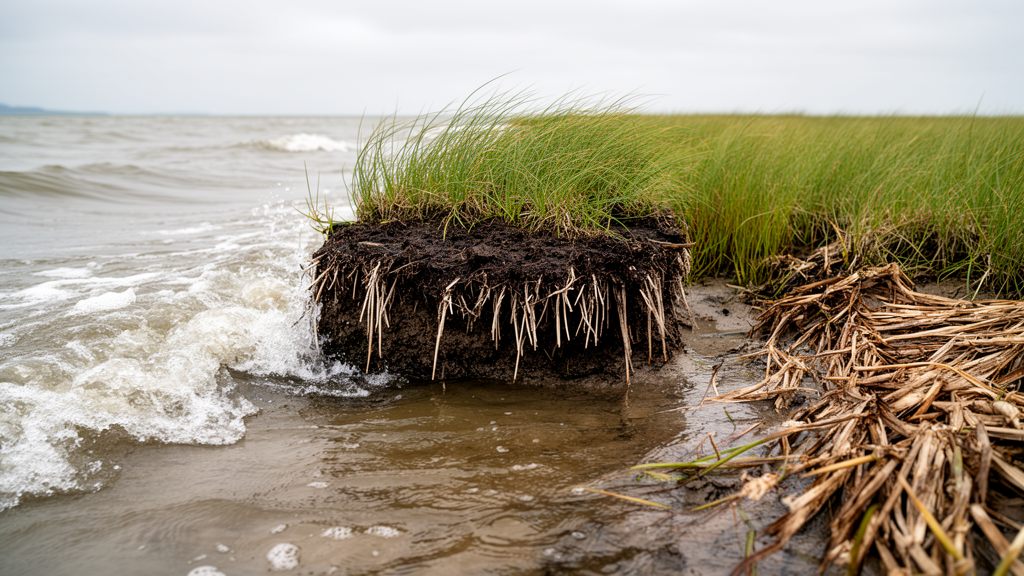
A large-scale wave-flume experiment found that the soil platform of a transplanted salt marsh resisted repeated extreme wave exposure with negligible erosion, while its above-ground vegetation was progressively damaged. After 21 hours of forcing that included significant wave heights of up to 2.00 m, the average marsh-surface decrease was 7 mm. That was smaller than the natural height variation among the 32 monitored locations, whose standard deviations ranged from 43 to 48 mm. In contrast, canopy height and biomass declined as exposure accumulated, reducing the additional wave attenuation provided by vegetation. The results indicate that salt-marsh ground can remain stable under severe waves, but substantial attenuation by marsh plants is concentrated at low-energy coasts.
The experiment addressed a major gap in quantitative evidence about how salt marshes behave during extreme storms. Marsh platforms attenuate waves partly because their elevated ground forces waves to break and lose energy, while rooted vegetation adds resistance within the water column. Those functions can deteriorate differently when storms damage the soil, break stems or remove biomass, but a comprehensive quantified understanding of the interactions had been lacking. The researchers therefore transplanted intact marsh blocks into the Delta Flume at Deltares, a 300 m long, 5 m wide and 9.5 m deep facility, and built two parallel salt-marsh profiles, each approximately 71 m long and 2.0–2.2 m wide.
The blocks came from landward and seaward locations in the Peazemerlannen nature reserve on the Dutch Wadden Sea coast. Their soils differed in texture and composition: the seaward material had a median grain size, D50, of 0.013 ± 0.010 mm and a clay content of 31.4 ± 6.8%, while the landward material had D50 of 0.003 ± 0.001 mm and a clay content of 44.5 ± 4.8%. The high-marsh zone was selected because its relatively high elevation generally contributes strongly to wave attenuation. Dominant vegetation was Elymus athericus, also classified as Elytrigia atherica, mixed with Atriplex species and Aster tripolium. Blocks were collected after the breeding season and before the storm season, with measures taken to preserve vegetation, roots and substrate during transport.
The experimental programme began in February 2024, deliberately testing the vegetation in its winter state, when its condition matched that of marsh plants outside the flume. The researchers treated this as a conservative test of breakage because growing-season vegetation can be more resistant, although extreme storms may still damage it. The flume programme combined water levels of 1.5, 2.5 and 4.0 m at the marsh with significant wave heights of 0.75, 1.25 and 2.00 m under a JONSWAP wave spectrum. Two wave-steepness values, 0.04 and 0.02, were also tested. The combinations were selected to maximize wave height relative to water depth, producing conservative conditions for vegetation damage and potentially reducing vegetation-related attenuation.
After short stability tests of approximately 100 waves, longer sequences of about 1,000 waves were applied at progressively greater depths and heights. The sequence was performed under three vegetation conditions: light damage, substantial damage and complete removal of above-ground vegetation by mowing. Comparing the vegetated and vegetation-free runs allowed the investigators to quantify the additional attenuation attributable to vegetation rather than the marsh platform alone. A reflection-compensated wave paddle generated the forcing, while fixed wave gauges measured waves near the seaward edge and at the landward end of the marsh. Three gauges at each location were used to separate incoming and reflected waves.
The platform showed no clear erosion threshold between the tested low- and high-energy conditions. Across the full experiment, average bed-level change at the 32 fixed monitoring points was a decrease of 7 mm, smaller than the marsh’s pre-existing microtopographic variation. The marsh substrate’s mean organic-matter content was 4.7 ± 1.7%, with individual values ranging from 2.3% to 7.6%, placing it within the comparatively low range represented by many European salt marshes. Most below-ground biomass was concentrated near the surface: 78% of measured root biomass occurred in the upper 5 cm. These findings support the erosion resistance of the tested soils under extreme forcing, but they do not establish that all salt-marsh soils are equally stable. Soil properties vary globally, and organic-rich, brackish and freshwater marsh soils may have different structures and rooting conditions that alter erodibility.
Vegetation showed a clear response to cumulative exposure. Measurements included canopy height, above-ground biomass, standing and broken stem dimensions, flexural strength and flotsam transported through the flume. Destructive sampling affected less than 1% of the model marsh. Stem shortening was closely associated with vegetation-related wave attenuation at the lowest tested wave height, with an r² value of 0.89 for 0.75 m waves. The relationship became weaker as wave height increased, falling to r² = 0.57 at 1.25 m and 0.33 at 2.00 m. A generalized linear model with a Tweedie distribution and log link likewise showed that vegetation-related attenuation declined with both increasing incoming wave height and longer exposure duration; both coefficients were negative and statistically significant at P < 0.001. Wave height and exposure duration together explained most of the modelled variation in the flume results, with a pseudo-R² of 0.97.
The distinction between marsh elevation and living vegetation was central to the findings. Even after all above-ground biomass was removed, the elevated platform continued to contribute attenuation. Vegetation supplied its greatest additional benefit where incoming wave heights were no more than 1 m: in this low-energy range, vegetation-related attenuation was greater than 10% and reached as much as 50%. At high-energy marsh coasts, where wave heights exceeded 1 m, the contribution from the full vegetation cover did not exceed 10%. Taller stems can increase resistance within the water column, but they also encounter greater loads as waves become more energetic. The experiment therefore supports a conditional rather than uniform role for marsh plants: intact vegetation can make a substantial contribution in sheltered settings, but damage during stronger wave exposure can reduce that benefit.
The researchers extended the flume results through a global assessment. They combined updated coastal elevation and salt-marsh extent datasets with wave information and storm-surge hydrographs, evaluating salt-marsh transects spaced 1 km apart. Exposure duration and expected vegetation damage were estimated for storms with recurrence times of 100 to 1,000 years. In the model, the most severe incoming wave height at the marsh edge was represented as 50% of water depth, and vegetation damage was estimated from the start of the storm until peak surge for periods when waves exceeded 0.5 m. Roughly 90% of globally observed peak water levels above 1 m fell within the flume’s tested water-level range. Exposure with water levels above 1.0 m and waves of 0.5 m generally did not exceed 1,000 minutes, or 16.67 hours, shorter than the 21-hour experimental duration. These comparisons place much of the global storm exposure within the conditions examined, although the assessment remains a model-based extension of the experiment.
Several limitations constrain how broadly the results can be applied. The flume represented one high-marsh zone dominated by E. athericus, whose stems have relatively weak breaking force compared with some other marsh plants, and only about 70 m of marsh was considered. A full salt marsh can contain several vegetation zones, each potentially contributing to attenuation. The experiment also used European soils with organic-matter contents representative of the lower part of the range found in North America, so the measured stability should not be treated as a universal estimate for organic-rich or brackish marsh soils. Practical global estimates will require detailed information on vegetation height, species composition and spatial variability. High-resolution satellite imagery, lidar and photogrammetry can assist mapping, but the study notes that these approaches require extensive field validation, especially where plant communities change over short distances. The evidence supports stable marsh platforms in the tested setting and a larger wave-attenuation contribution from vegetation at low-energy coasts, while leaving clear boundaries around global extrapolation.
Subject of Research: Salt-marsh soil stability, vegetation damage and wave attenuation under extreme storm conditions
Article Title: The contribution of salt marshes to wave attenuation during extreme storms
Article References: Willemsen, P. W. J. M., Mason, V. G., Zelst, V. V., van Bergeijk, V. M., Breteler, M. K., Muller, J. R. M., Dermentzoglou, D., Vouziouris, A., van Veelen, T. J., Dzimballa, S., Wijnberg, K. M., Hoitink, A. J. F., Buring, P., Paul, M., Antonini, A., Bouma, T. J., & Borsje, B. W. (2026). The contribution of salt marshes to wave attenuation during extreme storms. Nature. https://doi.org/10.1038/s41586-026-11145-8
Image Credits: AI Generated
DOI: 10.1038/s41586-026-11145-8
Keywords: salt marshes, extreme storms, wave attenuation, coastal protection, vegetation damage, wave flume, marsh erosion, storm resilience, global coastal assessment, contribution, salt, marshes
Cite Scienmag News
Denise Maddox. (October 22, 2026). Salt-marsh soil withstands extreme waves while vegetation breaks down. Scienmag. https://scienmag.com/salt-marsh-soil-withstands-extreme-waves-while-vegetation-breaks-down/
Denise Maddox. "Salt-marsh soil withstands extreme waves while vegetation breaks down." Scienmag, 22 October 2026, https://scienmag.com/salt-marsh-soil-withstands-extreme-waves-while-vegetation-breaks-down/. Accessed 22 October 2026.
Denise Maddox. "Salt-marsh soil withstands extreme waves while vegetation breaks down." Scienmag. October 22, 2026. https://scienmag.com/salt-marsh-soil-withstands-extreme-waves-while-vegetation-breaks-down/


