


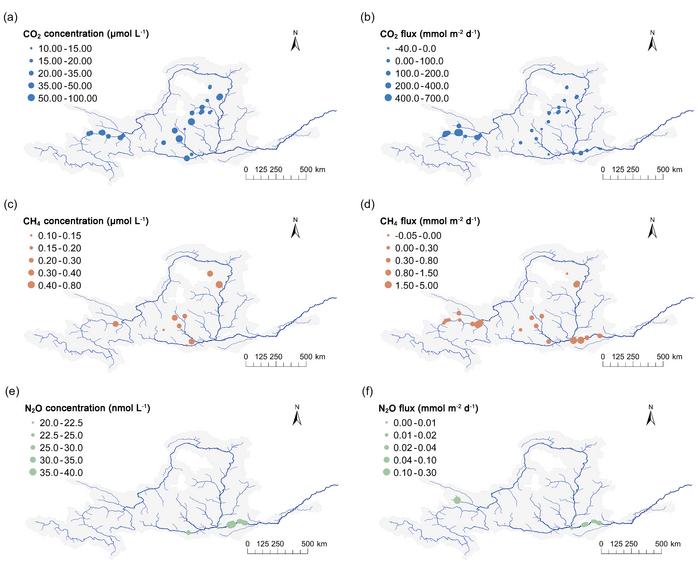
Led by the team of Xinghui Xia and Shaoda Liu (School of Environment, Beijing Normal University), this study integrates existing monitoring data to discuss the characteristics of greenhouse gas (GHG) emissions from reservoirs in the Yellow River Basin. while CO2 emission flux from reservoirs is lower than that from river channels, the emission fluxes of CH4 and N2O are 1.9 times and 10 times those from rivers, respectively, indicating that the emission of CH4 and N2O is significantly enhanced in reservoirs. Compared to the reservoirs in humid climate, reservoirs in the Yellow River Basin exhibit relatively lower emissions of CO2 and CH4 due to lower organic matter concentrations, but significantly higher N2O emissions due to higher nitrogen loads.

Credit: ©Science China Press
Led by the team of Xinghui Xia and Shaoda Liu (School of Environment, Beijing Normal University), this study integrates existing monitoring data to discuss the characteristics of greenhouse gas (GHG) emissions from reservoirs in the Yellow River Basin. while CO2 emission flux from reservoirs is lower than that from river channels, the emission fluxes of CH4 and N2O are 1.9 times and 10 times those from rivers, respectively, indicating that the emission of CH4 and N2O is significantly enhanced in reservoirs. Compared to the reservoirs in humid climate, reservoirs in the Yellow River Basin exhibit relatively lower emissions of CO2 and CH4 due to lower organic matter concentrations, but significantly higher N2O emissions due to higher nitrogen loads.
As influenced by substrate concentrations, water bodies with higher concentrations of dissolved CO2 and CH4 are predominantly found in smaller reservoirs situated in the middle-to-lower reach area, where soil organic matter content is higher and exogenous organic carbon inputs to reservoir are higher compared to upstream areas. Those with higher concentrations of dissolved N2O are distributed in the middle-to-lower reaches of the main stem, where they are located in areas with dense population, intensive agriculture, and industrial activities, contributing to heightened nutrient levels in the water.
Compared with the Yellow River channel, reservoirs are weaker sources of CO2 emissions, and they even act as carbon sinks. However, the emission fluxes of CH4 and N2O are 1.9 times and 10 times those from rivers. In contrast to flowing water bodies, the stagnant water in reservoirs provides a favorable environment for life activities of planktonic plants and microorganisms. Primary producers such as algae utilize DIC to synthesize organic matter, resulting in lower CO2 and higher CH4 emissions than rivers. Concurrently, the increase in surface dissolved O2 level favors the generation and emission of N2O through nitrification reactions.
Monte Carlo simulations for 237 reservoirs in the Yellow River Basin showed that the median CO2 emission for the 237 reservoirs in the Yellow River Basin is 41.57 Gmol C yr-1, the median CH4 emission is 0.52 Gmol C yr-1, the median N2O emission is 0.041 Gmol N yr-1. The emission of three GHGs accounts for 1.6%, 0.05%, and 1.9% of the global reservoir emission. Multiplying the flux by the 100-year global warming potential of each gas, the total GHG emission from reservoirs in the Yellow River Basin amount to 3.05 Tg CO2-eq yr-1, approximately 0.39% of the emission from global reservoirs. The land area of the Yellow River Basin accounts for approximately 0.53% of the global land area, indicating that the GHG emissions from reservoirs in the Yellow River Basin are slightly lower than the global average.
Huang S, Zhang P, Zheng W, Zhang J, Li Y, Wang Y, Jiang E, Liu S, Xia X. 2024. Characteristics and influencing factors of greenhouse gas emissions from reservoirs in the Yellow River Basin: A meta-analysis. Science China Earth Sciences, 67(7): 2210–2225,
Journal
Science China Earth Sciences
Cite Scienmag News
Violet Maxwell. (July 11, 2024). Greenhouse gas emissions from reservoirs in the Yellow River Basin. Scienmag. https://scienmag.com/greenhouse-gas-emissions-from-reservoirs-in-the-yellow-river-basin/
Violet Maxwell. "Greenhouse gas emissions from reservoirs in the Yellow River Basin." Scienmag, 11 July 2024, https://scienmag.com/greenhouse-gas-emissions-from-reservoirs-in-the-yellow-river-basin/. Accessed 6 September 2026.
Violet Maxwell. "Greenhouse gas emissions from reservoirs in the Yellow River Basin." Scienmag. July 11, 2024. https://scienmag.com/greenhouse-gas-emissions-from-reservoirs-in-the-yellow-river-basin/

