


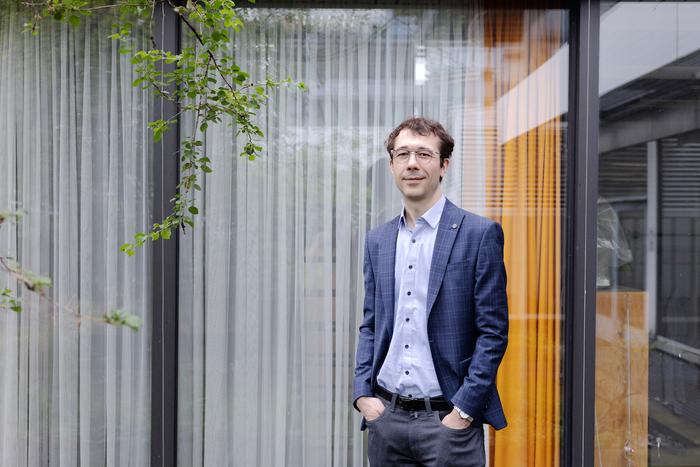
Professor Dr Malte Gather and Dr Julian Butscher, Dr Florian Le Roux and Dr Andreas Mischok from his research team have received a ‘Proof of Concept’ grant from the European Research Council (ERC) for their research project SPLiDAR. Malte Gather is head of the Humboldt Centre for Nano- and Biophotonics (HCNB) at the Department of Chemistry of the University of Cologne’s Faculty of Mathematics and Natural Sciences. This funding line aims at exploring the commercial or social potential of an ongoing or completed ERC-funded project. The Proof of Concept grant amounts to a lump sum of 150,000 euros.

Credit: Jana Bauch
Professor Dr Malte Gather and Dr Julian Butscher, Dr Florian Le Roux and Dr Andreas Mischok from his research team have received a ‘Proof of Concept’ grant from the European Research Council (ERC) for their research project SPLiDAR. Malte Gather is head of the Humboldt Centre for Nano- and Biophotonics (HCNB) at the Department of Chemistry of the University of Cologne’s Faculty of Mathematics and Natural Sciences. This funding line aims at exploring the commercial or social potential of an ongoing or completed ERC-funded project. The Proof of Concept grant amounts to a lump sum of 150,000 euros.
SPLiDAR builds on the research results that emerged from Malte Gather’s HyAngle project, for which he received an ERC Advanced Grant. It explores the commercialization possibilities of the spectral filters developed at the HCNB. These novel thin-film filters exhibit unrivalled angular stability and can be used in a wide range of optical and sensor applications, including light detection and ranging (LiDAR).
LiDAR is a method for three-dimensional imaging that uses laser scanning to accurately map the environment. It is used particularly widely in optical sensors for robotics, for analysing the atmosphere, but also in the field of driver assistance systems and autonomous driving in the automotive industry. In order for LiDAR measurements to be accurate, the laser light used must be detected over a large field of view and thus over a large range of angles without other sources of interference, such as sunlight or room lighting. Currently available laser filters have limited capability to supress this type of interference as their performance decreases significantly at large angles of incidence.
The team at the HCNB has developed novel spectral filters that utilize the quantum mechanical principle of strong light-matter interaction. These spectral filters can retain their properties over large angular distances, which is not possible for conventional thin-film filters due to fundamental physical principles. In addition to a wide range of other applications, such as in micro-optics and biophotonics, these filters will now be further developed and optimized for use in LiDAR systems. In addition to their filter capability, stability and durability under real-life conditions are also important.
The ERC Proof of Concept (PoC) grant is exclusively made available to principal investigators who already hold an ERC grant (Starting, Consolidator, Advanced or Synergy) and wish to transfer ideas arising from current or already completed ERC-funded projects to the market or for the direct benefit of society.
Cite Scienmag News
Denise Maddox. (July 11, 2024). Malte Gather receives ‘Proof of Concept’ grant from the European Research Council. Scienmag. https://scienmag.com/malte-gather-receives-proof-of-concept-grant-from-the-european-research-council/
Denise Maddox. "Malte Gather receives ‘Proof of Concept’ grant from the European Research Council." Scienmag, 11 July 2024, https://scienmag.com/malte-gather-receives-proof-of-concept-grant-from-the-european-research-council/. Accessed 4 September 2026.
Denise Maddox. "Malte Gather receives ‘Proof of Concept’ grant from the European Research Council." Scienmag. July 11, 2024. https://scienmag.com/malte-gather-receives-proof-of-concept-grant-from-the-european-research-council/

