


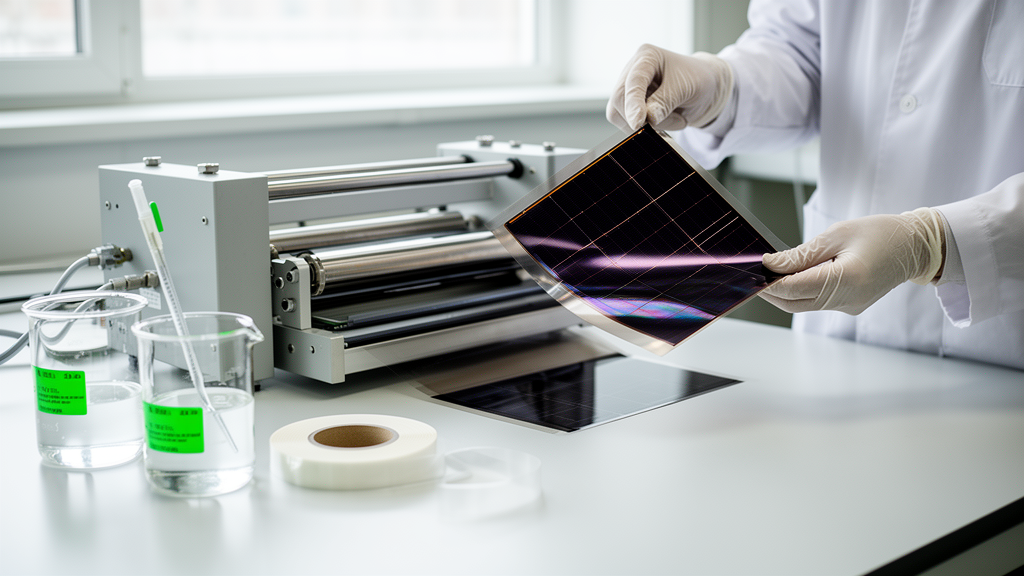
Solar cells that can be printed like newspapers, coated onto thin flexible sheets at room temperature, have long been the promise of perovskite photovoltaics. Now researchers at the University of Surrey, working with partners in the United Kingdom, Germany and Sweden, have taken a major step toward making that vision manufacturable without the toxic solvents that have dogged the technology since its earliest days. In a study published in the journal Nano Energy, the team describes a solvent system with significantly reduced toxicity that delivers high-efficiency perovskite solar modules while stripping hazardous chemicals out of the production line.
Perovskites are widely regarded as one of the most exciting candidates to sit alongside, or eventually replace, conventional silicon solar cells. Unlike silicon, which must be grown as rigid wafers in energy-intensive furnaces, perovskites can be dissolved into an ink and coated onto lightweight, bendable surfaces. That property opens the door to solar films on building facades, portable electronics and even the ultra-light panels needed for spacecraft. The catch has always been the ink itself: the solvents that keep perovskite precursors dissolved are among the nastiest chemicals in the industrial toolkit.
The field has long relied on dimethylformamide, known as DMF, N-methyl-2-pyrrolidone, known as NMP, and acetonitrile, known as ACN. Several of these are classed as reproductive toxins, meaning they pose serious risks to workers who handle them and require costly containment, ventilation and waste treatment infrastructure on any production line. The Surrey-led team designed their way around the problem with a solvent system they call significantly reduced-toxicity, or SRT. It is built on ethanol and 2-methyltetrahydrofuran, the latter derived from renewable sources such as farm and forestry waste, with a small amount of a milder additive to control how the perovskite film forms during coating.
The scale of the solvent problem becomes clear when manufacturing volumes are considered. The researchers note that producing a single gigawatt of electricity from perovskite modules can consume more than 90,000 litres of solvent on one coating line. Replacing toxic solvents at that volume removes a genuine health and environmental burden from the manufacturing process, not merely a laboratory inconvenience. It is the kind of systems-level thinking that separates a promising lab result from a technology ready for a factory floor.
Crucially, the team demonstrated that their greener recipe works beyond the scale of a single laboratory cell. They built mini-modules with active areas of up to 11.5 square centimetres and achieved power conversion efficiencies above 18 per cent, among the highest figures reported anywhere for greener, scalable perovskite processing. The modules also remained stable under continuous illumination during testing, addressing one of the persistent doubts that critics raise about perovskite durability. Efficiency and stability together, at module scale rather than tiny cell scale, are what investors and manufacturers need to see.
The process is engineered for continuous, high-throughput production from the outset. The ink is coated at room temperature and dried with a jet of gas, a step fully compatible with roll-to-roll manufacturing, the same principle that lets newspapers print at speed. Because no high-temperature annealing ovens are required, the energy budget of production drops as well. The researchers showed the method working on flexible substrates, which is precisely where perovskites hold their clearest advantage over rigid silicon panels.
Another quiet but significant achievement is what the process leaves out. Many perovskite recipes require an anti-solvent step, in which a second chemical is flooded over the wet film to trigger crystallisation. That stage usually introduces further toxic chemicals and adds complexity and variability to the coating line. By skipping the anti-solvent step entirely and working at low temperature, the Surrey process uses less energy, fewer materials and fewer opportunities for things to go wrong, all of which matter enormously when a process is scaled from a spin-coated sample to a kilometre of moving substrate.
Dr Ehsan Rezaee, lead researcher of the study at the University of Surrey, emphasised that the chemistry and the manufacturing process were designed together with industry in mind. For a technology to move from the laboratory into a real manufacturing environment, he explained, researchers must consider not only performance but also the solvents, processing conditions, safety, resource use and the overall complexity of production. That philosophy, co-designing the material and the factory simultaneously, is increasingly seen as the only realistic route for emerging photovoltaic technologies to reach commercial deployment.
Professor Ravi Silva, corresponding author and Director of the Advanced Technology Institute at the University of Surrey, pointed to impacts that go well beyond swapping one hazardous solvent for another. A process based on easy-to-use, non-toxic solvents and simpler coating steps reduces the need for solvent handling, waste treatment and the safety infrastructure that accompanies them, he said. That points toward more compact, resource-efficient and potentially lower-cost manufacturing for emerging solar technologies. Silva added that the team wants to help make clean energy available across the world, and that supporting decarbonisation at scale in the same step would be a double win for society.
The research was led by the University of Surrey and involved collaborators at the University of Oxford, the University of Cambridge, the Helmholtz-Zentrum Berlin in Germany, the MAX IV Laboratory in Sweden and the National Physical Laboratory. Advanced synchrotron and characterisation facilities at those partner institutions underpin the detailed understanding of how the greener solvent system controls film formation. The work was supported by the Engineering and Physical Sciences Research Council and by the European Union Horizon 2020 project MUSICODE. If the SRT solvent approach can be carried through pilot production lines, the dream of solar panels printed like newspapers, cheaply, safely and at room temperature, moves a decisive step closer to reality.
Subject of Research: Low-toxicity solvent systems for scalable perovskite solar cell manufacturing
Article Title: Greener chemistry brings low-toxicity perovskite solar cells closer to production
Article References: Greener chemistry brings low-toxicity perovskite solar cells closer to production. (n.d.). Original publication
Image Credits: AI Generated
DOI: Not provided
Keywords: perovskite solar cells, green chemistry, solvent toxicity, roll-to-roll manufacturing, solar energy, photovoltaics, thin-film solar, renewable energy, Nano Energy, University of Surrey, sustainable manufacturing, flexible electronics
Cite Scienmag News
Bethany Barker. (October 16, 2026). Greener solvent chemistry moves printable perovskite solar cells toward factory scale. Scienmag. https://scienmag.com/greener-solvent-chemistry-moves-printable-perovskite-solar-cells-toward-factory-scale/
Bethany Barker. "Greener solvent chemistry moves printable perovskite solar cells toward factory scale." Scienmag, 16 October 2026, https://scienmag.com/greener-solvent-chemistry-moves-printable-perovskite-solar-cells-toward-factory-scale/. Accessed 16 October 2026.
Bethany Barker. "Greener solvent chemistry moves printable perovskite solar cells toward factory scale." Scienmag. October 16, 2026. https://scienmag.com/greener-solvent-chemistry-moves-printable-perovskite-solar-cells-toward-factory-scale/


