


During routine veterinary inspections at fish landing stations and markets in Jubail Province, Saudi Arabia, in 2025, a team of fish pathologists examined 1,850 specimens belonging to four commercially important marine species from the Arabian Gulf. Out of that large surveillance sample, ten fish carried neoplastic growths, an overall observed frequency of just 0.54 percent. That figure may sound reassuringly low, but the diversity of tumor types found in a single geographical region has caught the attention of marine pathologists and environmental toxicologists alike, because tumors in wild fish can serve as early warning signals for ecosystem stressors ranging from petroleum hydrocarbons to heavy metals.
The study, published in Frontiers in Marine Science, focused on four species with high market value in the Eastern Province of Saudi Arabia: the spangled emperor Lethrinus nebulosus, known locally as shari; the bludger Carangoides gymnostethus, known as deela; the pinkear emperor Lethrinus lentjan, known as bakhsheena; and the white-spotted spinefoot Siganus canaliculatus, known as safee. These species represent three families and are among the most prevalent commercial fish in Jubail Province. The researchers recorded the length and weight of every fish, inspected the body surface, fins, and head visually and by palpation, and carefully removed and measured any tissue masses for size, consistency, and cut surface characteristics.
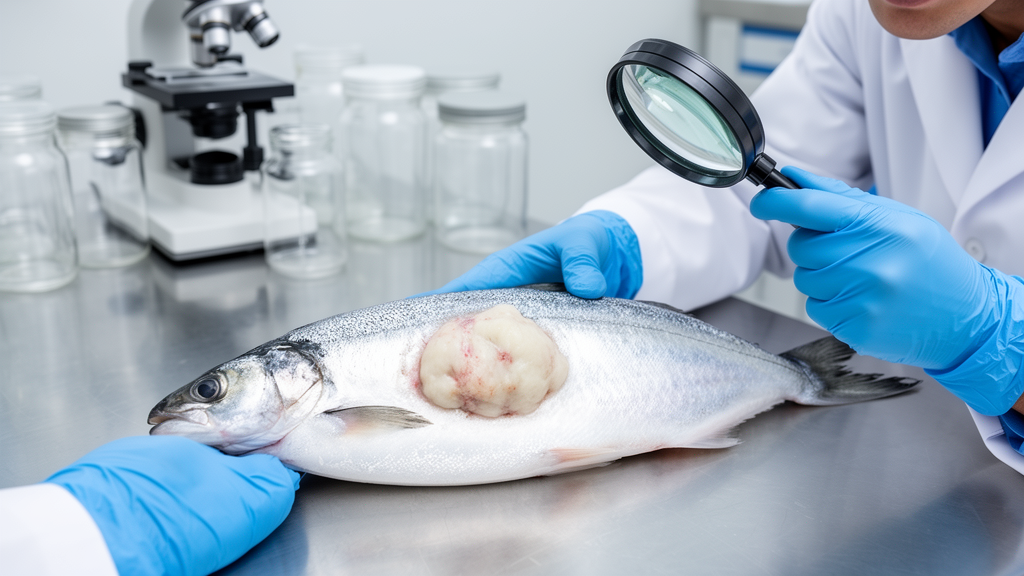
Gross pathological examination revealed distinct patterns across the affected species. In the spangled emperor, a prominent swelling appeared in the dorsal-caudal region near the posterior end of the dorsal fin, and reflection of the skin exposed a well-circumscribed, round, white nodular mass measuring 20 millimeters in length and 15 millimeters in diameter. In the bludger, a similar swelling near the lateral line concealed a globular, lobulated, creamy-white mass with visible fine vasculature on its surface, measuring 25 by 20 millimeters. Notably, when the excised masses from both species were placed in a jar of water, they floated, a pathognomonic feature of high lipid content that immediately suggested a diagnosis of lipoma.
Histopathological assessment using hematoxylin and eosin and Masson’s trichrome stains confirmed that the growths in both the spangled emperor and the bludger were lipomas arising from the subdermal layer. The neoplastic tissue was composed mainly of proliferating fat cells, or adipocytes, that were well differentiated and contained large intracytoplasmic vacuoles displacing the nuclei to the cellular periphery. Some hyalinized skeletal muscle cells and fibrous connective tissue from the stratum compactum of the subcutaneous skin were observed between the proliferated adipocytes. The tumor masses showed no evidence of mitoses or other criteria of malignancy, and the presence of isolated muscle fibers between adipocytes likely represents entrapment of existing tissue during expansive tumor growth rather than true infiltration, distinguishing these cases from the infiltrative lipomas described in goldfish and farmed Mediterranean seabass.
A more unusual finding emerged in the pinkear emperor, where a solitary, fleshy, well-pedunculated overgrowth extended laterally on the left side near the posterior end of the dorsal fin in the caudal peduncle region. The lesion measured 15 by 10 millimeters, showed epidermal ulceration on its surface, and was firmly attached to the underlying musculature. Necropsy examination revealed no evidence of distant metastasis to other visceral organs. Histopathological examination showed masses of skeletal muscle underlying the ulcerated skin, with muscle fibers exhibiting a complete loss of the normal parallel arrangement of myotomes. The fibers were long and spindle-shaped with oval nuclei, forming irregular clusters cut transversely and longitudinally in a random fashion, with polygonal profiles within the tumor mass. Bony spines of the dorsal fin were observed in association with a marked increase in collagen fibers that stained positively with Masson’s trichrome. Loss of muscular striation and Zenker’s necrosis were not uncommon. Critically, the absence of pleomorphism, cellular atypia, and mitoses indicated no evidence of malignancy, leading to a diagnosis of rhabdomyoma, an exceptionally rare benign skeletal muscle tumor in marine fish from the Arabian Gulf.
The most aggressive lesion was found in the white-spotted spinefoot, where a large, fleshy, highly vascular mass measuring 55 by 20 millimeters was attached to deep muscle tissue around the vertebral column. The tumor expanded into the abdominal cavity, displacing visceral organs while remaining attached to the muscular tissue surrounding the spine. Despite this localized infiltration and significant size, gross examination revealed no further systemic involvement or evidence of metastasis. Histopathological investigation revealed a neoplastic overgrowth characterized by features of malignancy, including proliferation of poorly differentiated skeletal myocytes accompanied by inflammatory cell infiltration and hemorrhage. Zenker’s necrosis of the myocytes was not uncommon, and dystrophic calcification surrounding the neoplastic tissue was also observed. Multiple intracellular eosinophilic hyaline substances of various sizes within the tumor cells and macrophages were consistently noted, along with newly formed blood vessels, marked mitotic activity, frequent mitoses, and edema. The tumor cells exhibited clear pleomorphism, with significant variation in cell size and shape, nuclear atypia with enlarged hyperchromatic nuclei and prominent nucleoli, frequent atypical mitotic figures, and loss of the normal fascicular architecture typical of healthy muscle tissue. Based on these findings, the tumor was diagnosed as rhabdomyosarcoma, a malignant skeletal muscle neoplasm of probable myogenic origin.
The Arabian Gulf presents a uniquely stressful marine environment characterized by extreme salinity, fluctuating temperatures, and significant anthropogenic pressure from the oil and gas industry. It acts as a sink for various pollutants, including heavy metals, petroleum hydrocarbons, and polychlorinated biphenyls. During the Gulf War, approximately 11 million barrels of oil were released into the western coastal areas of the Arabian Gulf, forming oil slicks that extended more than 1,200 kilometers southwestward from Mina Al-Ahmadi to Qatar. Oil pollution has both short-term and long-term effects on fisheries production, potentially causing severe mortality of fish eggs and larvae and reducing larval hatching success. Industrial pollutants in the region, including PCBs and hydrocarbons, are known to interfere with cell signaling and DNA repair mechanisms, raising the possibility that environmental contamination could contribute to tumor formation in marine organisms.
However, the researchers urge considerable caution in interpreting these findings as indicators of environmental integrity. The low observed frequency of 0.54 percent, with a 95 percent confidence interval of 0.29 to 0.99 percent, might initially suggest a sporadic occurrence unlikely to result from severe pollution in the area. Species-related susceptibility, age-related factors, genetic predisposition, chronic tissue injury, spontaneous neoplasia, and infectious or viral factors are all considered relevant in fish tumorigenesis. Mesenchymal tumors, particularly rhabdomyosarcomas, have been experimentally induced in fish using chemical carcinogens such as N-methyl-N-nitrosourea, demonstrating that chemical exposure can indeed produce such lesions. Nevertheless, the diversity of tumor types in a single geographical region warrants concern and suggests these fish may serve as biological sentinels for the Gulf ecosystem.
Distinguishing between benign and malignant mesenchymal tumors is vital for assessing the impact on fish populations and for marketability considerations, as the unsightly appearance of such growths may affect consumer acceptance. The diagnostic challenges are considerable: differentiating true lipomas from reactive inflammatory fat necrosis or chronic granulomatous responses requires careful histological evaluation, while the rarity of rhabdomyomas necessitates exclusion of post-injury tissue repair and regenerative muscle hypertrophy. For rhabdomyosarcomas, the lack of validated species-specific immunohistochemical markers means diagnosis must rely strictly on hematoxylin and eosin morphology, with differential considerations including poorly differentiated fibrosarcoma and undifferentiated pleomorphic sarcoma.
The study provides a critical baseline for future surveillance of mesenchymal tumors in the Arabian Gulf and fills a significant gap in the marine pathology of the Saudi Arabian coast. Future studies should employ immunohistochemistry to further elucidate the histogenesis of poorly differentiated sarcomas, and correlating tumor prevalence with heavy metal concentrations in fish tissues will be a crucial next step in determining whether these neoplasms could act as biomarkers of environmental degradation. The researchers emphasize that the environmental link should be framed as a hypothesis and a rationale for future investigation rather than a confirmed conclusion, while continued histopathological surveillance remains essential for monitoring the health of the Gulf’s demersal and pelagic fish populations.
Subject of Research: Marine Biology
Article Title: Descriptive morpho pathological lesions and surveillance baseline of mesenchymal tumors in some commercially important marine fish species from the Arabian Gulf, Saudi Arabia
Article References: Al-Hizab, F. A., Al-Dhuayan, I. S., Mahmoud, M. A., & Ibrahim, M. M. (2026). Descriptive morpho pathological lesions and surveillance baseline of mesenchymal tumors in some commercially important marine fish species from the Arabian Gulf, Saudi Arabia. Frontiers in Marine Science, 13, Article 1972671. https://doi.org/10.3389/fmars.2026.1972671
Image Credits: AI Generated
DOI: 10.3389/fmars.2026.1972671
Keywords: fish tumors, Arabian Gulf, marine pathology, environmental toxicology, rhabdomyosarcoma, lipoma, fish health, Saudi Arabia, Descriptive, morpho, pathological, lesions
Cite Scienmag News
Violet Maxwell. (October 16, 2026). Rare Tumors Found in Commercial Fish Raise Environmental Questions in the Arabian Gulf. Scienmag. https://scienmag.com/rare-tumors-found-in-commercial-fish-raise-environmental-questions-in-the-arabian-gulf/
Violet Maxwell. "Rare Tumors Found in Commercial Fish Raise Environmental Questions in the Arabian Gulf." Scienmag, 16 October 2026, https://scienmag.com/rare-tumors-found-in-commercial-fish-raise-environmental-questions-in-the-arabian-gulf/. Accessed 16 October 2026.
Violet Maxwell. "Rare Tumors Found in Commercial Fish Raise Environmental Questions in the Arabian Gulf." Scienmag. October 16, 2026. https://scienmag.com/rare-tumors-found-in-commercial-fish-raise-environmental-questions-in-the-arabian-gulf/


