


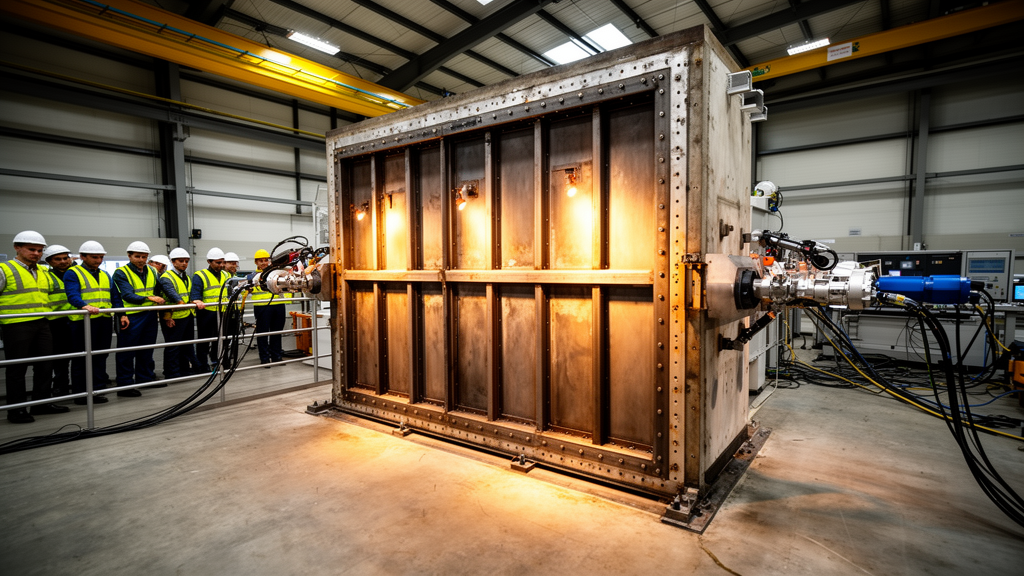
When a major earthquake strikes a city, the shaking is only the first act of the disaster. Ruptured gas lines, toppled stoves, damaged electrical systems, and the igniting of everyday combustible contents routinely set buildings ablaze in the minutes and hours that follow, while the structures themselves are still bearing the scars of the ground motion. Engineers have long recognized this earthquake-then-fire sequence as one of the most dangerous compound hazards in urban seismic zones, yet the fire behavior of many modern structural systems after seismic damage remains poorly understood. A new study published in the Bulletin of Earthquake Engineering takes aim at that gap for one of the most efficient lateral load-resisting systems in contemporary construction: the concrete-filled composite shear wall.
Composite concrete-filled shear walls combine steel plates and infilled concrete into a single structural element, exploiting the best properties of both materials. The steel provides tensile strength, ductility, and confinement, while the concrete contributes mass, stiffness, and compressive capacity, with the two materials working together to resist the lateral forces imposed by wind and earthquakes. These walls have earned a reputation for great strength, stiffness, and ductility, and they have found applications ranging from high-rise buildings to safety-related nuclear facilities. But almost all of that reputation rests on tests and analyses performed at ambient conditions, on walls that have never been damaged. What happens when one of these walls, cracked and yielded from a violent earthquake, is then engulfed by fire, is a question that has received far less attention.
That question is precisely what motivated Parisa Samiee and Gholamreza Ghodrati Amiri of the Iran University of Science and Technology, together with Shirin Esmaeili Niari and Vahid Akrami of the University of Mohaghegh Ardabili. Their approach was computational. The team developed a detailed finite element model of the problem in the commercial package ABAQUS, and, critically, they did not simply trust their model on faith. Before running any new simulations, they first verified the numerical procedure against previously published experimental data, a validation step that lends credibility to everything that follows. Only after the model demonstrated that it could reproduce known behavior did the researchers unleash it on a comprehensive parametric investigation of composite shear walls under sequential hazards.
The numerical procedure itself was a staged, multi-physics affair that mirrors the real sequence of a compound disaster. It began with a heat-transfer analysis to capture how thermal energy penetrates the wall and how temperatures evolve through the steel plates and the concrete core. Monotonic lateral loading was then applied to establish baseline strength and deformation characteristics. To evaluate hysteretic behavior, the response of the walls under the repeated, reversing displacements characteristic of earthquake shaking, the researchers ran cyclic analyses following the ATC-24 loading protocol, a widely used guideline for cyclic seismic testing of steel structural components. Finally, and most distinctively, they coupled the results of the seismic stage with a sequential post-earthquake fire analysis, in which a wall already damaged by simulated earthquake loading was subjected to simulated fire exposure and its remaining resistance tracked until failure.
One of the central design variables the team examined was the boundary element, a reinforced zone at the edges of the wall where flexural demands concentrate during lateral loading. The parametric study swept through wall configuration, the length of these boundary elements, the surfaces of the wall exposed to fire, and the ratio of lateral loading applied before the fire began. The results quantify just how much these edge zones matter. Boundary elements greatly improved the ambient lateral strength and deformation capacity of the walls, producing increases in peak load of 6.3 to 13.5 percent and increases in yield displacement of 26.5 to 42.9 percent. In plain terms, walls equipped with boundary elements could not only carry more lateral force but also deform significantly further before reaching their yield point, a valuable property in any seismic design philosophy that expects structures to endure large inelastic excursions.
The cyclic loading results reinforced that picture. When subjected to the reversing displacement histories of the ATC-24 protocol, the walls with boundary elements exhibited more saturated hysteresis loops, meaning the force-displacement curves enclosed more area and maintained their load-carrying capacity more consistently through repeated cycles. Fuller, more stable hysteresis loops translate directly into greater energy dissipation, the mechanism by which a structure absorbs and dissipates the kinetic energy delivered by an earthquake. The boundary-element walls also achieved higher peak strengths under cyclic loading, confirming that the benefit of these edge zones is not an artifact of monotonic testing but a robust feature of their behavior under realistic seismic demands.
The most striking findings, however, emerged from the post-earthquake fire stage, where the interplay between prior seismic damage and subsequent thermal attack came into sharp focus. Depending on the fire scenario and the level of damage the wall had accumulated before the fire began, a boundary element with a length of 0.15 times the wall dimension could extend the time to failure by up to 95.6 percent. In effect, this modest design enhancement nearly doubled the window of time that a damaged wall could continue to resist fire before collapsing. In a real post-earthquake environment, that additional time is not an abstract metric; it is the margin that allows occupants to evacuate, firefighters to operate, and search-and-rescue teams to work beneath and beside structures that have already been shaken to their limits.
If boundary elements emerged as the hero of the study, multi-sided fire exposure emerged as the villain. Among all the parameters examined, exposure to fire on multiple sides was identified as the most harmful factor, cutting the time to failure by up to 89.7 percent. The physics behind this result is intuitive once stated: a wall heated from one face retains a cooler, stronger core and a relatively undamaged back face to which loads can be transferred, whereas a wall heated on several faces loses structural capacity nearly everywhere at once, with its steel plates softening at elevated temperature and its concrete core degrading simultaneously across its section. The finding carries a direct lesson for building layout and fire protection strategy, since shear walls positioned at building perimeters or adjacent to open floor plans may be far more vulnerable in a post-earthquake fire than interior walls shielded on one or more faces.
Another layer of the investigation concerned the lateral loading ratio, the fraction of the wall’s capacity that had been mobilized by the earthquake before the fire began. This parameter matters because it encodes the severity of the preceding seismic event relative to the wall’s design capacity. A wall that survived the earthquake essentially undamaged enters the fire with its full material properties and geometry intact, while a wall pushed deep into its inelastic range brings cracked concrete, yielded steel, and possibly local buckling into the fire scenario. The study’s demonstration that failure time in the fire stage depends on the level of damage prior to the fire underscores the central premise of sequential hazard analysis: the fire resistance of a structure is not a fixed property stamped on its drawings, but a degraded and damage-dependent quantity that can only be assessed honestly by simulating the earthquake first.
The broader significance of this work lies in its contribution to performance-based design, an evolving philosophy in structural engineering that asks not merely whether a building complies with prescriptive code provisions, but whether it actually achieves defined performance objectives under realistic multi-hazard scenarios. Fire researchers and earthquake engineers have increasingly converged on the view that designing for the two hazards in isolation can leave dangerous blind spots, because the fire that follows an earthquake strikes a fundamentally different structure than the one the fire code assumed. By delivering a validated finite element framework that chains heat transfer, monotonic and cyclic seismic loading, and post-earthquake fire analysis into a single coherent procedure, and by quantifying how boundary elements and fire exposure configuration govern survival time, the researchers have given designers both a tool and a set of design-relevant numbers. For concrete-filled composite shear walls, one of the most promising lateral systems in modern construction, the message is now backed by analysis: thoughtful detailing at the wall edges can buy precious minutes in the fire that follows the quake, while a fire burning on multiple faces can steal almost all of them away.
Subject of Research: Post-earthquake fire performance of concrete-filled composite shear walls analyzed with finite element simulation
Article Title: Post-earthquake fire performance of concrete-filled composite shear wall
Article References: Samiee, P., Ghodrati Amiri, G., Esmaeili Niari, S., & Akrami, V. (2026). Post-earthquake fire performance of concrete-filled composite shear wall. Bulletin of Earthquake Engineering. https://doi.org/10.1007/s10518-026-02719-y
Image Credits: AI Generated
DOI: 10.1007/s10518-026-02719-y
Keywords: post-earthquake fire, composite shear wall, concrete-filled, finite element analysis, boundary element, cyclic loading, ATC-24 protocol, fire resistance, sequential hazards, ABAQUS, seismic performance, hysteretic behavior
Cite Scienmag News
Violet Maxwell. (October 16, 2026). After the Quake Comes the Fire: New Study Puts Composite Shear Walls to the Test. Scienmag. https://scienmag.com/after-the-quake-comes-the-fire-new-study-puts-composite-shear-walls-to-the-test/
Violet Maxwell. "After the Quake Comes the Fire: New Study Puts Composite Shear Walls to the Test." Scienmag, 16 October 2026, https://scienmag.com/after-the-quake-comes-the-fire-new-study-puts-composite-shear-walls-to-the-test/. Accessed 16 October 2026.
Violet Maxwell. "After the Quake Comes the Fire: New Study Puts Composite Shear Walls to the Test." Scienmag. October 16, 2026. https://scienmag.com/after-the-quake-comes-the-fire-new-study-puts-composite-shear-walls-to-the-test/


