


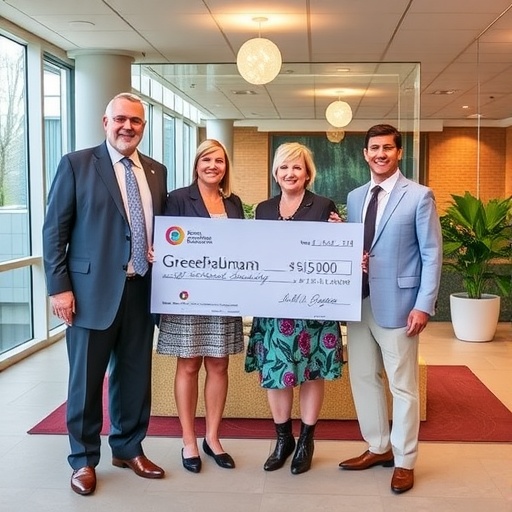
The University of Maryland Greenebaum Comprehensive Cancer Center (UMGCCC), a leading National Cancer Institute (NCI)-designated comprehensive cancer center, has recently received a philanthropic boost of $5.5 million from the Marlene and Stewart Greenebaum Family Foundation. This transformative donation heralds a new era of innovation and growth for the center, which has a distinguished history rooted in the founders’ personal journey with cancer treatment. The Greenebaums’ initial groundbreaking gift was made three decades ago following Marlene Greenebaum’s successful breast cancer treatment, establishing a legacy that continues to fuel advancements in cancer research and care.
The infusion of funds from the Greenebaum family will predominantly support pioneering faculty research at the University of Maryland School of Medicine (UMSOM), bolstering efforts to develop cutting-edge cancer therapies. A major focus will be on immunotherapies, particularly chimeric antigen receptor (CAR) T-cell therapies, which have revolutionized treatment paradigms in hematologic malignancies and are now being explored aggressively for efficacy against solid tumors. This strategy involves reprogramming a patient’s immune cells to recognize and eradicate cancer cells with heightened specificity, offering hope for treating cancers that have historically been resistant to conventional approaches.
Beyond therapeutic innovations, the endowment will also strengthen survivorship programs at UMGCCC. Emerging wearable technologies capable of continuous physiological monitoring will be integrated into patient care strategies to optimize quality of life for cancer survivors. Personalized supportive care, including tailored nutritional regimens and psychosocial resources, will form a crucial component in enhancing long-term outcomes and mitigating treatment-related toxicities. This holistic approach underscores the center’s commitment to not only prolong lives but also improve the lived experience of patients beyond their clinical treatment.
As UMGCCC prepares for a significant physical expansion with its relocation to the Stoler Center for Advanced Medicine scheduled for fall 2026, the family’s donation assumes added significance. The new facility’s lobby will bear the Greenebaum name, symbolizing their enduring impact on the institution. The Stoler Center will house state-of-the-art laboratories, patient care suites, and clinical trial infrastructure designed to facilitate seamless translational research and multidisciplinary collaboration, ultimately accelerating the bench-to-bedside delivery of novel therapies.
Michael Greenebaum, scion of the Greenebaum family and an influential philanthropist, articulated the familial dedication behind the gift. Marking the 30th anniversary of the original donation, he emphasized that the contribution empowers the center to meet the escalating demand for expert oncology care in Maryland and its surrounding regions. The family’s longstanding involvement exemplifies how philanthropy can catalyze scientific breakthroughs and foster comprehensive patient-centric cancer care.
The Greenebaum family’s involvement extends beyond financial support. Michael Greenebaum serves as Chair of the University of Maryland School of Medicine’s Board of Visitors and sits on the UMGCCC Board of Advisors. He is also the founder of the Maryland Half-Marathon & 5K, which has raised over $8 million for the center, demonstrating an innovative approach to community engagement in cancer fundraising. This multi-faceted participation underscores the synergistic relationship between leadership, philanthropy, and research advancement.
The foundational success story of Marlene Greenebaum’s battle with breast cancer is intertwined with pioneering research at UMGCCC. She benefited from treatment with an aromatase inhibitor, a type of hormone therapy developed by Angela Brodie, PhD, a leading breast cancer researcher associated with the cancer center. Aromatase inhibitors function by blocking the enzyme aromatase, which converts androgens to estrogens, thereby reducing estrogen levels that fuel hormone receptor-positive breast cancers. This therapeutic breakthrough has become a standard of care globally, emblematic of how translational science at academic centers can alter clinical practices.
Leadership at UMGCCC recognizes the critical importance of sustained philanthropic support. Dr. Taofeek K. Owonikoko, the center’s Executive Director, noted that continuous funding is imperative for maintaining the momentum of clinical trials, which now number over 450 and represent a doubling from earlier years. These trials explore next-generation agents, combination immunotherapies, precision oncology approaches, and modalities aimed at overcoming tumor microenvironment-mediated resistance pathways. Such a robust clinical pipeline positions the center as a leader in oncology innovation.
UMGCCC’s research budget exceeds $130 million annually, reflecting its stature as a premier academic and research institution. The breadth of oncology clinical and basic research encompasses molecular biology, genomics, immunology, bioinformatics, and population health studies. The center’s faculty conduct extensive investigations into tumor biology, mechanisms of metastasis, and the development of novel biomarkers to enable early detection and therapeutic responsiveness. This comprehensive research spectrum embodies a systems biology approach to conquering cancer’s complexity.
The clinical environment benefits enormously from integration with UMGCCC’s basic science enterprises. The reciprocal relationship facilitates rapid hypothesis testing and functional validation of emerging targets in vivo through patient-derived xenograft models and organoid cultures. Moreover, the multidisciplinary teams comprising oncologists, surgeons, radiologists, pathologists, and data scientists collaborate intensively to tailor individualized treatment regimens, reinforcing the precision medicine paradigm.
Maryland’s University of Maryland Medical Center (UMMC), the flagship hospital in the 11-hospital University of Maryland Medical System (UMMS), serves as the clinical anchor for UMGCCC. UMMC’s advanced infrastructure supports high-complexity procedures, including solid organ transplantation and sophisticated imaging modalities vital for cancer diagnosis and management. The integration of clinical care and research fosters an ecosystem that translates scientific discoveries swiftly into standard practice, benefiting thousands of patients annually.
The upcoming expansion into the Stoler Center also represents a strategic bet on the future of oncology, emphasizing seamless integration of digital health technologies, telemedicine capabilities, and patient navigation services to improve access and adherence to cancer care protocols. The center’s mission aligns with global efforts to reduce cancer mortality through innovation while addressing survivorship challenges in an aging population that increasingly confronts late effects of cancer treatment.
In conclusion, the recent $5.5 million gift from the Marlene and Stewart Greenebaum Family Foundation marks a significant milestone for the University of Maryland Greenebaum Comprehensive Cancer Center. This philanthropic investment supports transformative cancer research, accelerates development of breakthrough therapies like CAR T-cell treatment for solid tumors, and enhances survivorship programs through advanced wearable technologies and tailored clinical support. The planned move to the Stoler Center for Advanced Medicine will bolster these efforts, situating UMGCCC to remain at the vanguard of cancer care and research. The Greenebaum family’s enduring legacy continues to inspire scientific innovation and exceptional patient care, reaffirming the profound impact of philanthropy in advancing the fight against cancer.
News Publication Date: Not specified in the source content.
Web References:
- https://www.umms.org/umgccc
- https://www.umms.org/about/leadership/mohan-suntha
- https://www.medschool.umaryland.edu/profiles/gladwin-mark/
- https://www.umms.org/ummc/about/leadership/bert-w-omalley
- https://www.umms.org/find-a-doctor/profiles/dr-taofeek-kunle-owonikoko-md–phd-1578770871
- https://www.umms.org/ummc/about/leadership/heather-culp
- https://www.medschool.umaryland.edu/
- http://www.umm.edu/
- http://www.umms.org/
Cite Scienmag News
Nathaniel Bowman. (April 13, 2026). Greenebaum Family Contributes $5.5 Million to Propel Cancer Research and Enhance Patient Care. Scienmag. https://scienmag.com/greenebaum-family-contributes-5-5-million-to-propel-cancer-research-and-enhance-patient-care/
Nathaniel Bowman. "Greenebaum Family Contributes $5.5 Million to Propel Cancer Research and Enhance Patient Care." Scienmag, 13 April 2026, https://scienmag.com/greenebaum-family-contributes-5-5-million-to-propel-cancer-research-and-enhance-patient-care/. Accessed 5 September 2026.
Nathaniel Bowman. "Greenebaum Family Contributes $5.5 Million to Propel Cancer Research and Enhance Patient Care." Scienmag. April 13, 2026. https://scienmag.com/greenebaum-family-contributes-5-5-million-to-propel-cancer-research-and-enhance-patient-care/


