


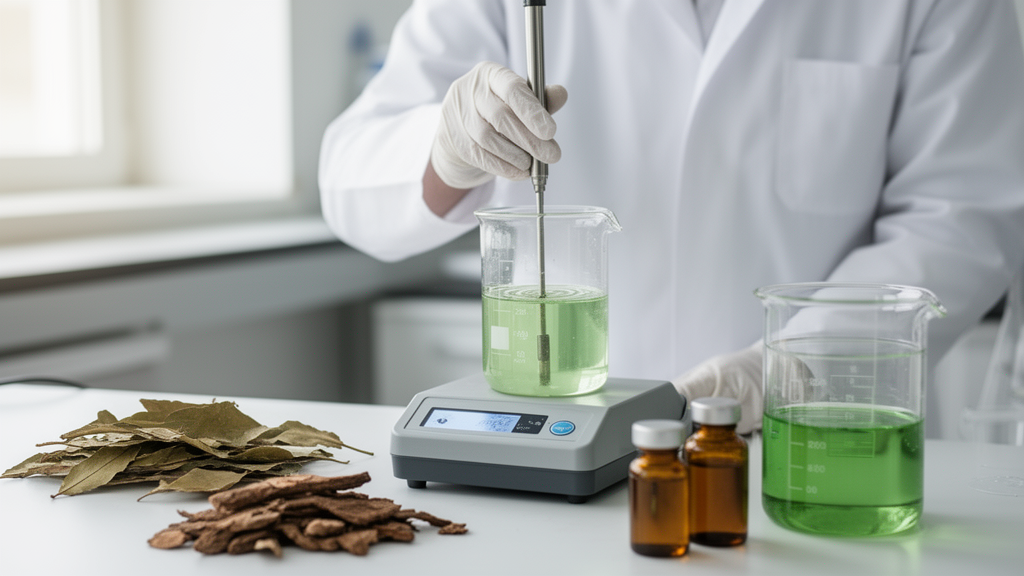
Chemists in South Africa have shown that a carefully tuned mixture of natural, plant-derived solvents—paired with ultrasound—can pull antioxidant compounds out of the leaves of Cassia abbreviata, a medicinal tree native to Southern Africa, with markedly better efficiency than the same solvent used without optimization.
These mixtures are formed by combining natural primary metabolites—sugars, organic acids and amino acids—in specific molar ratios. The resulting liquids have low volatility, high solvency capacity and tunable polarity, which allows them to selectively extract both water-loving and fat-loving compounds. Because their components are biocompatible, biodegradable and of low toxicity, NADES have attracted attention as greener alternatives to the methanol and other organic solvents traditionally used to strip bioactive constituents from plant tissue, solvents whose toxicity, volatility and poor biodegradability raise environmental and health concerns.
To make the solvents, the researchers used choline chloride as the hydrogen bond acceptor and paired it individually with five hydrogen bond donors: oxalic acid, glycerol, urea, citric acid and ascorbic acid, at defined molar ratios. Each mixture was heated to 90 degrees Celsius for an hour and a half with continuous stirring until a homogeneous, transparent liquid formed, then cooled and stored in the dark at room temperature. For the urea, ascorbic acid and citric acid formulations, 20 percent water was added to help the mixture form a clear liquid. Fourier transform infrared spectroscopy confirmed that the solvents had genuinely formed: characteristic peaks shifted and broadened in the synthesized NADES spectra relative to the pure starting materials, evidence of the strong intermolecular hydrogen-bonded networks that define a eutectic mixture.
The six solvents were then tested against conventional 80 percent methanol for extracting metabolites from dried, powdered leaves collected in Shakadza Village in Limpopo Province. Ultraviolet-visible spectroscopy told a nuanced story. Methanol produced the highest absorbance across the spectrum, with a strong band near 280 nanometers indicating abundant UV-absorbing flavonoids and phenolic acids, plus a broad band near 650 nanometers signaling co-extracted chlorophyll. The NADES extracts showed generally lower absorbance, with peaks confined to the 250 to 350 nanometer ultraviolet region—evidence that they pulled out phenolic-type compounds effectively but left chlorophyll behind. Acid-based formulations, including the choline chloride–oxalic acid, choline chloride–ascorbic acid and choline chloride–citric acid mixtures, gave stronger ultraviolet peaks than the neutral glycerol- and urea-based solvents, consistent with stronger hydrogen bonding to phenolic hydroxyl and carbonyl groups.
Antioxidant assays complicated the picture in an instructive way. In the DPPH free radical scavenging assay, the choline chloride–ascorbic acid solvent produced an extract with a scavenging effect of 91.38 percent, far above the methanol extract’s 54.31 percent. But the authors flagged a critical caveat: ascorbic acid is itself an antioxidant, so the assay may have measured the solvent’s own radical-neutralizing capacity rather than that of the extracted metabolites. The same concern applied to the ferric reducing antioxidant power assay, where the ascorbic acid solvent again scored highest at 5.87 millimolar gallic acid equivalents versus 4.45 for methanol. For this reason the team excluded the ascorbic acid formulation from consideration as the best performer, an unusually transparent move that guards against a common pitfall in green-solvent research.
On total flavonoid content, methanol clearly won, yielding 4.47 micrograms per milliliter of gallic acid equivalents, while the best NADES, the choline chloride–urea mixture, reached only 0.91 micrograms per milliliter, with the remaining solvents near zero. Weighing all three assays, the researchers selected the choline chloride–urea solvent for optimization: it was the second-best NADES overall and performed relatively well on both flavonoid recovery and ferric reducing power, without the confounding antioxidant contribution of ascorbic acid.
The optimization itself followed a single-factor cumulative design, in which each parameter was varied in turn and its best value carried forward as a fixed baseline for the next test. Ultrasonic temperature came first: raising the temperature from 30 to 80 degrees Celsius steadily increased metabolite recovery, reaching a maximum absorbance of 2.13 absorbance units, likely because lower temperatures leave the viscous solvent unable to penetrate plant cell walls effectively. Solvent volume behaved counterintuitively—5 milliliters was optimal, and larger volumes diluted the sample and reduced measured concentrations. Sample mass favored the upper tested limit of 500 milligrams, where absorbance climbed to about 3.69 units, reflecting a steeper concentration gradient between plant matrix and solvent. Extraction time peaked early, at just 8 minutes, with absorbance of 3.66 units holding roughly steady thereafter except for a dip at 20 minutes that the authors attribute to possible contamination during processing.
The final parameter, pH, delivered the largest single gain. Testing pH 3, 7 and 11, the team found extraction rose in alkaline conditions, reaching 3.6 absorbance units at pH 11. This aligns with prior reports that alkaline media improve flavonoid solubility and stability and help deprotonate phenolic hydroxyl groups while swelling and disrupting the cell matrix to speed mass transfer. The authors acknowledge that strongly alkaline processing carries chemical risks—irreversible oxidative destruction, polymerization or alkaline hydrolysis of sensitive phenolics—but note that such degradation was not observed here, plausibly because the very short 8-minute exposure limited contact with air and hydroxide ions.
With the optimized protocol in hand—80 degrees Celsius, 5 milliliters of solvent, 500 milligrams of leaf powder, 8 minutes and pH 11—the comparison with methanol shifted. The optimized NADES extract showed higher absorbance than unoptimized NADES in the 288 to 558 nanometer region associated with phenolics and flavonoids, while methanol remained stronger only around 668 nanometers, its chlorophyll signature. DPPH scavenging by the optimized extract reached 74 percent, up from 58 percent before optimization and above methanol. Ferric reducing power rose to 2.55 gallic acid equivalents, surpassing methanol’s 1.27. Total flavonoid content improved to 2.26 micrograms per milliliter from near zero, though methanol still led at 4.47. All experiments were performed in duplicate, and the authors note that conventional methanol still recovers a wider overall chemical diversity. The findings support the study’s hypothesis that NADES with ultrasound assistance significantly improves recovery of targeted antioxidant and UV-absorbing metabolites from C. abbreviata leaves, positioning the approach as a promising, sustainable alternative—particularly when the goal is polar bioactive compounds rather than the full extractive breadth of an organic solvent.
Subject of Research: Optimization of ultrasound-assisted natural deep eutectic solvent extraction of bioactive metabolites from Cassia abbreviata leaves
Article Title: Optimization of NADES for the efficient extraction of metabolites from Cassia abbreviata leaves with ultrasonic assistance and bioactivity assay evaluation
Article References: Tshikalange, M., Tavengwa, N. T., Mathomu, L. M., & Ndou, D. L. (2026). Optimization of NADES for the efficient extraction of metabolites from Cassia abbreviata leaves with ultrasonic assistance and bioactivity assay evaluation. Results in Chemistry, 32, Article 104014. https://doi.org/10.1016/j.rechem.2026.104014
Image Credits: AI Generated
DOI: 10.1016/j.rechem.2026.104014
Keywords: Cassia abbreviata, NADES, ultrasound-assisted extraction, green chemistry, antioxidants, DPPH assay, FRAP assay, total flavonoid content, choline chloride, Limpopo, phytochemistry, sustainable extraction
Cite Scienmag News
Bethany Barker. (October 27, 2026). Green solvents tuned by ultrasound boost recovery of antioxidants from a Southern African medicinal tree. Scienmag. https://scienmag.com/green-solvents-tuned-by-ultrasound-boost-recovery-of-antioxidants-from-a-southern-african-medicinal-tree/
Bethany Barker. "Green solvents tuned by ultrasound boost recovery of antioxidants from a Southern African medicinal tree." Scienmag, 27 October 2026, https://scienmag.com/green-solvents-tuned-by-ultrasound-boost-recovery-of-antioxidants-from-a-southern-african-medicinal-tree/. Accessed 27 October 2026.
Bethany Barker. "Green solvents tuned by ultrasound boost recovery of antioxidants from a Southern African medicinal tree." Scienmag. October 27, 2026. https://scienmag.com/green-solvents-tuned-by-ultrasound-boost-recovery-of-antioxidants-from-a-southern-african-medicinal-tree/


