


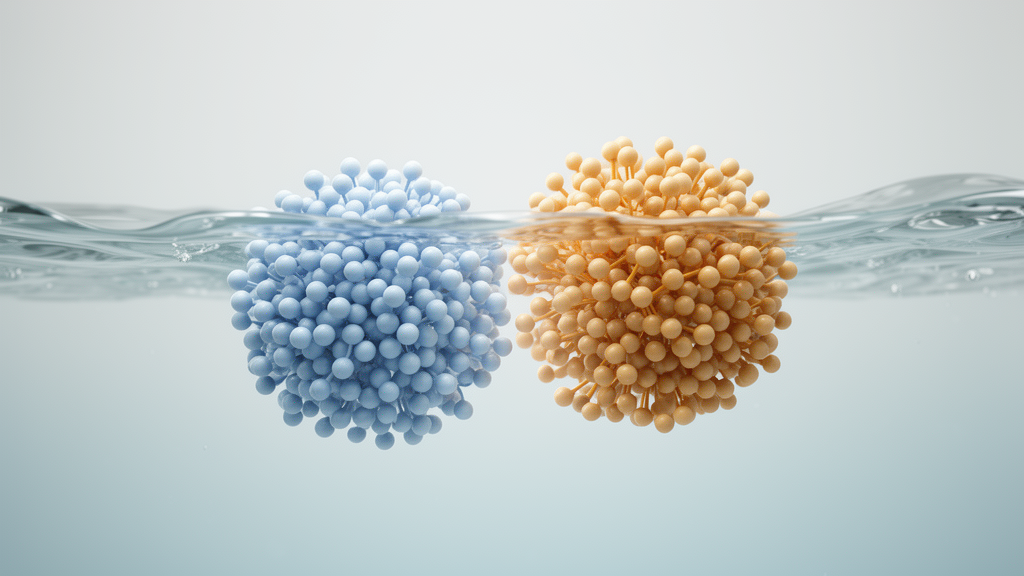
Surfactants owe their remarkable usefulness to a simple architectural trick: each molecule carries a water-loving head and a water-fearing tail, allowing it to wedge itself into interfaces and lower the energy needed to keep oil and water, or air and water, apart. A new review published in Results in Chemistry argues that the most interesting surfactant science now happens when molecules of different origins are blended together. Jasana Maharjan, Nootan Prasad Bhattarai, Chandradip Kumar Yadav and Ajaya Bhattarai systematically examined mixed systems of natural and synthetic surfactants, compiling evidence from 67 full-text studies published between 2005 and 2026, drawn from an initial pool of 142 records identified through Google Scholar, SpringerLink, Wiley Online Library and ScienceDirect.
The review draws a careful distinction between two categories of natural surfactants. Biosurfactants are surface-active molecules synthesized by living microorganisms such as bacteria, yeasts and fungi through fermentation, with rhamnolipids, surfactin, sophorolipids and mannosylerythritol lipids as prominent examples. Bio-based surfactants, by contrast, are derived from renewable plant and animal feedstocks through chemical or enzymatic conversion, including alkyl polyglucosides, sucrose esters and saponins. Saponins, the plant-derived secondary metabolites whose name comes from the Latin word for soap, are found in high concentrations in soybeans, soapwort, the soapbark tree, baby’s breath and corn-cockle. Shikakai, a centuries-old Ayurvedic herb, is another bio-based surfactant whose pod-like fruits are rich in natural saponins. Synthetic surfactants, meanwhile, are classified by the charge of their hydrophilic head group into anionic species such as sodium dodecyl sulfate, cationic species such as cetyltrimethylammonium bromide, zwitterionic species and non-ionic species such as alcohol ethoxylates.
A central message of the review is that the origin of a surfactant matters less than its molecular architecture. The hydrophobic alkyl chain length, core hydrophobicity and headgroup composition fundamentally dictate self-assembly behavior, governing adsorption, micelle stability, aggregation morphology and the critical micelle concentration, the threshold concentration at which micelles begin to form. Solution conditions compound this structural control: temperature, pH, ionic strength, electrolyte presence and solvent composition all shift the balance of electrostatic, hydrogen-bonding and hydrophobic forces that determine whether mixed systems behave ideally, attractively or antagonistically. The authors stress that physicochemical properties must therefore be analyzed through the combined effect of molecular structure and solution conditions rather than through source of origin alone.
Why mix at all? The review reports that mixed systems of natural and synthetic surfactants typically exhibit non-ideal mixing behavior with enhanced surface performance, including lower critical micelle concentrations and greater surface tension reduction than either component alone. These combinations have potential applications spanning detergents, pharmaceutical formulations, cosmetics, food stabilization, nanomaterial synthesis, enhanced oil recovery, agriculture and wastewater treatment. In detergents, mixed systems improve foaming and dirt removal; in pharmaceuticals, they enhance the solubility of hydrophobic drugs and their delivery; in environmental applications, they increase pollutant removal through high solubilization effects. The authors caution, however, that efficacy depends on molecular structure, composition, concentration, pH and temperature rather than on origin.
Characterizing these interactions requires a battery of complementary techniques, which the review catalogs in detail. Surface tension measurements, using pendant-drop, Wilhelmy plate and du Noüy ring methods, reveal adsorption behavior and the critical micelle concentration. Small-angle neutron scattering resolves the shape, size and aggregation number of mixed micelles at the nanoscale, while neutron reflectometry determines the composition and thickness of surfactant layers adsorbed at interfaces. Dynamic light scattering tracks hydrodynamic droplet sizes, viscosity measurements probe aggregation and micellar growth, and contact angle measurements assess wettability at solid-liquid interfaces. Together, these methods link molecular interactions to both bulk structure and interfacial arrangement.
The compiled experimental evidence shows striking composition-dependent effects. In a tea saponin system, the lowest surface tension was achieved by the tea saponin–SDS mixture at 18.2 millinewtons per meter, followed by tea saponin–CTAB at 19.1 and tea saponin–Brij 35 at 28, all below the values for the individual surfactants. When the synthetic surfactant DDAB was added to Shikakai, the critical micelle concentration fell from 0.5 millimolar to 0.35 millimolar and surface tension dropped from 38.71 to 34.46 millinewtons per meter, driven by hydrophobic interactions between hydrocarbon tails and electrostatic attraction between the charged DDAB head group and the carbonyl groups of Shikakai. In coal-water slurry studies, optimal saponin additions to CTAB and SDS enhanced coal particle dispersion, with apparent viscosities ranging from 0.564 to 0.645 pascal-seconds for the saponin–SDS system and 0.650 to 0.823 pascal-seconds for saponin–CTAB.
Small-angle neutron scattering of the escin–SDS system revealed a pronounced non-monotonic dependence of aggregation number on composition: starting near 119 for pure SDS, the number fell to about 45 at an escin mole fraction of 0.2, then climbed to roughly 135 at 0.5 and nearly 400 at escin fractions of 0.75 or higher, indicating substantial restructuring of mixed micelles as composition changes. Neutron reflectometry showed that escin mixed ideally with the shorter-headed non-ionic surfactant C12EO5, with surface composition matching bulk composition, but non-ideally with the larger-headed C12EO8, where steric and packing constraints from bulky ethylene oxide headgroups amplify repulsive interactions. For rhamnolipid–LAS systems, the RL1/LAS mixture underwent a structural transition from small globular micelles to a lamellar phase at 60 millimolar and vesicular aggregation at 80 millimolar, while RL2-rich mixtures formed smaller micelles with lower aggregation numbers because of the bulky dirhamnolipid headgroup.
Thermodynamic analysis through interaction parameters and excess Gibbs free energies paints a nuanced picture in which not all mixtures cooperate. Negative interaction parameters signal attractive, non-ideal mixing: CTAB–tea saponin at −8.93 and SDS–tea saponin at −9.26, Shikakai–DDAB ranging from −5.56 to −1.06, and the sophorolipid–choline laurate system between −5.90 and −5.10. The escin–C12EO5 system showed attractive mixing with an excess Gibbs free energy of −0.15 RT, whereas escin–C12EO8 was repulsive at +0.40 RT. The surfactin–SDBS mixture displayed a positive micellar interaction parameter of +1.35 due to electrostatic repulsion between similarly charged headgroups, yet micellization remained spontaneous with a Gibbs free energy of mixing of −0.88 kilojoules per mole. The Shikakai–DDAB system showed exothermic, entropy-driven micellization with enthalpy values from −0.497 to −3.418 kilojoules per mole and entropy values from 4.718 to 5.730 joules per mole per kelvin. The authors emphasize that a negative Gibbs free energy alone does not confirm attractive interaction, since individual surfactants also micellize spontaneously; the degree of non-ideality is the decisive measure of synergism.
The review also confronts its own limitations honestly. The authors note that literature on natural–synthetic mixed systems remains limited and heterogeneous, that publication bias cannot be avoided because studies reporting favorable interactions are more likely to be published than those showing negligible or negative ones, and that results must therefore not be generalized to all mixed systems. They further caution that for natural extracts such as shikakai and technical saponin preparations, which contain multiple saponin species and other constituents, experimentally determined critical micelle concentrations should be regarded as apparent values, and regular solution theory parameters for such systems should be interpreted as effective measures of deviation from ideal mixing rather than unique molecular interaction energies.
Looking forward, the authors identify high production costs, unoptimized bioreactor designs, structural complexity and purification difficulties as the main barriers to large-scale deployment of biosurfactants, while the toxicity and poor biodegradability of conventional synthetic surfactants continue to motivate safer alternatives. They call for more extensive laboratory and industrial studies using diverse biosurfactant and synthetic surfactant combinations, economical downstream recovery technologies, and advanced bioreactors. Computational approaches are highlighted as a key frontier: artificial intelligence and molecular dynamics simulations could predict critical micelle concentrations, interaction parameters and interfacial behaviors before experiments begin, and the successful application of a hybrid Bayesian optimization–support vector regression model for predicting biosurfactant production suggests that similar data-driven pipelines could accelerate the rational design of sustainable natural–synthetic surfactant formulations.
Subject of Research: Mixed systems of natural and synthetic surfactants, their physicochemical interactions, micellization behavior and applications
Article Title: Physicochemical interactions, micellar behavior, and applications of mixed systems comprising natural and synthetic surfactants: a review
Article References: Maharjan, J., Bhattarai, N. P., Yadav, C. K., & Bhattarai, A. (2026). Physicochemical interactions, micellar behavior, and applications of mixed systems comprising natural and synthetic surfactants: a review. Results in Chemistry, 32, Article 103995. https://doi.org/10.1016/j.rechem.2026.103995
Image Credits: AI Generated
DOI: 10.1016/j.rechem.2026.103995
Keywords: surfactants, biosurfactants, mixed micelles, critical micelle concentration, surface tension, saponins, rhamnolipids, thermodynamics, neutron scattering, regular solution theory, synergism, wettability
Cite Scienmag News
Bethany Barker. (October 27, 2026). Mixing Natural and Synthetic Surfactants Reshapes Micelles, CMC and Surface Activity. Scienmag. https://scienmag.com/mixing-natural-and-synthetic-surfactants-reshapes-micelles-cmc-and-surface-activity/
Bethany Barker. "Mixing Natural and Synthetic Surfactants Reshapes Micelles, CMC and Surface Activity." Scienmag, 27 October 2026, https://scienmag.com/mixing-natural-and-synthetic-surfactants-reshapes-micelles-cmc-and-surface-activity/. Accessed 27 October 2026.
Bethany Barker. "Mixing Natural and Synthetic Surfactants Reshapes Micelles, CMC and Surface Activity." Scienmag. October 27, 2026. https://scienmag.com/mixing-natural-and-synthetic-surfactants-reshapes-micelles-cmc-and-surface-activity/


