


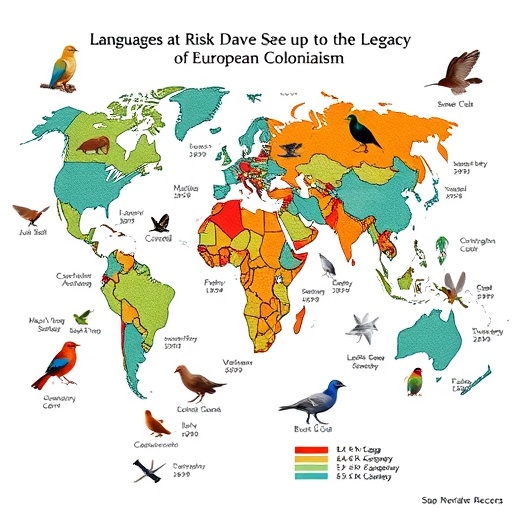
Human activities have long been recognized as a driving force in shaping both the biological and cultural landscapes of our planet. Recently, an international consortium of researchers led by the University of Vienna has provided compelling evidence elucidating the intricate connections between the threats faced by species and the vulnerabilities of human languages. By merging insights from linguistics and biodiversity science, this groundbreaking study reveals that European colonialism is a pivotal factor underpinning the ongoing loss of global biocultural diversity. The findings, published in the prestigious journal People and Nature, shed light on complex historical processes with profound contemporary implications.
Approximately one million species are currently at risk of extinction, and nearly half of the world’s languages face similar threats to their survival. This convergence of endangered biological and linguistic diversity prompted the research team to systematically analyze cross-national data on species and language endangerment. Their objective was to identify global hotspots where the extinction and disappearance risks to both species and languages are particularly acute. Beyond mapping these areas, the researchers probed the historical and socio-political contexts that shape these patterns, aiming to understand the underlying drivers of biocultural vulnerability.
The study highlights that islands within Oceania and East Asia emerge as critical biocultural hotspots. Regions such as New Zealand, Japan, and Taiwan display concentration of both species and language threats, indicating a nuanced spatial overlap of biocultural risk factors. Additionally, tropical island nations like Madagascar, Haiti, and Mauritius stand out as zones with intense threats to animal species. However, the pattern for language endangerment is more geographically dispersed. In the Americas, southern Africa, and Australia, linguistic diversity is highly imperiled, with regional dynamics differing markedly from those governing species endangerment hotspots.
The research uncovers a striking commonality: the enduring legacy of European colonialism serves as a principal shared cause for the elevated risk levels observed in both biological species and languages. According to lead biodiversity researcher Bernd Lenzner of the University of Vienna, this colonial imprint remains deeply embedded in the structural conditions of formerly colonized countries. Quantitative models employed in the study demonstrate that the extent of threat intensifies in proportion to the duration and multiplicity of European occupations experienced by a nation. This indicates a lasting and cumulative impact deriving from colonial historicity.
European colonialism instigated widespread ecological and sociocultural upheaval. The imposition of foreign governance directly caused habitat destruction through land conversion, while the introduction of invasive species and novel pathogens disrupted native ecosystems. These processes weakened biological communities, making endemic species vulnerable to extinction. Simultaneously, colonial expansion catalyzed violent conflicts and forced displacement within indigenous populations, fracturing linguistic communities. The resultant suppression of native languages, often replaced by colonial lingua francas, created enduring pathways for language attrition and loss.
Island ecosystems are particularly susceptible to these compounded threats, as underscored by linguist and lead author Hannes Fellner. Islands tend to harbor species with limited population sizes and geographic ranges, amplifying their sensitivity to invasions and environmental disturbance. Similarly, island language communities frequently comprise smaller numbers of speakers. Crucially, demographic shifts, including youth migration from islands to urban centers or abroad, accelerate the erosion of linguistic vitality. These demographic and ecological vulnerabilities intersect to place island biocultural diversity at pronounced risk.
The implications of these findings carry enhanced urgency in the era of accelerating globalization. The colonial legacy continues to reverberate, influencing contemporary economic, ecological, and sociolinguistic realities. Large-scale interventions—whether through multinational economic projects, mass migrations, or environmental changes—mirror the disruptive scale of colonialism with potentially unpredictable long-term effects. The study highlights the necessity of integrating historical perspective into conservation strategies addressing not only biodiversity but also cultural heritage, as their fates are intimately intertwined.
This investigation represents a significant advancement in the nascent field of biocultural diversity research, which aims to bridge biological conservation and cultural preservation. By coupling linguistic data with biodiversity metrics across geopolitical units, the researchers provide a robust empirical foundation for biocultural risk assessment. Their approach transcends traditional disciplinary boundaries, reflecting the complex, multifactorial nature of extinction processes affecting both non-human and human dimensions of diversity.
The University of Vienna, with its centuries-old commitment to scholarship, spearheaded this multi-institutional effort, exemplifying how academic collaboration can address globally pertinent challenges. The integration of linguists and biodiversity experts allowed for a comprehensive datasets analysis encompassing species threat status, assessed through measures like the IUCN Red List, alongside classifications of language vitality derived from repositories such as UNESCO’s Atlas of the World’s Languages in Danger.
Methodologically, the study utilized spatial statistical models to identify biocultural threat hotspots and regression techniques to correlate threat levels with historical variables, including colonial duration and intensity. Robust controls for geographic and socio-economic factors enabled isolation of the colonial legacy’s unique contribution to current threat landscapes. Such rigorous analysis provides compelling causal inference beyond simple correlative associations.
The environmental, social, and linguistic disruptions imposed by colonialism illustrate how human history is inseparable from ecological and cultural trajectories. As Bernd Lenzner emphasizes, recognizing the entrenched colonial effects is essential for designing equitable conservation frameworks that respect indigenous rights and knowledge systems. Similarly, Hannes Fellner stresses that understanding patterns of language decline requires acknowledging sociopolitical power dynamics that have marginalized linguistic diversity through centuries.
In conclusion, this pivotal study reveals that European colonialism’s historical imprint is a dominant determinant of the present-day vulnerability of both species and languages. Biocultural diversity loss is not merely a contemporary crisis but a legacy phenomenon rooted in the colonial past. Addressing this compounded extinction threat demands multidisciplinary approaches that incorporate historical context, foster cross-cultural collaboration, and promote integrative efforts to safeguard the intertwined treasures of Earth’s biological and linguistic heritage.
News Publication Date:
20-Apr-2026
Web References:
10.1002/pan3.70308
Cite Scienmag News
Margaret Porter. (April 21, 2026). Global Species and Languages at Risk Due to the Legacy of European Colonialism. Scienmag. https://scienmag.com/global-species-and-languages-at-risk-due-to-the-legacy-of-european-colonialism/
Margaret Porter. "Global Species and Languages at Risk Due to the Legacy of European Colonialism." Scienmag, 21 April 2026, https://scienmag.com/global-species-and-languages-at-risk-due-to-the-legacy-of-european-colonialism/. Accessed 3 September 2026.
Margaret Porter. "Global Species and Languages at Risk Due to the Legacy of European Colonialism." Scienmag. April 21, 2026. https://scienmag.com/global-species-and-languages-at-risk-due-to-the-legacy-of-european-colonialism/


