


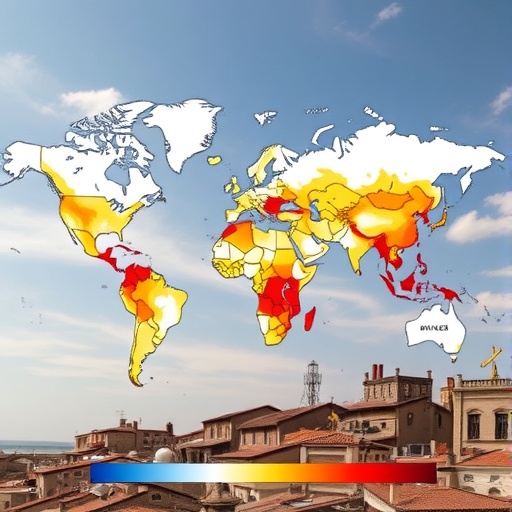
Heat extremes are no longer confined to the hottest days on the calendar. A new global assessment warns that climate change is reshaping heat events hour by hour, exposing millions of people to dangerous temperatures during periods that conventional daily indicators may classify as ordinary. The study, published in Nature Climate Change, finds that hourly heat extremes are emerging across every region of the world and that the burden is distributed profoundly unevenly among countries, income groups and generations.
Traditional heatwave monitoring generally relies on daily maximum or minimum temperatures, or on the number of consecutive days above a defined threshold. These measures remain valuable for tracking broad trends, but they can conceal how heat develops through the day. A location may avoid being classified as having an exceptionally hot day while still experiencing several hours of hazardous temperatures, particularly during the afternoon, evening or overnight. By examining temperature conditions at an hourly scale, the researchers reveal a more continuous and extensive form of heat exposure.
The analysis focuses on hourly heat extremes, or HHEs, during summer and evaluates both the occurrence of these events and the number of people exposed to them. This distinction is important because risk depends not only on whether a region experiences an extreme temperature, but also on how long people remain exposed, when the heat occurs and whether it interrupts nighttime cooling. Hourly conditions can influence sleep, physical work, energy demand and the ability of homes and bodies to recover between hot periods.
The researchers report that HHEs are already emerging worldwide and are projected to accelerate sharply under a high-emissions scenario. By the end of the century, the global frequency of hourly heat extremes could be approximately four times higher than today. At the same time, the number of people exposed to these conditions is projected to increase sixfold. The difference between the growth in events and the growth in exposure reflects both the expansion of extreme heat and the distribution of populations across regions where warming and demographic change overlap.
Daily statistics also appear to underestimate the total duration of heat stress. According to the study, each day already identified as hot is expected to gain about four additional hot hours in the future. Even more strikingly, approximately three additional hot hours will occur on days that daily metrics would not classify as hot. These overlooked hours could create a hidden layer of risk, allowing dangerous conditions to affect workers, children, older adults and people with chronic illnesses without triggering conventional heatwave warnings.
The findings also expose a stark economic divide. Low- and middle-income countries account for more than three-quarters of current and projected human exposure to hourly heat extremes. Many of these countries are located in regions expected to experience rapid warming, while also having fewer resources for air conditioning, resilient housing, reliable electricity, public cooling centers and emergency health systems. Outdoor workers and people living in densely populated urban settlements may face particularly intense exposure, although the study’s central message applies across rural and urban environments.
Heat exposure is not distributed equally across generations either. Successive generations are projected to experience substantially more hourly heat extremes over their lifetimes than people born earlier in the century. The contrast is especially severe in low-income countries, where younger cohorts may spend nearly their entire lives under climatic conditions that were exceptional for previous generations. This intergenerational pattern links today’s emissions choices directly to the environmental risks inherited by children and those not yet born.
The study’s results suggest that heat preparedness must move beyond counting hot days. Forecasting systems and public-health alerts may need to incorporate the timing, duration and accumulation of extreme temperatures within individual days. Hourly data could support more precise warnings for workplaces, schools, hospitals and households, while helping electricity providers anticipate surges in cooling demand. Urban planning, building design and occupational safety standards could likewise be adapted to reduce exposure during the most dangerous hours rather than responding only after a formal heatwave has been declared.
The authors emphasize that reducing greenhouse-gas emissions remains essential for limiting the scale of future exposure, but adaptation will also be unavoidable. Equitable responses will require directing resources toward populations facing the greatest risks, particularly in low- and middle-income countries. By making invisible hours of heat visible, the research challenges the way societies define extreme weather and provides a sharper measure of the climate pressures that people will experience throughout their daily lives. In a warming world, the most dangerous heat may not arrive as a single record-breaking day, but as a steadily expanding presence woven into ordinary summer hours.
Cite Scienmag News
Sloane Callahan. (August 10, 2026). Global, Intergenerational Inequality in Exposure to Hourly Heat Extremes. Scienmag. https://scienmag.com/global-intergenerational-inequality-in-exposure-to-hourly-heat-extremes/
Sloane Callahan. "Global, Intergenerational Inequality in Exposure to Hourly Heat Extremes." Scienmag, 10 August 2026, https://scienmag.com/global-intergenerational-inequality-in-exposure-to-hourly-heat-extremes/. Accessed 3 September 2026.
Sloane Callahan. "Global, Intergenerational Inequality in Exposure to Hourly Heat Extremes." Scienmag. August 10, 2026. https://scienmag.com/global-intergenerational-inequality-in-exposure-to-hourly-heat-extremes/


